Author: Ste Magazine

  • Mastering the Present Perfect Continuous Tense: Rules, Examples, and Practice Questions

    Mastering the Present Perfect Continuous Tense: Rules, Examples, and Practice Questions

    Definition

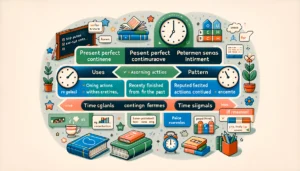
    The Present Perfect Continuous Tense, also known as the Present Perfect Progressive Tense, is used to describe actions that started in the past and are still continuing or have recently stopped but have a connection to the present. This tense emphasizes the duration of an action or the continuity of an activity over a period of time.

    Uses

    1. To express an action that started in the past and is still continuing:

    Examples:

    • She has been studying for three hours. (This sentence indicates that the studying began three hours ago and is still happening at the moment of speaking.)
    • We have been living in this city since 2010. (This shows that the action of living in the city started in 2010 and continues up to the present.)
    • He has been working at the same company for five years. (This implies that he started working at the company five years ago and is still employed there.)
    1. To indicate a recently finished action that has a result in the present:

    Examples:

    • They have been working on the project, and now it’s nearly complete. (The action of working on the project has recently finished, and the result is that the project is almost done.)
    • I have been cooking all afternoon, and the meal is finally ready. (The cooking just finished, and the result is that the meal is now ready to be eaten.)
    • She has been cleaning the house, so it looks spotless now. (The action of cleaning was recently completed, resulting in a spotless house.)
    1. To show repeated actions that started in the past and are still continuing:

    Examples:

    • He has been visiting his grandmother every weekend. (This sentence tells us that the visits started in the past and are still happening regularly.)
    • They have been meeting for coffee every morning for years. (This indicates that the action of meeting for coffee started years ago and continues to this day.)
    • She has been attending yoga classes every week since January. (This shows that the action of attending yoga classes began in January and continues regularly.)

    By understanding these uses and examples, learners can effectively apply the Present Perfect Continuous Tense to express ongoing actions, recently completed actions with present relevance, and repeated actions continuing from the past.

    Pattern

    The grammatical pattern of the Present Perfect Continuous Tense is: Subject + has/have + been + verb (present participle)

    Positive Form

    • Pattern: Subject + has/have + been + verb (present participle)
    • Example: “I have been studying Mandarin Chinese for three hours.”

    Negative Form

    • Pattern: Subject + has/have + not + been + verb (present participle)
    • Example: “I have not been studying English for three hours.”

    Interrogative Form

    • Pattern: Has/Have + subject + been + verb (present participle)?
    • Example: “Have you been studying Japanese for three hours?”

    Time Signals

    Common time signals used with the Present Perfect Continuous Tense include:

    • For (a period of time): for two hours, for a month
    • Since (a point in time): since Monday, since 2010
    • Lately, Recently

    Common Mistakes and How to Avoid Them

    1. Using the wrong auxiliary verb:
      • Mistake: “She have been reading.”
      • Correction: “She has been reading.”
      • Tip: Remember to use “has” with third-person singular subjects (he, she, it) and “have” with all other subjects (I, you, we, they).
    2. Omitting ‘been’:
      • Mistake: “They have working all day.”
      • Correction: “They have been working all day.”
      • Tip: Always include “been” after “has/have” in this tense.
    3. Confusing Present Perfect with Present Perfect Continuous:
      • Mistake: “I have read for three hours.”
      • Correction: “I have been reading for three hours.”
      • Tip: Use the Present Perfect Continuous to emphasize the duration or continuity of the action.

    Conclusion

    The Present Perfect Continuous Tense is a versatile tense used to describe actions that started in the past and are still ongoing or have recently stopped with present relevance. By understanding its uses, patterns, and common mistakes, learners can effectively communicate actions with a sense of duration and continuity.

    Quiz

    Test your understanding of the Present Perfect Continuous Tense with this 10-question multiple-choice quiz. Choose the correct answer for each question.

    1. How long ____ you been studying English?

    2. She ____ been living in New York since 2015.

    3. They ____ been working on this project for months.

    4. I ____ been feeling well lately.

    5. He ____ been playing the guitar since he was a child.

    6. We ____ been watching this show for hours.

    7. She ____ been going to the gym regularly.

    8. You ____ been working hard recently.

    9. It ____ been raining all day.

    10. I ____ been trying to reach you.

  • Mastering the Present Continuous Tense: Rules, Examples, and Practice Questions

    Mastering the Present Continuous Tense: Rules, Examples, and Practice Questions

    Definition

    The Present Continuous Tense, also known as the Present Progressive Tense, is used to describe actions that are currently happening at the moment of speaking or actions that are ongoing. This tense emphasizes the continuity and progression of an action.

    Uses

    The Present Continuous Tense is used in various contexts. Here are three primary uses along with multiple examples and explanations:

    1. Actions happening at the moment of speaking

    Examples:

    • She is reading a book right now. (This sentence indicates that the action of reading is occurring at this very moment.)
    • They are playing soccer in the park. (This sentence shows that the action of playing soccer is taking place as we speak.)
    • I am cooking dinner. (This sentence means that the action of cooking is happening right now.)
    1. Temporary actions or situations

    Examples:

    • They are staying at a hotel for the weekend. (This sentence implies that staying at the hotel is a temporary situation, limited to the weekend.)
    • He is working on a temporary project. (This sentence indicates that working on the project is a temporary situation.)
    • We are using my sister’s car while she is away. (This sentence shows that using the sister’s car is a temporary arrangement while she is away.)
    1. Planned future events

    Examples:

    • We are meeting them for dinner tomorrow. (This sentence indicates a future event that has already been arranged or planned.)
    • She is flying to New York next week. (This sentence shows a planned trip to New York in the future.)
    • They are starting a new course next month. (This sentence means that starting a new course is a planned future event.)

    Pattern

    The grammatical pattern of the Present Continuous Tense is straightforward:

    • Positive form: Subject + am/is/are + verb (base form) + -ing
      • Example: “I am working on my project.”
    • Negative form: Subject + am/is/are + not + verb (base form) + -ing
      • Example: “She is not watching TV.”
    • Question form: Am/Is/Are + subject + verb (base form) + -ing?
      • Example: “Are you coming to the party?”

    Time Signals

    Common time signals used with the Present Continuous Tense include:

    • Now
    • Right now
    • At the moment
    • Currently
    • Today
    • This week
    • Tonight

    Common Mistakes and How to Avoid Them

    Learners often make mistakes when using the Present Continuous Tense. Here are some common errors and tips to avoid them:

    1. Using the wrong auxiliary verb
      • Mistake: “He am playing soccer.”
      • Correction: “He is playing soccer.”
      • Tip: Ensure that the auxiliary verb (am, is, are) matches the subject.
    2. Forgetting the -ing ending
      • Mistake: “She is read a book.”
      • Correction: “She is reading a book.”
      • Tip: Always add the -ing ending to the main verb.
    3. Using the Present Continuous for non-continuous verbs
      • Mistake: “I am knowing the answer.”
      • Correction: “I know the answer.”
      • Tip: Some verbs (e.g., know, like, believe) are not typically used in the continuous form. Use the simple present tense for these verbs.

    Conclusion

    The Present Continuous Tense is essential for describing ongoing actions, temporary situations, and planned future events. By understanding its uses, grammatical pattern, time signals, and common mistakes, learners can use this tense effectively in their communication.

    Quiz

    Test your understanding of the Present Continuous Tense with this 10-question multiple-choice quiz. Choose the correct answer for each question.

    1. Which sentence is correct?

    2. What is the correct form of the verb in this sentence? "They ___ (play) soccer right now."

    3. Choose the correct sentence:

    4. Which sentence is in the Present Continuous Tense?

    5. Choose the correct form: "They ________ (play) soccer right now."

    6. Identify the time signal often used with the Present Continuous Tense:

    7. Which sentence indicates a temporary action?

    8. Fill in the blank: "I ________ (study) for my exams this week."

    9. Which form is correct for the Present Continuous Tense?

    10. Fill in the blank: "They ________ (not/watch) TV now."

  • Mastering the Present Perfect Tense: Rules, Examples, and Practice Questions

    Mastering the Present Perfect Tense: Rules, Examples, and Practice Questions

    Definition

    The Present Perfect Tense is used to describe actions that have occurred at an unspecified time before now. The exact time is not important. This tense is also used to describe actions that began in the past and continue to the present.

    Uses

    1. Actions That Occurred at an Unspecified Time in the Past
      The Present Perfect Tense is used to express actions that happened at some point in the past, but the exact time is not mentioned.
      Examples:
      -I have visited Paris. (The speaker has visited Paris at some time in the past, but the specific time is not mentioned.)
      -They have read the book. (The action of reading the book happened at some point in the past, without specifying when.)
      -She has gone to the store. (She went to the store at an unspecified time in the past.)
    2. Actions That Started in the Past and Continue to the Present
      This tense is used to describe actions that began in the past and are still happening now or have an effect on the present moment.
      Examples:
      -She has lived here for ten years. (She started living here ten years ago and still lives here.)
      -We have known each other since childhood. (The relationship began in childhood and continues to the present.)
      -He has worked at this company since 2015. (He started working at the company in 2015 and still works there.)
    3. Completed Actions with Relevance to the Present
      The Present Perfect Tense is also used to describe past actions that have a connection to the present moment.
      Examples:
      -He has finished his homework. (He completed his homework at some point in the past, and now the homework is done.)
      -I have cleaned the house. (The house was cleaned at some point in the past, and it is now clean.)
      -They have made dinner. (Dinner was prepared at some point in the past, and it is now ready to be eaten.)

    Pattern

    The grammatical pattern of the Present Perfect Tense is as follows:

    • Affirmative: Subject + has/have + past participle
      • Example: “She has eaten.”
    • Negative: Subject + has/have + not + past participle
      • Example: “They have not seen.”
    • Interrogative: Has/Have + subject + past participle?
      • Example: “Have you been?”

    Time Signals

    Common time signals used with the Present Perfect Tense include:

    • Ever
    • Never
    • Already
    • Yet
    • Just
    • Recently
    • So far
    • Until now
    • For
    • Since

    Common Mistakes and How to Avoid Them

    1. Using the Simple Past Instead of Present Perfect
      • Mistake: “I visited Paris last year.”
      • Correction: “I have visited Paris.”
      • Tip: Use the Present Perfect when the time is not specified or is not important.
    2. Forgetting to Use ‘Has’ or ‘Have’
      • Mistake: “She eaten her lunch.”
      • Correction: “She has eaten her lunch.”
      • Tip: Always include ‘has’ or ‘have’ before the past participle.
    3. Confusing ‘For’ and ‘Since’
      • Mistake: “I have lived here since ten years.”
      • Correction: “I have lived here for ten years.”
      • Tip: Use ‘for’ to indicate the duration of time and ‘since’ to indicate the starting point.

    Conclusion

    The Present Perfect Tense is a versatile and essential part of English grammar. It is used to describe actions without specifying the exact time, actions that continue to the present, and completed actions with relevance to now. Remember the pattern, time signals, and common mistakes to master the Present Perfect Tense.

    Quiz

    Test your understanding of the Present Perfect Tense with this 10-question multiple-choice quiz. Choose the correct answer for each question.

    1. Which sentence is in the Present Perfect Tense?

    2. Choose the correct form: "She ___ (to be) to the new restaurant."

    3. Which time signal is commonly used with the Present Perfect Tense?

    4. Fill in the blank: "They ___ (to finish) their project."

    5. Identify the error: "I has visited London."

    6. Which sentence is correct?

    7. Choose the correct form: "We ___ (to not see) that film."

    8. Which sentence uses ‘since’ correctly?

    9. Fill in the blank: "___ you ever ___ (to try) sushi?"

    10. Identify the error: "They has just arrived."

  • Mastering the Simple Future Tense: Rules, Examples, and Practice Questions

    Mastering the Simple Future Tense: Rules, Examples, and Practice Questions

    Definition

    The Simple Future Tense is a verb tense used to describe actions that will happen at a later time. It is a crucial part of English grammar that helps convey plans, promises, predictions, and spontaneous decisions. The Simple Future Tense is used to express actions or events that will occur in the future. It is formed by using the auxiliary verb “will” followed by the base form of the main verb.

    Uses

    1. Predictions: The Simple Future Tense is often used to make predictions about the future.

    Examples:

    • It will rain tomorrow. (This sentence predicts the weather for the next day.)
    • The stock market will recover by the end of the year. (This sentence predicts the performance of the stock market.)
    • She will become a successful doctor. (This sentence predicts someone’s future career success.)
    1. Spontaneous Decisions: It is used when deciding to do something at the moment of speaking.

    Examples:

    • I will help you with your homework. (The speaker offers help spontaneously.)
    • I will get the door. (The speaker decides to open the door at that moment.)
    • I will buy some snacks. (The speaker decides to purchase snacks immediately.)
    1. Promises or Offers: This tense is commonly used to make promises or offers.

    Examples:

    • I will call you later. (The speaker is making a promise to call in the future.)
    • We will send you the documents tomorrow. (The speaker promises to send documents.)
    • I will take care of your plants while you’re away. (The speaker offers to take care of the plants.)

    Pattern

    The structure of the Simple Future Tense is straightforward. It follows the pattern:

    • Affirmative: Subject + will + base form of the verb.
      • Example: “She will travel to Paris.”
    • Negative: Subject + will not (won’t) + base form of the verb.
      • Example: “They will not (won’t) attend the meeting.”
    • Interrogative: Will + subject + base form of the verb?
      • Example: “Will you join us for dinner?”

    Time Signals

    To indicate that an action will occur in the future, certain time signals are often used:

    • Tomorrow
    • Next week/month/year
    • In a few days
    • Soon
    • Later

    Common Mistakes and How to Avoid Them

    1. Using “will” with another future form:
      • Incorrect: “I will going to the store.”
      • Correct: “I will go to the store.”
      • Tip: Remember that “will” should be followed by the base form of the verb.
    2. Confusion between “will” and “going to”:
      • Incorrect: “I will going to study tonight.”
      • Correct: “I am going to study tonight.”
      • Tip: Use “will” for spontaneous decisions and “going to” for planned actions.
    3. Neglecting subject-verb agreement:
      • Incorrect: “She will goes to school.”
      • Correct: “She will go to school.”
      • Tip: Ensure that the verb following “will” is always in its base form, regardless of the subject.

    Conclusion

    The Simple Future Tense is essential for discussing future events, predictions, spontaneous decisions, and promises. By understanding its uses, patterns, and common mistakes, learners can effectively communicate about the future in English. Remember to use appropriate time signals and ensure proper verb forms to avoid common errors.

    Quiz

    Test your understanding of the Simple Future Tense with this 10-question multiple-choice quiz. Choose the correct answer for each question.

    1. Which sentence is in the Simple Future Tense?

    2. Choose the correct form of the verb: "They ____ (visit) the museum tomorrow."

    3. Which time signal is commonly used with the Simple Future Tense?

    4. Identify the incorrect sentence:

    5. Fill in the blank: "I ____ (not / attend) the meeting."

    6. Which of the following sentences is a prediction?

    7. Form the question: "____ (you / finish) your homework?"

    8. Identify the promise in the following sentences:

    9. Correct the mistake: "He will plays football."

    10. Choose the correct sentence:

  • Mastering the Simple Past Tense: Rules, Examples, and Practice Questions

    Mastering the Simple Past Tense: Rules, Examples, and Practice Questions

    The Simple Past Tense

    The Simple Past Tense is used to describe actions or events that occurred in the past and are no longer happening. It is a fundamental tense in English, crucial for recounting events, narrating stories, and expressing completed actions.

    Uses

    1. Completed Actions in the Past

    Examples:

    • She visited Paris last summer. (This sentence indicates that the action of visiting Paris happened and was completed in the past.)
    • He bought a new car yesterday. (This sentence shows a single, completed action that took place in the past.)
    • They attended the concert last weekend. (This sentence describes a completed event that happened at a specific time in the past.)
    1. Series of Completed Actions

    Examples:

    • He finished his homework, cooked dinner, and watched a movie. (This sentence describes a sequence of actions that all occurred in the past, one after the other.)
    • She packed her bags, locked the door, and left for the airport. (This sentence shows a series of actions completed in the past.)
    • They met at the café, discussed the project, and decided on the next steps. (This sentence outlines multiple completed actions in the past.)
    1. Duration in the Past

    Examples:

    • They lived in Japan for three years. (This sentence specifies the duration of an action that started and ended in the past.)
    • She worked at the company from 2015 to 2019. (This sentence describes the duration of her employment, which is now in the past.)
    • He studied French for two years in college. (This sentence indicates the length of time he spent studying French, which is no longer ongoing.)

    Pattern

    The grammatical pattern of the Simple Past Tense is straightforward:

    • Affirmative Sentences: Subject + Verb (in the past form) + Object/Complement
      • Example: “I played football.”
    • Negative Sentences: Subject + did not (didn’t) + Verb (base form) + Object/Complement
      • Example: “She didn’t watch the movie.”
    • Interrogative Sentences: Did + Subject + Verb (base form) + Object/Complement?
      • Example: “Did they visit the museum?”

    Time Signals

    Common time signals used with the Simple Past Tense include:

    • Yesterday
    • Last (night, week, month, year, etc.)
    • Ago (two days ago, a week ago, etc.)
    • In (1990, June, etc.)
    • When (when I was young, when he arrived, etc.)

    Common Mistakes and How to Avoid Them

    1. Incorrect Verb Forms
      • Mistake: Using the base form of the verb instead of the past form.
      • Correction: Ensure you are using the correct past form, especially for irregular verbs (e.g., “go” should be “went”).
    2. Incorrect Negation
      • Mistake: Using “didn’t” with a past form of the verb.
      • Correction: Use “didn’t” with the base form (e.g., “She didn’t went” should be “She didn’t go”).
    3. Incorrect Word Order in Questions
      • Mistake: Placing the subject before “did” in questions.
      • Correction: Use the correct order (e.g., “Did he went?” should be “Did he go?”).

    Conclusion

    The Simple Past Tense is essential for discussing past events and actions. By understanding its uses, grammatical patterns, and common mistakes, learners can effectively communicate about the past.

    Quiz

    Test your understanding of the Simple Past Tense with this 10-question multiple-choice quiz. Choose the correct answer for each question.

    1. Which sentence is in the Simple Past Tense?

    2. Choose the correct form of the verb: "She ___ a cake yesterday."

    3. Which sentence is negative in the Simple Past Tense?

    4. Select the time signal commonly used with the Simple Past Tense:

    5. Which one is the correct question form?

    6. Identify the irregular past tense verb:

    7. Complete the sentence: "They ___ for a long time."

    8. Which sentence is correct?

    9. Which verb is the correct form of Simple Past Tense?

    10. Which sentence describes a series of actions in the past?

  • Mastering the Simple Present Tense: Rules, Examples, and Practice Questions

    Mastering the Simple Present Tense: Rules, Examples, and Practice Questions

    Understanding the Simple Present Tense

    The simple present tense is one of the most commonly used tenses in English. It describes habits, general truths, unchanging situations, emotions, and fixed arrangements. Understanding how to properly use the simple present tense is essential for mastering the English language.

    Uses of Simple Present Tense

    1. Habits and Routines
      Examples:
      -She drinks coffee every morning. (This sentence describes a habitual action that she performs regularly every morning.)
      -They play tennis every weekend. (This indicates a routine activity that happens every weekend.)
      -I read the newspaper daily. (This shows a regular habit of reading the newspaper each day.)
    2. General Truths and Facts
      Examples:
      -The sun rises in the east. (This is a general truth that does not change over time.)
      -Water boils at 100 degrees Celsius. (This is a scientific fact that remains constant.)
      -Cats meow. (This describes a general truth about the behavior of cats.)
    3. Unchanging Situations
      Examples:
      -He lives in New York. (This describes a situation that is not expected to change.)
      -She works at a bank. (This indicates a stable employment situation.)
      -The store opens at 9 AM. (This describes a fixed opening time that does not change.)

    Structure of Simple Present Tense

    The simple present tense is formed using the base form of the verb for most subjects (I, you, we, they). For the third person singular (he, she, it), an ‘s’ or ‘es’ is added to the base form of the verb.

    • Affirmative Sentences:
      • I/You/We/They play football.
      • He/She/It plays football.
    • Negative Sentences:
      • I/You/We/They do not (don’t) play football.
      • He/She/It does not (doesn’t) play football.
    • Interrogative Sentences:
      • Do I/you/we/they play football?
      • Does he/she/it play football?

    Spelling Rules for Adding ‘s’ or ‘es’

    1. For most verbs, simply add ‘s’:
      • run → runs
      • eat → eats
    2. For verbs ending in ‘s’, ‘ss’, ‘sh’, ‘ch’, ‘x’, or ‘z’, add ‘es’:
      • kiss → kisses
      • wash → washes
    3. For verbs ending in a consonant + ‘y’, change ‘y’ to ‘i’ and add ‘es’:
      • try → tries
      • study → studies
    4. For verbs ending in a vowel + ‘y’, simply add ‘s’:
      • play → plays
      • enjoy → enjoys

    Common Mistakes and How to Avoid Them

    1. Forgetting to add ‘s’ or ‘es’ in the third person singular:
      • Incorrect: He go to school.
      • Correct: He goes to school.
    2. Using the base form instead of ‘does’ for questions in third person singular:
      • Incorrect: Does she likes apples?
      • Correct: Does she like apples?
    3. Neglecting the auxiliary ‘do/does’ in negative sentences:
      • Incorrect: She not like coffee.
      • Correct: She does not like coffee.

    Quiz

    Test your understanding of the Simple Present Tense with this 10-question multiple-choice quiz. Choose the correct answer for each question.

    1. She _____ every morning.

    2. The sun _____ in the west.

    3. They usually _____ to the gym on Fridays.

    4. He _____ to New York every summer.

    5. _____ she like chocolate?

    6. Water _____ at 100 degrees Celsius.

    7. We don’t _____ to the park on Sundays.

    8. The dog always _____ loudly at night.

    9. She _____ her homework every day.

    10. My brother _____ football very well.

  • What You Need to Know About Organic Gardening

    What You Need to Know About Organic Gardening

    Organic gardening is more than just a trend; it’s a movement toward a healthier, more sustainable way of living. Whether you’re a seasoned gardener or a complete novice, diving into organic gardening can be both rewarding and challenging. Here’s what you need to know to get started and succeed in your organic gardening journey.

    Understanding Organic Gardening

    At its core, organic gardening is about growing plants without the use of synthetic chemicals. This means no artificial fertilizers, pesticides, or herbicides. Instead, organic gardeners rely on natural processes and materials to nurture their plants. The goal is to create a balanced, self-sustaining ecosystem that promotes healthy soil, plants, and beneficial insects.

    Soil Health: The Foundation of Organic Gardening

    Healthy soil is the cornerstone of a thriving organic garden. Unlike conventional gardening, where synthetic fertilizers can temporarily boost plant growth, organic gardening focuses on building long-term soil fertility. This involves adding organic matter like compost, manure, and cover crops to improve soil structure and nutrient content.

    Composting is one of the best ways to enhance your soil. It involves recycling kitchen scraps, garden waste, and other organic materials into rich, nutrient-dense humus. Compost improves soil aeration, water retention, and provides a steady supply of nutrients to plants.

    Choosing the Right Plants

    Selecting plants suited to your local climate and soil conditions is crucial for success in organic gardening. Native plants, or those adapted to your region, are often more resistant to pests and diseases, reducing the need for intervention. Additionally, opting for heirloom or open-pollinated seeds ensures genetic diversity and better adaptation to your local environment over time.

    Natural Pest and Disease Management

    Managing pests and diseases without synthetic chemicals can be challenging, but it’s not impossible. The key is prevention and early intervention. Here are some strategies:

    1. Companion Planting: Some plants naturally repel pests or attract beneficial insects. For example, marigolds can deter nematodes, while basil can ward off tomato hornworms.
    2. Beneficial Insects: Encourage predators like ladybugs, lacewings, and predatory wasps, which can help control pest populations.
    3. Crop Rotation: Changing the location of your crops each season can prevent the buildup of pests and diseases in the soil.
    4. Physical Barriers: Use row covers, netting, and other barriers to protect plants from pests.
    5. Natural Sprays: Neem oil, insecticidal soaps, and homemade garlic or hot pepper sprays can be effective against various pests.

    Watering and Mulching

    Proper watering is vital for healthy plant growth. Organic gardening emphasizes efficient water use, as overwatering can lead to nutrient leaching and increased susceptibility to diseases. Drip irrigation systems and soaker hoses are excellent for delivering water directly to the root zone, minimizing evaporation and runoff.

    Mulching is another essential practice. A thick layer of organic mulch, such as straw, leaves, or grass clippings, helps retain soil moisture, suppress weeds, and regulate soil temperature. As the mulch breaks down, it also adds organic matter to the soil.

    The Importance of Biodiversity

    Biodiversity is a fundamental principle of organic gardening. A diverse garden is more resilient to pests, diseases, and environmental stresses. Plant a variety of flowers, herbs, and vegetables to attract a range of beneficial insects and pollinators. This diversity creates a balanced ecosystem where no single species dominates, reducing the likelihood of pest outbreaks.

    Harvesting and Sustainability

    When it comes to harvesting, organic gardening encourages sustainable practices. Harvesting should be done in a way that doesn’t deplete the plants or soil. For example, when picking leafy greens, take only a few leaves from each plant, allowing the plant to continue growing and producing.

    Continuous Learning and Adaptation

    Organic gardening is a continuous learning process. Each season brings new challenges and opportunities for growth. Stay informed by reading books, attending workshops, and joining gardening communities. Experiment with different techniques and be patient, as organic gardening often requires a longer-term perspective compared to conventional methods.

    In conclusion, organic gardening is a fulfilling and sustainable way to grow your food and beautify your environment. By focusing on soil health, natural pest management, efficient watering, and biodiversity, you can create a thriving organic garden that benefits both you and the planet. Embrace the journey, enjoy the process, and remember that every step you take towards organic gardening contributes to a healthier, more sustainable world.