Category: English Grammar

  • Adjectives

    Adjectives

    Adjectives

    Common Mistakes in Learning Adjectives

    Learning adjectives can be tricky, and there are some common pitfalls that students often encounter. Being aware of these common mistakes will help you avoid them and master adjectives more effectively.

    1. Confusing Adjectives with Adverbs: This is perhaps the most frequent mistake. Adjectives modify nouns and pronouns, while adverbs modify verbs, adjectives, and other adverbs. For example:

      • Incorrect: He runs quick. (Quick is an adjective, but it should modify the verb “runs,” so we need an adverb.)

      • Correct: He runs quickly.

      • Incorrect: She is a beautifully girl. (Beautifully is an adverb, but it should modify the noun “girl,” so we need an adjective.)

      • Correct: She is a beautiful girl.

    2. Misusing Comparative and Superlative Forms: Remember the rules for forming comparative and superlative adjectives. Don’t use “-er” and “more” together, or “-est” and “most” together. Also, remember irregular forms (like good/better/best).

      • Incorrect: He is more taller than his brother.

      • Correct: He is taller than his brother. OR He is more tall than his brother (less common, but grammatically possible with some words)

      • Incorrect: She is the most prettiest girl in the class.

      • Correct: She is the prettiest girl in the class. OR She is the most pretty girl in the class (less common, but grammatically possible with some words)

    3. Incorrect Adjective Order: When using multiple adjectives, remember the typical order (opinion, size, age, shape, color, origin, material, type). While native speakers sometimes deviate for emphasis, sticking to the order generally makes your writing sound more natural.

      • Awkward: a red, big car
      • Better: a big, red car
    4. Using Adjectives as Nouns: In most cases, adjectives cannot be used as nouns.

      • Incorrect: The rich should help the poor. (Here, “rich” and “poor” are being used to represent groups of people.)
      • Correct: The rich people should help the poor people. OR The wealthy should help the impoverished. (Using the adjectives to modify implied nouns or using other nouns.)
    5. Forgetting Predicative Adjectives: Remember that adjectives can also follow linking verbs and describe the subject. Don’t just focus on adjectives that come before nouns.

      • Correct: The flowers are fragrant.
    6. Not Capitalizing Proper Adjectives: Proper adjectives, derived from proper nouns, should always be capitalized.

      • Incorrect: french fries
      • Correct: French fries
    7. Overusing Adjectives: While adjectives add detail, using too many can make your writing clunky and difficult to read. Choose your adjectives carefully and use them effectively. Sometimes, a strong verb or precise noun can be more powerful than a string of adjectives.

    8. Confusing Demonstrative Adjectives with Demonstrative Pronouns: Demonstrative adjectives modify nouns, while demonstrative pronouns replace nouns.

      • Adjective: This book is mine.
      • Pronoun: This is mine.

    Exercise

    Test your understanding on Adjectives by answering the following questions.

    1. Which one of the following is NOT an adjective?

    2. What type of adjective is "Italian" in the phrase "Italian cuisine"?

    3. Which sentence uses a predicative adjective?

    4. What is the comparative form of "good"?

    5. Which word is an example of a compound adjective?

    6. What is the superlative form of "beautiful"?

    7. Which of the following is a possessive adjective?

    8. In the phrase "a small, old, brown dog," which adjective comes first according to the typical order?

    9. Which adjective is used correctly in the sentence: "He is the _______ of the three brothers."?

    10. Which sentence contains an interrogative adjective?

  • Understanding Temporal Conjunctions in English

    Understanding Temporal Conjunctions in English

    Understanding Temporal Conjunctions in English

    In English grammar, conjunctions are words that connect clauses, phrases, or words. One specific type of conjunction is the temporal conjunction, which helps indicate time relationships between different parts of a sentence. These conjunctions show when an action happens in relation to another action.

    Temporal conjunctions are used to link two clauses by showing time-based relationships. They help answer the questions when, how long, or how often an event occurs.

    a. Common Temporal Conjunctions

    Here are some commonly used temporal conjunctions:

    • Before – indicates that one event happens earlier than another.
    • After – shows that one event follows another.
    • When – specifies the time something happens.
    • While – shows that two events happen at the same time.
    • Until – indicates that an event continues up to a certain point.
    • As soon as – means immediately after another action.
    • Since – refers to a point in the past when something started.
    • Once – means after something happens.
    • By the time – refers to a deadline or a specific moment before something happens.

    b. Examples of Temporal Conjunctions in Sentences

    1. Before I go to bed, I always brush my teeth.
    2. We will start the meeting after John arrives.
    3. Call me when you get home.
    4. She was reading a book while waiting for the bus.
    5. You cannot leave until you finish your homework.
    6. I will call you as soon as I arrive at the airport.
    7. She has been studying here since last year.
    8. Once you understand the concept, it becomes easy.
    9. By the time we reached the station, the train had already left.

    c. How to Use Temporal Conjunctions Correctly

    1. Placement of Temporal Conjunctions:A temporal conjunction can appear at the beginning or in the middle of a sentence.
      If it appears at the beginning, use a comma to separate the clauses.
      Example: Before you go to bed, turn off the lights.
      If it appears in the middle, no comma is needed.
      Example: Turn off the lights before you go to bed.
    2. Using Correct Verb Tenses:The verb tenses in the clauses must match the time relationship.
      Example: She had left before I arrived. (Past perfect + past simple)
      Example: I will call you as soon as I arrive. (Future + present simple)
    3. Avoiding Common Mistakes:Do not use future tense after conjunctions like “when,” “before,” or “after” in time clauses.
      Incorrect: I will call you when I will arrive.
      Correct: I will call you when I arrive.

    d. Conclusion

    Temporal conjunctions are essential in English because they help clarify the timing of events in a sentence. By understanding and using them correctly, you can improve your writing and speaking skills. Keep practicing, and soon, using temporal conjunctions will become second nature!

    e. Practice Exercises

    Choose the correct temporal conjunction!

    1. ______ you finish your work, you can go home.

    2. I haven’t seen him ______ last summer.

    3. We stayed inside ______ it was raining.

    4. They left ______ we arrived.

    5. I will call you ______ I get the results.


  • Understanding Sentence Structures

    Understanding Sentence Structures

    Understanding Sentence Structures: Simple, Compound, Complex, and Compound-Complex Sentences

    Have you ever noticed how some sentences are short and to the point, while others are longer and more detailed? The way we structure sentences helps us express our ideas clearly. In English, there are four types of sentence structures: simple, compound, complex, and compound-complex.

    By understanding these structures, you’ll improve both your writing and speaking skills. Let’s explore each type step by step!


    1. Simple Sentences: The Building Blocks

    A simple sentence is the most basic type. It contains only one independent clause, which means it expresses a complete thought. It has a subject and a verb, and it may also include an object or other details.

    ✅ Formula: Subject + Verb (+ Object)

    🔹 Examples:
    ✅ She sings. (Subject: She, Verb: sings)
    ✅ Tom plays basketball every evening. (Subject: Tom, Verb: plays, Object: basketball, Time: every evening)
    ✅ The sun shines brightly in the morning. (Subject: The sun, Verb: shines, Adverb of Manner: brightly, Time: in the morning)

    Even though some simple sentences are short, they can still be powerful. A short, clear sentence like “She is kind.” can say a lot in just three words!


    2. Compound Sentences: Connecting Ideas

    A compound sentence is formed when two independent clauses are joined together. This is often done using coordinating conjunctions (FANBOYS: For, And, Nor, But, Or, Yet, So) or a semicolon (;).

    🔹 Examples:
    ✅ I was tired, but I finished my homework. (Two independent clauses: “I was tired” + “I finished my homework”)
    ✅ She loves to read, so she visits the library often.
    ✅ The sky was dark; we knew a storm was coming.

    By using compound sentences, we can connect related thoughts and make our writing more engaging.


    3. Complex Sentences: Adding Depth

    A complex sentence contains one independent clause and at least one dependent clause. A dependent clause cannot stand alone as a complete sentence; it relies on the independent clause. These clauses are connected using subordinating conjunctions (because, although, when, since, if, etc.).

    🔹 Examples:
    Although it was raining, we went for a walk. (Dependent clause: “Although it was raining” + Independent clause: “we went for a walk”)
    ✅ I stayed home because I was feeling sick.
    ✅ She smiled when she saw her friend.

    Complex sentences allow us to explain reasons, add conditions, or give extra details about an action.


    4. Compound-Complex Sentences: Mastering Complexity

    A compound-complex sentence combines both compound and complex structures. It has at least two independent clauses and one or more dependent clauses.

    🔹 Examples:
    Although she was tired, she studied hard, and she passed the test. (Dependent clause: “Although she was tired” + Compound part: “she studied hard, and she passed the test”)
    ✅ I went to the park because the weather was nice, and I met my friends there.
    ✅ The teacher was happy because the students did well on the test, but she reminded them to keep working hard.

    These sentences are great for expressing complex thoughts in a single sentence.


    Summary Table

    Sentence Type Structure Example
    Simple Sentence 1 independent clause She loves to read.
    Compound Sentence 2 independent clauses joined by FANBOYS or (;) She was tired, but she kept working.
    Complex Sentence 1 independent + 1 or more dependent clauses Because it was raining, we stayed inside.
    Compound-Complex Sentence 2 independent + 1 or more dependent clauses Although it was late, he continued studying, and he passed the test.

    Conclusion

    Now that you understand the four sentence structures, you can use them to improve your writing! Simple sentences keep things clear, compound sentences connect ideas, complex sentences add depth, and compound-complex sentences let us express detailed thoughts.

    The more you practice, the better you’ll become at writing and identifying different sentence structures. Try the exercises below!


    Practice Exercises

    A. Identify the Sentence Type

    Read the sentences below and identify whether they are simple, compound, complex, or compound-complex.

    1. She walked to the store.
    2. The movie was exciting, but the ending was disappointing.
    3. Because I studied hard, I passed the test.
    4. Although I was tired, I finished my homework, and I went to bed early.
    5. The teacher smiled when the students answered correctly.
    6. We planned a picnic, but it rained, so we stayed inside.

    B. Create Your Own Sentences

    Write one sentence for each type:

    1. A simple sentence
    2. A compound sentence
    3. A complex sentence
    4. A compound-complex sentence

    C. Combine Sentences

    Rewrite the following sentence pairs into the correct sentence structure:

    1. (Simple → Compound)
      • I like coffee.
      • I also enjoy tea.
    2. (Compound → Complex)
      • She was late, so she missed the bus.
      • She was late because she woke up late.
    3. (Complex → Compound-Complex)
      • Although it was raining, we went outside.
      • We played soccer.
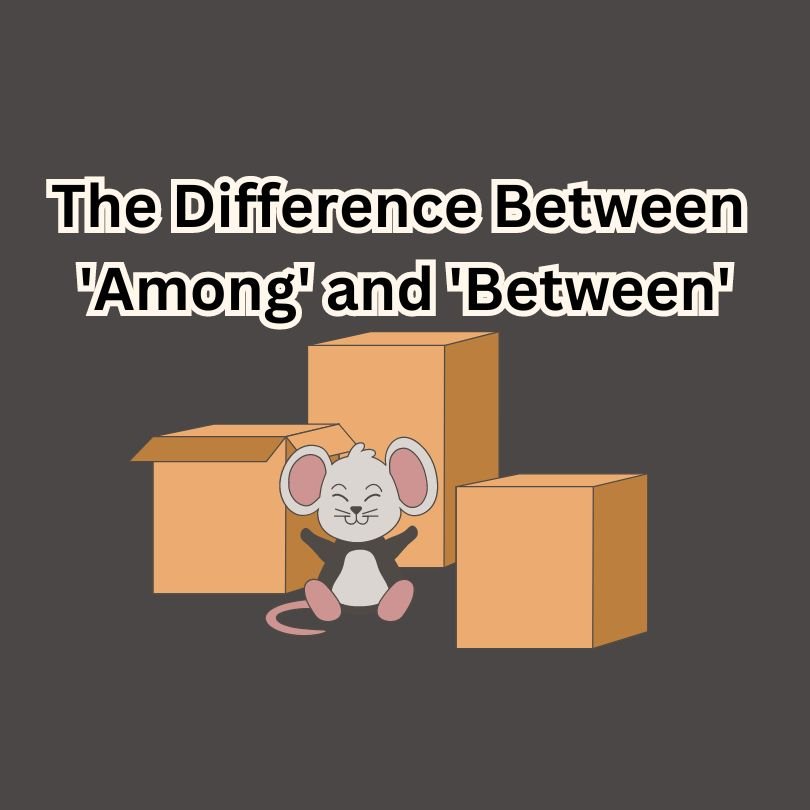
  • What is the Difference Between ‘Among’ and ‘Between’?

    What is the Difference Between ‘Among’ and ‘Between’?

    Question: What is the Difference Between ‘Among’ and ‘Between’?

    Answer:

    Understanding the Basics

    The words “among” and “between” are both prepositions used to describe relationships between objects or people. However, they are used in different contexts and are not interchangeable. Understanding the difference between these two words can help you communicate more clearly and accurately.

    Among

    “Among” is used when referring to a group of more than two people or things. It implies a sense of being part of a collective or surrounded by multiple elements.

    Examples:

    • She found a letter among the pile of papers.
    • There was a great sense of camaraderie among the team members.
    • The secret was known only among the closest friends.

    In these examples, “among” indicates that something is within or part of a larger group.

    Between

    “Between” is used when referring to a relationship involving two distinct people or things. It can also be used when referring to distinct, individual elements even if they are more than two, provided they are seen as separate entities.

    Examples:

    • She stood between her two best friends.
    • The treaty was signed between the two countries.
    • There was a noticeable difference between the three designs.

    In these examples, “between” specifies a relationship or position involving distinct individuals or items.

    Key Differences

    1. Number of Elements:
      • “Among” is used for more than two elements.
      • “Between” is typically used for two elements but can also apply to multiple distinct elements.
    2. Context of Use:
      • “Among” implies being part of a larger group.
      • “Between” indicates a distinct relationship or position involving separate entities.

    Examples in Sentences

    • Among:
      • Among the crowd, she felt at home.
      • The tasks were divided among the team members.
    • Between:
      • She couldn’t decide between the red dress and the blue dress.
      • The negotiations between the companies were intense.

    Dialogue Example

    John: I can’t decide between pizza and pasta for dinner.

    Mary: Why not have both? You can share them among the family.


    John: Good idea! Also, I noticed a difference between the two new managers.

    Mary: Yes, there’s a lot of competition among the staff because of their different management styles.

    Understanding the difference between “among” and “between” is crucial for clear and accurate communication. Remember that “among” is used when referring to more than two elements within a group, while “between” is used for relationships involving two or more distinct entities. By practicing these rules and using the provided examples, you can confidently navigate these prepositions in your daily conversations and writing. Mastering these subtle distinctions will enhance your English grammar skills and improve your ability to express ideas effectively.

  • What is the Difference Between “A Few” and “A Little”?

    What is the Difference Between “A Few” and “A Little”?

    Question: What is the Difference Between “A Few” and “A Little”?

    Answer:

    Understanding the difference between “a few” and “a little” is essential for mastering English grammar. Both phrases are used to indicate a small quantity, but they are applied differently based on whether the noun they describe is countable or uncountable. In this article, we will explain the usage of “a few” and “a little” in a simple and detailed manner, provide examples, and demonstrate their use in daily conversations through dialogues.

    What Are Countable and Uncountable Nouns?

    Before diving into the difference between “a few” and “a little,” it’s important to understand the concepts of countable and uncountable nouns.

    • Countable nouns are items that can be counted individually. They have both singular and plural forms (e.g., “apple” and “apples”).
    • Uncountable nouns are items that cannot be counted individually. They do not have a plural form (e.g., “water,” “sand”).

    A Few

    “A few” is used with countable nouns to indicate a small number of items.

    Examples:

    • I have a few friends in New York.
    • She bought a few apples at the market.
    • We need a few chairs for the event.

    In these sentences, “a few” refers to a small number of individual items that can be counted.

    A Little

    “A little” is used with uncountable nouns to indicate a small amount of something.

    Examples:

    • There is a little milk left in the fridge.
    • He needs a little water to drink.
    • She added a little sugar to her coffee.

    In these sentences, “a little” refers to a small quantity of something that cannot be counted individually.

    Using “A Few” and “A Little” in Daily Life

    To better understand how “a few” and “a little” are used in daily conversations, let’s look at some dialogues.

    Dialogue 1: Using “A Few”

    Emily: Do you have any plans for the weekend?

    John: Yes, I have a few things to do. I need to buy a few groceries and meet a few friends.

    Emily: Sounds like a busy weekend!

    Dialogue 2: Using “A Little”

    Sarah: Can I have some water, please?

    Tom: Sure, there’s a little water left in the bottle. Help yourself.

    Sarah: Thank you!

    Key Points to Remember

    • Use “a few” with countable nouns (e.g., “a few books,” “a few cars”).
    • Use “a little” with uncountable nouns (e.g., “a little time,” “a little rice”).

    By remembering these simple rules, you can use “a few” and “a little” correctly in your conversations and writing.

    Meta Description

    Learn the difference between “a few” and “a little” with easy-to-understand explanations, examples, and dialogues. Master the use of countable and uncountable nouns in English grammar. Enhance your English skills with practical tips and phrases.

    By understanding and practicing the use of “a few” and “a little,” you can improve your English communication skills and make your speech and writing more accurate and effective.

  • Will vs. Going to: Understanding Future Intentions and Plans

    Will vs. Going to: Understanding Future Intentions and Plans

    Question: What is the difference between Will and Going to?

    Answer:

    Introduction

    When learning English, one of the common areas of confusion is knowing when to use “will” and “going to” for expressing future intentions and plans. While both are used to talk about the future, they are used in different contexts and have distinct meanings. This article will help you understand the differences between “will” and “going to” and provide practical examples to use them correctly.

    Understanding “Will”

    “Will” is a modal verb that is used to express:

    1. Spontaneous Decisions: Decisions made at the moment of speaking.
      • Example: “I’m thirsty. I think I will get a glass of water.”
    2. Predictions: Predictions about the future that are based on opinions or experiences.
      • Example: “I think it will rain tomorrow.”
    3. Promises: Making promises or offers.
      • Example: “I will help you with your homework.”
    4. Offers: Offering help or services.
      • Example: “I will carry your bag for you.”

    Understanding “Going to”

    “Going to” is used to express:

    1. Plans or Intentions: Plans that were decided before the moment of speaking.
      • Example: “I am going to visit my grandparents next weekend.”
    2. Predictions with Evidence: Predictions about the future that are based on current evidence.
      • Example: “Look at those dark clouds. It is going to rain.”

    Key Differences

    1. Decision Time: “Will” is used for decisions made at the moment of speaking, while “going to” is used for decisions made before the moment of speaking.
      • Example:
        • Will: “I will call him now.”
        • Going to: “I am going to call him after dinner.”
    2. Predictions: “Will” is often used for general predictions, while “going to” is used for predictions based on evidence.
      • Example:
        • Will: “You will get better soon.”
        • Going to: “You are going to get better. The doctor said so.”
    3. Plans and Intentions: “Going to” is used for plans or intentions.
      • Example: “She is going to start a new job next month.”

    Practical Exercises

    1. Fill-in-the-Blanks
      • I ____ (will/going to) travel to Japan next summer. (Answer: am going to)
      • It looks like it ____ (will/going to) snow soon. (Answer: is going to)
      • I think they ____ (will/going to) win the match. (Answer: will)
      • She ____ (will/going to) call you when she arrives. (Answer: will)
    2. Correct the Sentences
      • I think I’m going to get a taxi. (Correct: I think I will get a taxi.)
      • Look at the sky. It will rain. (Correct: Look at the sky. It is going to rain.)
    3. Role-Play Activity
      • Pair up with a partner and create dialogues using “will” and “going to” appropriately. Discuss future plans, make spontaneous decisions, and predict the future.

    Conclusion

    Understanding the differences between “will” and “going to” is essential for expressing future plans and intentions correctly in English. Remember, “will” is used for spontaneous decisions, general predictions, promises, and offers, while “going to” is used for pre-decided plans and predictions with evidence. Practice using these forms in different contexts to become more comfortable and confident in your English communication.

  • Understanding the Difference Between “Who” and “Whom”

    Understanding the Difference Between “Who” and “Whom”

    Question: What is the Difference Between “Who” and “Whom”?

    Answer:

    English grammar can often be challenging, and one common area of confusion is the correct usage of “who” and “whom.” Both words are pronouns, but they serve different functions in a sentence. Understanding when to use “who” and when to use “whom” is crucial for clear and grammatically correct writing. This article will explain the differences between “who” and “whom,” provide examples, and offer tips for proper usage.

    Who vs. Whom: The Basic Rule

    The basic rule is that “who” is used as the subject of a sentence or clause, while “whom” is used as the object of a verb or preposition.

    Subjective Case: Who

    “Who” is used as the subject of a verb. It performs the action in a sentence.

    Examples:

    • Who is coming to the party?
    • Do you know who made this cake?
    • Who is responsible for this project?

    In these examples, “who” is the subject performing the action.

    Objective Case: Whom

    “Whom” is used as the object of a verb or preposition. It receives the action in a sentence.

    Examples:

    • Whom did you invite to the party?
    • To whom should I address the letter?
    • Whom are you going to call?

    In these examples, “whom” is the object receiving the action.

    Tips for Correct Usage

    Determining when to use “who” or “whom” can sometimes be tricky. Here are some tips to help you decide:

    Tip 1: Answer the Question

    When in doubt, try answering the question posed by the sentence. If the answer is “he” or “she,” use “who.” If the answer is “him” or “her,” use “whom.”

    Examples:

    • Who/Whom is calling? (He is calling. → Who is calling?)
    • To who/whom did you give the book? (I gave the book to him. → To whom did you give the book?)

    Tip 2: Check the Function

    Identify whether the pronoun is acting as a subject or an object in the sentence. Remember, “who” is for subjects, and “whom” is for objects.

    Tip 3: Use Formality

    In formal writing and speech, using “whom” correctly can enhance clarity and precision. In casual conversation, people often use “who” even when “whom” is technically correct.

    Common Mistakes and How to Avoid Them

    Even seasoned writers sometimes misuse “who” and “whom.” Here are some common mistakes and how to avoid them:

    Mistake 1: Using “Who” as an Object

    Incorrect: Who did you see at the concert? Correct: Whom did you see at the concert?

    Mistake 2: Using “Whom” as a Subject

    Incorrect: Whom is calling me? Correct: Who is calling me?

    Mistake 3: Ignoring Prepositions

    Incorrect: Who did you give the book to? Correct: To whom did you give the book?

    Tip: Pay attention to the placement of prepositions, especially in formal writing.

    Practice Makes Perfect

    To master the use of “who” and “whom,” practice by creating sentences and checking if the pronoun is a subject or an object. Here are a few exercises to get started:

    Exercise 1: Choose the Correct Word

    1. (Who/Whom) is going to the meeting?
    2. I don’t know (who/whom) to ask for help.
    3. She is the person (who/whom) everyone admires.
    4. (Who/Whom) are they talking about?

    Answers:

    1. Who
    2. Whom
    3. Whom
    4. Whom

    Exercise 2: Correct the Mistakes

    1. Who did they choose as their leader?
    2. Whom is in charge of the project?
    3. Who should I send the email to?
    4. To who did you speak?

    Corrected Sentences:

    1. Whom did they choose as their leader?
    2. Who is in charge of the project?
    3. To whom should I send the email?
    4. To whom did you speak?

    Conclusion

    Understanding the difference between “who” and “whom” is essential for accurate and effective communication. Remember that “who” is used as the subject of a sentence, while “whom” is used as the object. By practicing and being mindful of these rules, you can avoid common mistakes and improve your grammar skills. Happy writing!

  • Understanding the Difference Between “Fewer” and “Less”

    Understanding the Difference Between “Fewer” and “Less”

    Question: What is the Difference Between “Fewer” and “Less”?

    Answer:

    English grammar can often be confusing, especially when it comes to words that seem similar but are used in different contexts. Two such words are “fewer” and “less.” While both are used to indicate a smaller quantity of something, they are not interchangeable. Understanding the correct usage of “fewer” and “less” is essential for clear and precise communication. This article will explore the differences between these two words, provide examples, and offer tips on how to use them correctly.

    Fewer vs. Less: The Basic Rule

    The primary rule to remember is that “fewer” is used with countable nouns, and “less” is used with uncountable nouns.

    Countable Nouns

    Countable nouns are items that can be counted individually. They have both singular and plural forms. Examples include “apples,” “books,” “cars,” and “students.” When referring to a smaller quantity of countable nouns, use “fewer.”

    Examples:

    • She has fewer apples than he does.
    • There are fewer books on the shelf.
    • Fewer cars were sold this month compared to last month.
    • We need fewer students in each classroom to improve learning.

    Uncountable Nouns

    Uncountable nouns, also known as mass nouns, refer to substances or concepts that cannot be counted individually. They do not have a plural form. Examples include “water,” “money,” “time,” and “information.” When referring to a smaller quantity of uncountable nouns, use “less.”

    Examples:

    • She drinks less water than he does.
    • There is less money in my wallet.
    • We have less time to complete the project.
    • The new software requires less information to operate.

    Common Mistakes and How to Avoid Them

    Even native English speakers sometimes misuse “fewer” and “less.” Here are some common mistakes and tips to avoid them:

    Mistake 1: Using “Less” with Countable Nouns

    Incorrect: There are less people in the room. Correct: There are fewer people in the room.

    Tip: If you can count the items individually, use “fewer.”

    Mistake 2: Using “Fewer” with Uncountable Nouns

    Incorrect: I need fewer advice from you. Correct: I need less advice from you.

    Tip: If the noun cannot be counted individually, use “less.”

    Mistake 3: Using “Less” with Countable Time Periods

    Incorrect: He stayed for less than five days. Correct: He stayed for fewer than five days.

    Tip: When referring to countable time periods (days, hours, minutes), use “fewer.”

    Exceptions to the Rule

    While the fewer/less rule is generally reliable, there are a few exceptions, particularly in informal English and idiomatic expressions. For example:

    • “Less” is commonly used with distances, amounts of money, and periods of time, even though they are technically countable. Examples:
      • The store is less than five miles away.
      • I spent less than twenty dollars.
      • We have less than ten minutes left.

    Practice Makes Perfect

    To master the use of “fewer” and “less,” practice by creating sentences and checking if the noun is countable or uncountable. Here are a few exercises to get started:

    Exercise 1: Choose the Correct Word

    1. There are (fewer/less) chairs in the room now.
    2. She needs (fewer/less) sugar in her tea.
    3. We have (fewer/less) assignments this week.
    4. He spent (fewer/less) than fifty dollars.

    Answers:

    1. Fewer
    2. Less
    3. Fewer
    4. Less

    Exercise 2: Correct the Mistakes

    1. He has less friends now than before.
    2. The recipe requires fewer flour than we have.
    3. There are less cars in the parking lot today.
    4. She has fewer patience for nonsense.

    Corrected Sentences:

    1. He has fewer friends now than before.
    2. The recipe requires less flour than we have.
    3. There are fewer cars in the parking lot today.
    4. She has less patience for nonsense.

    Conclusion

    Understanding the difference between “fewer” and “less” is essential for accurate and effective communication. Remember that “fewer” is used with countable nouns, while “less” is used with uncountable nouns. By practicing and being mindful of these rules, you can avoid common mistakes and improve your grammar skills. Happy writing!

  • Adverb in English

    Adverb in English

    Adverb in English

    Definition

    An adverb is a part of speech, can be a word or a group of words (phrases or clauses), that modifies verbs, adjectives, and other adverbs, except nouns. An adverb gives more information about those words by telling time, place, manner, degree, cause/reason, frequency, inference, result, condition, exception, purpose, etc. An adverb generally answer questions such as when, where, how, why, in what extent, and how often, etc.

    Below I have one sentence and I’ll present how the adverbs in the sentence answer every question above. Here’s the sentence:
    Mom always prepares breakfast very quickly in the kitchen every morning because she wants us to have some food before leaving. (The words highlighted in yellow are the adverbs).
    Pay attention to the following questions!

    1. When does mom prepare breakfast? She prepares breakfast every morning.
    2. Where does mom prepare breakfast? She prepares breakfast in the kitchen.
    3. How does mom prepare breakfast? She prepares breakfast quickly.
    4. Why does mom prepare breakfast? Because she wants us to have some food before leaving.
    5. How fast (in what extent of speed) does mom prepare breakfast? She prepares breakfast very quickly.
    6. How often does mom prepare breakfast? She always prepares breakfast for us.

    Explanation:

    In sentence 1every morning answer the question whenevery morning serve as adverb of time.
    In sentence 2in the kitchen answer the question wherein the kitchen serve as adverb of place.
    In sentence 3quickly answers the question howquickly serves as adverb of manner.
    In sentence 4because she wants us to have some food before leaving answer the question why; because … serve as adverb of reason.
    In sentence 5very answers the question how fast (in what extent/degree of speed); very serves as adverb of degree.
    In sentence 6always answers the question how often; always serves as adverb of frequency.

    To get more comprehensive understanding on adverbs, you’d better see the following discussion on kinds of adverbs. I’ll present more detail information there.

    Kinds of Adverbs

    There are many kinds of adverbs, among others are:

    1. Adverbs of Time
    2. Adverb of Place
    3. Adverb of Manner
    4. Adverb of Cause and Effect
    5. Adverb of Reason
    6. Adverb of Degree
    7. Adverb of Frequency
    8. Adverb of Certainty
    9. Adverb of Purpose
    10. Adverb of Comment

    You can go to to Position of Adverbs  to build more understanding on adverbs.

  • be going to and would like to

    be going to and would like to

    “be going to” and “would like to”

    1. be going to

    We can use “be going to + infinitive” to talk about future intention/plan which is fairly certain.
    e.g:
    I am studying Japanese. I am going to be a Japanese teacher.
    She is preparing everything now. She is going to conduct a party next Saturday.
    They don’t buy the concert tickets. They are not going to go to the concert.

    2. 2. would like to+infinitive

    Use “would like to+infinitive” to talk about ambition, hope or preference.
    e.g:
    I would like to speak Mandarin fluently.
    I would like to go to Japan soon.
    I would like to be financially free.