Category: TEFL

  • Teaching English Grammar in Senior High Schools Using the Mind Mapping Method

    Teaching English Grammar in Senior High Schools Using the Mind Mapping Method

    Introduction

    Teaching English grammar in senior high schools can be challenging for educators and students alike. Traditional methods of teaching grammar often involve rote memorization and repetitive exercises, which can be tedious and uninspiring. However, incorporating mind mapping into grammar instruction can transform the learning experience, making it more engaging and effective. This article explores the benefits of using mind mapping to teach English grammar and provides practical tips for educators.

    What is Mind Mapping?

    Mind mapping is a visual representation of information that organizes and structures concepts hierarchically. It begins with a central idea, with related subtopics branching out from it. This method, developed by Tony Buzan, leverages the brain’s natural way of processing information, making it easier for students to understand and retain complex concepts.

    Benefits of Mind Mapping in Grammar Instruction

    1. Enhanced Understanding: Mind maps help students visualize the relationships between different grammatical concepts, making it easier to grasp how they interconnect.
    2. Improved Memory Retention: The visual and hierarchical nature of mind maps aids in better memory retention. Students can recall information more effectively by associating it with visual cues.
    3. Increased Engagement: Creating mind maps is an interactive process that involves creativity and critical thinking, which can make learning grammar more enjoyable for students.
    4. Simplified Complex Information: Mind maps break down complex grammatical rules into smaller, manageable parts, making it easier for students to comprehend and apply them.

    How to Use Mind Mapping to Teach Grammar

    1. Identify the Central Concept: Begin by identifying the central concept you want to teach, such as “English Grammar.” Place this concept at the center of the mind map.
    1. Create Main Branches: Identify the main categories related to the central concept. For English grammar, these could include:
      • Tenses
      • Parts of Speech
      • Sentence Structure
      • Punctuation
      • Common Errors
    2. Add Sub-Branches: For each main category, add sub-branches that represent more detailed topics. For example, under “Tenses,” you could have:
      • Present Simple
      • Past Simple
      • Future Simple
      • Present Continuous
      • Past Continuous
      • Present Perfect
      • Past Perfect
    3. Include Examples and Rules: On each branch or sub-branch, include examples and grammatical rules. This helps students see the practical application of each concept.
    4. Use Colors and Images: To make the mind map more engaging, use different colors for each branch and include relevant images or icons. This visual appeal can help in better retention and understanding.

    Practical Tips for Educators

    1. Interactive Lessons: Encourage students to create their own mind maps during lessons. This interactive approach can help them internalize the concepts better.
    2. Group Activities: Organize group activities where students collaborate to create mind maps. This not only fosters teamwork but also allows students to learn from each other.
    3. Digital Tools: Utilize digital mind mapping tools like MindMeister, XMind, or Coggle. These tools offer various features that can enhance the learning experience.
    4. Regular Reviews: Incorporate mind maps into regular review sessions. Revisiting the maps can help reinforce the concepts and ensure long-term retention.
    5. Assessment: Use mind maps as a part of assessments. Ask students to create mind maps on specific grammar topics to demonstrate their understanding.

    Example: Teaching Tenses with Mind Mapping

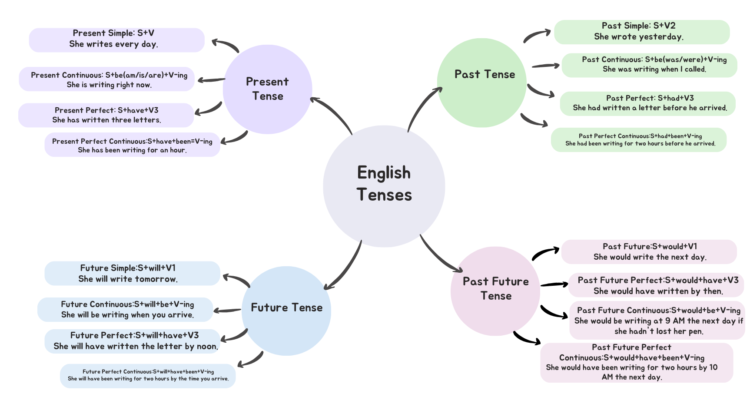
    To illustrate how mind mapping can be used to teach tenses, let’s take “Tenses” as the central concept. Here’s how the mind map might look:

    Central Concept: Tenses

    • Present Tense
      • Present Simple: “She writes every day.”
      • Present Continuous: “She is writing right now.”
      • Present Perfect: “She has written three letters.”
      • Present Perfect Continuous: “She has been writing for an hour.”
    • Past Tense
      • Past Simple: “She wrote yesterday.”
      • Past Continuous: “She was writing when I called.”
      • Past Perfect: “She had written a letter before he arrived.”
      • Past Perfect Continuous: “She had been writing for two hours before he arrived.”
    • Future Tense
      • Future Simple: “She will write tomorrow.”
      • Future Continuous: “She will be writing when you arrive.”
      • Future Perfect: “She will have written the letter by noon.”
      • Future Perfect Continuous: “She will have been writing for two hours by the time you arrive.”

    Conclusion

    Using mind mapping to teach English grammar in senior high schools offers a dynamic and effective approach to learning. By visually organizing grammatical concepts, students can better understand, remember, and apply what they learn. Educators can make grammar lessons more engaging and interactive, ultimately leading to improved student outcomes.

    By breaking down tenses into their subcategories and providing examples, students can see the differences and similarities between them more clearly.

    Conclusion

  • Teaching English Vocabulary in Senior High Schools Using the Mind Mapping Method

    Teaching English Vocabulary in Senior High Schools Using the Mind Mapping Method

    In the modern educational landscape, teaching English vocabulary effectively is crucial for senior high school students. Traditional methods of rote memorization are increasingly being supplemented or replaced by more engaging and interactive techniques. One such method is mind mapping, a visual tool that can significantly enhance vocabulary acquisition and retention. This article explores how mind mapping can be utilized to teach English vocabulary to senior high school students, offering practical tips and strategies for educators.
    What is Mind Mapping?

    Mind mapping is a graphical representation of ideas and concepts. It is a visual thinking tool that helps structure information, allowing students to better analyze, comprehend, and recall information. By linking related ideas and concepts around a central theme, mind maps create a network of knowledge that mirrors the way the brain naturally works.

    Benefits of Using Mind Mapping in Vocabulary Teaching

    1. Enhances Memory Retention: The visual nature of mind maps helps students remember vocabulary better than linear notes.
    2. Encourages Active Learning: Creating mind maps involves active participation, which increases engagement and understanding.
    3. Promotes Creativity: Mind maps encourage students to think creatively and make connections between words and concepts.
    4. Improves Organization: Vocabulary is organized in a clear, hierarchical structure, making it easier to review and study.

    How to Implement Mind Mapping in the Classroom

    1. Introduce the Concept

    Begin by explaining what a mind map is and how it works. Show examples of mind maps related to various subjects to illustrate their versatility. Highlight the benefits and encourage students to think about how they can use mind maps for vocabulary learning.

    2. Choose a Central Theme

    Select a central theme for the mind map, such as “English Vocabulary.” This will be the core concept from which all related ideas will branch out. For a more focused approach, you can choose themes like “Travel Vocabulary,” “Science Vocabulary,” or “Literary Terms.”

    3. Create Main Branches

    Identify the main categories related to the central theme. For vocabulary, these could include:

    • Synonyms
    • Antonyms
    • Usage in Sentences
    • Word Forms
    • Related Words

    4. Develop Sub-Branches

    Each main branch can be further divided into sub-branches. For example, under “Synonyms,” students can list synonyms for specific vocabulary words. Under “Usage in Sentences,” they can write example sentences.

    5. Use Colors and Images

    Encourage students to use different colors for each branch and add relevant images or icons. This not only makes the mind map visually appealing but also aids in memory retention.

    6. Review and Revise

    Regularly review the mind maps with students. Encourage them to add new words and connections as they learn more. This iterative process helps reinforce their vocabulary knowledge.

    Practical Examples of Mind Maps for Vocabulary Learning

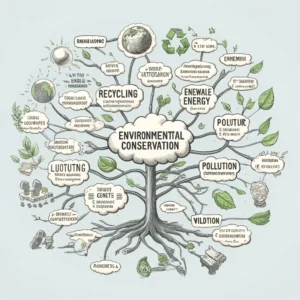
    Example 1: Mind Map for “Environmental Vocabulary”

    • Central Theme: Environmental Vocabulary
      • Main Branches:
        • Synonyms: Conservation, Preservation
        • Antonyms: Pollution, Degradation
        • Usage in Sentences: “The conservation of natural resources is crucial for sustainability.”
        • Word Forms: Conserve (verb), Conservation (noun), Conservative (adjective)
        • Related Words: Ecosystem, Biodiversity, Sustainability

    Example 2: Mind Map for “Literary Terms”

    • Central Theme: Literary Terms
      • Main Branches:
        • Synonyms: Narration, Storytelling
        • Antonyms: Non-fiction, Reality
        • Usage in Sentences: “The narrative technique used in this novel is unique.”
        • Word Forms: Narrate (verb), Narration (noun), Narrative (adjective)
        • Related Words: Protagonist, Plot, Theme

    Tips for Effective Mind Mapping

    1. Keep It Simple: Start with basic mind maps and gradually increase complexity as students become more comfortable with the technique.
    2. Encourage Personalization: Allow students to personalize their mind maps with their own drawings, symbols, and colors. This makes the process more engaging.
    3. Integrate Technology: Use digital mind mapping tools like MindMeister, XMind, or Canva to create interactive and easily editable mind maps.
    4. Collaborative Learning: Encourage group activities where students create mind maps together. This fosters teamwork and allows them to learn from each other.

    Conclusion

    Mind mapping is an innovative and effective method for teaching English vocabulary in senior high schools. By organizing vocabulary visually and making connections between words and concepts, mind maps can enhance students’ understanding and retention of new vocabulary. Implementing mind mapping in the classroom not only makes vocabulary learning more engaging but also equips students with a powerful tool for organizing and recalling information. Educators are encouraged to incorporate this method into their teaching strategies to help students master English vocabulary more effectively.

    By utilizing mind mapping in vocabulary instruction, educators can create a dynamic and effective learning environment that supports student success in mastering English vocabulary.

  • The History of Mind Mapping

    The History of Mind Mapping

    Introduction

    Mind mapping, a powerful tool for visualizing and organizing information, has become increasingly popular in educational, business, and personal development contexts. Its ability to simplify complex information and stimulate creative thinking has made it a go-to technique for many. But where did this innovative method originate, and how has it evolved over time? In this article, we delve into the fascinating history of mind mapping, exploring its origins, development, and the key figures who have contributed to its widespread adoption.

    The Origins of Mind Mapping

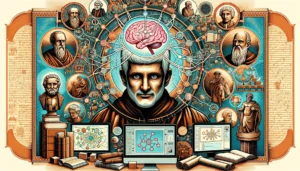
    The concept of mind mapping has roots that extend far back in history, even though the term “mind mapping” itself was not used until much later. Ancient philosophers and thinkers have long utilized visual diagrams to represent knowledge and ideas. One of the earliest examples can be traced to the 3rd century BC, when the Greek philosopher Porphyry of Tyre created visual representations of Aristotle’s work to illustrate logical connections.

    In the Middle Ages, the use of visual tools continued with the development of “Ramon Llull’s Ars Magna,” a method created by Ramon Llull in the 13th century. Llull’s system used diagrams to represent philosophical and theological concepts, demonstrating an early use of visual thinking to solve complex problems.

    Tony Buzan and the Modern Mind Map

    The modern mind map, as we know it today, owes much of its development to Tony Buzan, a British psychologist, author, and educational consultant. Buzan popularized the concept in the 1970s, emphasizing its utility in enhancing memory, creativity, and problem-solving skills.

    Buzan’s interest in cognitive psychology and brain research led him to develop the mind map as a tool to harness the brain’s natural associative capabilities. He introduced several principles that differentiate mind mapping from other diagrammatic techniques:

    1. Central Idea: A mind map starts with a central idea or theme, placed in the center of the page.
    2. Branches: Main ideas branch out from the central theme, radiating in all directions.
    3. Keywords: Each branch contains a single keyword or short phrase to represent the main idea.
    4. Images and Colors: The use of images, symbols, and colors enhances memory and makes the mind map more engaging.
    5. Organic Structure: The structure of a mind map is organic and free-flowing, mimicking the natural thought process of the human brain.

    Buzan’s books, such as “The Mind Map Book” and “Use Your Head,” played a crucial role in spreading the concept. His workshops and seminars further popularized mind mapping among educators, students, and professionals.

    Evolution and Technological Advancements

    The advent of digital technology in the late 20th and early 21st centuries brought significant advancements to mind mapping. Software tools like MindMeister, XMind, and FreeMind made it easier to create, edit, and share mind maps. These digital tools offered features like drag-and-drop functionality, collaboration capabilities, and integration with other digital resources, making mind mapping more accessible and versatile.

    Mind Mapping in Education

    Mind mapping has found a special place in the field of education. Educators use mind maps to help students understand complex subjects, organize information, and enhance their critical thinking skills. Research has shown that mind mapping can improve comprehension and retention of information, making it a valuable tool in the learning process.

    Mind Mapping in Business

    In the business world, mind mapping is used for brainstorming, project planning, and strategic thinking. It allows teams to visualize ideas, identify relationships between concepts, and develop innovative solutions to problems. The visual nature of mind maps makes them effective for presenting information and facilitating discussions.

    The Future of Mind Mapping

    As technology continues to evolve, so too will the applications and capabilities of mind mapping. Emerging technologies such as artificial intelligence and virtual reality have the potential to take mind mapping to new heights, offering more immersive and interactive experiences. These advancements could further enhance the ability of individuals and teams to visualize and organize information in dynamic ways.

    Conclusion

    The history of mind mapping is a testament to the enduring power of visual thinking. From its ancient roots to its modern applications, mind mapping has continually evolved, adapting to new knowledge and technologies. Today, it stands as a vital tool in education, business, and personal development, helping people organize their thoughts, solve problems, and unlock their creative potential. As we look to the future, mind mapping will undoubtedly continue to innovate and inspire, shaping the way we think and learn.

  • Mind Mapping for Teaching English in Senior High School

    Mind Mapping for Teaching English in Senior High School

    Introduction

    Teaching English in senior high school can be a challenging task, given the diverse needs and varying proficiency levels of students. One effective strategy that educators can employ is mind mapping. This visual tool not only aids in the organization of thoughts but also enhances understanding and retention of information. In this article, we will explore how mind mapping can be utilized to teach English in senior high school, its benefits, and practical tips for implementation.

    What is Mind Mapping?

    Mind mapping is a visual representation of information, structured in a way that resembles a web or a tree. It starts with a central idea, from which related topics branch out in all directions. This method leverages the brain’s natural ability to recognize patterns and relationships, making complex information easier to understand and remember.

    Benefits of Mind Mapping in Teaching English

    1. Enhanced Comprehension: Mind maps help students break down complex topics into manageable chunks, making it easier to grasp the core concepts.
    2. Improved Memory Retention: The visual nature of mind maps aids in better retention of information. Students can recall information more effectively when they visualize it in a structured format.
    3. Encourages Creativity: Mind mapping allows students to explore ideas freely and make connections they might not have considered otherwise.
    4. Boosts Engagement: Interactive and visually appealing mind maps can make learning more engaging and enjoyable for students.
    5. Organizes Thoughts: Mind maps provide a clear structure for students to organize their thoughts, making it easier to plan essays, projects, and presentations.

    How to Create a Mind Map

    1. Choose a Central Topic: Start with a central idea or theme. For an English lesson, this could be a literary concept, a grammar rule, or a writing task.
    2. Branch Out with Main Ideas: From the central topic, draw branches for the main ideas. These should be the key points related to the central theme.
    3. Add Sub-Branches for Details: Each main idea can have sub-branches that delve into more specific details or examples.
    4. Use Colors and Images: Incorporate colors, images, and symbols to make the mind map visually appealing and to highlight important information.
    5. Review and Revise: Regularly review and update the mind map to reflect new information or insights.

    Practical Applications of Mind Mapping in English Classes

    1. Vocabulary Building

    Mind maps can be an excellent tool for vocabulary building. Start with a new word as the central topic and branch out with its definition, synonyms, antonyms, usage in sentences, and related words. This helps students see the relationships between words and enhances their understanding of vocabulary.

    2. Literary Analysis

    When analyzing a piece of literature, students can create a mind map to explore the various elements of the story. The central topic could be the title of the book or a main theme, with branches for characters, plot points, themes, and literary devices. This allows students to visualize the structure of the literary work and understand its components in depth.

    3. Grammar Rules

    Teaching grammar can be simplified using mind maps. For instance, if the lesson is about tenses, the central topic could be “Tenses,” with branches for each type of tense (present, past, future) and sub-branches for examples and rules of each tense. This method helps students see the connections between different grammatical concepts.

    4. Essay Planning

    Mind maps are particularly useful for planning essays. Students can start with the essay topic as the central idea and create branches for the introduction, body paragraphs, and conclusion. Each branch can then have sub-branches for key points, evidence, and arguments. This helps students organize their thoughts and ensure their essay has a logical flow.

    Tips for Implementing Mind Mapping in the Classroom

    1. Introduce the Concept: Begin by explaining what mind mapping is and its benefits. Show examples to illustrate how it works.
    2. Use Technology: Utilize mind mapping software and apps to create digital mind maps. Tools like MindMeister, XMind, and Coggle can make the process more interactive and engaging.
    3. Encourage Collaboration: Have students work in groups to create mind maps. This fosters collaboration and allows them to learn from each other.
    4. Incorporate into Assessments: Use mind maps as part of assessments to evaluate students’ understanding and organization of information.
    5. Provide Feedback: Give constructive feedback on students’ mind maps to help them improve their technique and understanding.

    Conclusion

    Mind mapping is a versatile and powerful tool that can significantly enhance the teaching and learning of English in senior high school. By organizing information visually, mind maps make complex concepts more accessible and engaging for students. Whether it’s building vocabulary, analyzing literature, learning grammar, or planning essays, mind mapping can transform the way students approach and understand English. As educators, embracing this tool can lead to more effective teaching and a more enriching learning experience for students.