
Tag: English dialogues

  • What is the Difference Between “A Few” and “A Little”?

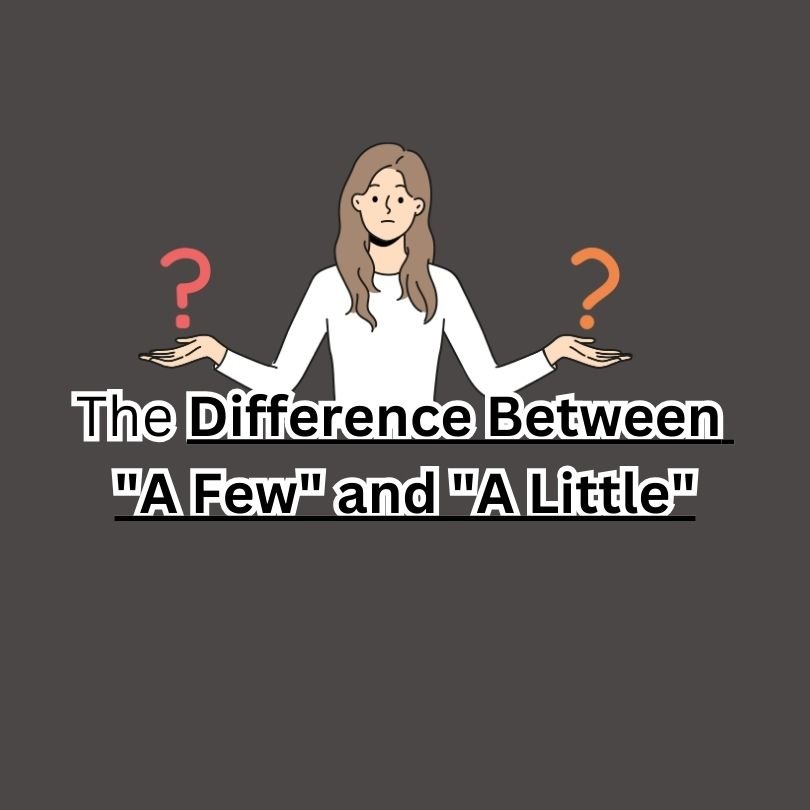
    What is the Difference Between “A Few” and “A Little”?

    Question: What is the Difference Between “A Few” and “A Little”?

    Answer:

    Understanding the difference between “a few” and “a little” is essential for mastering English grammar. Both phrases are used to indicate a small quantity, but they are applied differently based on whether the noun they describe is countable or uncountable. In this article, we will explain the usage of “a few” and “a little” in a simple and detailed manner, provide examples, and demonstrate their use in daily conversations through dialogues.

    What Are Countable and Uncountable Nouns?

    Before diving into the difference between “a few” and “a little,” it’s important to understand the concepts of countable and uncountable nouns.

    • Countable nouns are items that can be counted individually. They have both singular and plural forms (e.g., “apple” and “apples”).
    • Uncountable nouns are items that cannot be counted individually. They do not have a plural form (e.g., “water,” “sand”).

    A Few

    “A few” is used with countable nouns to indicate a small number of items.

    Examples:

    • I have a few friends in New York.
    • She bought a few apples at the market.
    • We need a few chairs for the event.

    In these sentences, “a few” refers to a small number of individual items that can be counted.

    A Little

    “A little” is used with uncountable nouns to indicate a small amount of something.

    Examples:

    • There is a little milk left in the fridge.
    • He needs a little water to drink.
    • She added a little sugar to her coffee.

    In these sentences, “a little” refers to a small quantity of something that cannot be counted individually.

    Using “A Few” and “A Little” in Daily Life

    To better understand how “a few” and “a little” are used in daily conversations, let’s look at some dialogues.

    Dialogue 1: Using “A Few”

    Emily: Do you have any plans for the weekend?

    John: Yes, I have a few things to do. I need to buy a few groceries and meet a few friends.

    Emily: Sounds like a busy weekend!

    Dialogue 2: Using “A Little”

    Sarah: Can I have some water, please?

    Tom: Sure, there’s a little water left in the bottle. Help yourself.

    Sarah: Thank you!

    Key Points to Remember

    • Use “a few” with countable nouns (e.g., “a few books,” “a few cars”).
    • Use “a little” with uncountable nouns (e.g., “a little time,” “a little rice”).

    By remembering these simple rules, you can use “a few” and “a little” correctly in your conversations and writing.

    Meta Description

    Learn the difference between “a few” and “a little” with easy-to-understand explanations, examples, and dialogues. Master the use of countable and uncountable nouns in English grammar. Enhance your English skills with practical tips and phrases.

    By understanding and practicing the use of “a few” and “a little,” you can improve your English communication skills and make your speech and writing more accurate and effective.

  • Greetings in English: A Comprehensive Guide

    Greetings in English: A Comprehensive Guide

    Greetings in English: A Comprehensive Guide

    Greetings are an essential part of any language, and English is no exception. They serve as the first point of contact in conversations and can set the tone for interactions. In this article, we will explore the various types of greetings in English, provide examples, and demonstrate how to use them in daily conversations through dialogues.

    Types of Greetings in English

    1. Formal Greetings
    2. Informal Greetings
    3. Time-Specific Greetings
    4. Seasonal and Holiday Greetings
    Formal Greetings

    Formal greetings are used in professional settings or when addressing someone with respect. They are typically used with people you do not know well, such as colleagues, business partners, or elders.

    • Good morning: Used from sunrise until noon.
    • Good afternoon: Used from noon until around 6 PM.
    • Good evening: Used after 6 PM until bedtime.
    • Hello: A neutral, formal greeting suitable for any time of day.
    • How do you do?: A very formal greeting used when meeting someone for the first time.

    Example:

    • “How do you do, Mr. Smith?”
    Informal Greetings

    Informal greetings are used among friends, family, or peers. They are more relaxed and casual.

    • Hi
    • Hey
    • What’s up?
    • How’s it going?
    • How are you?

    Example:

    • “Hey, Sarah! What’s up?”
    Time-Specific Greetings

    These greetings are used at specific times of the day.

    • Good night: Used when parting ways at night or going to bed.
    • Good day: A formal way to greet someone during the daytime, not commonly used in modern English but still understood.

    Example:

    • “Good night, everyone. See you tomorrow.”
    Seasonal and Holiday Greetings

    These greetings are used during specific seasons or holidays to spread cheer and good wishes.

    • Merry Christmas
    • Happy New Year
    • Happy Holidays
    • Happy Easter

    Example:

    • “Happy Holidays, everyone!”

    Using Greetings in Daily Life

    To understand how these greetings are used in daily conversations, let’s look at some dialogues.

    Dialogue 1: Formal Setting

    John: How do you do, Dr. Adams?

    Dr. Adams: How do you do, John?

    John: Pleased to meet you.

    Dialogue 2: Informal Setting

    Anna: Hey, Tom! How’s it going?

    Tom: Hi, Anna! It’s going well, thanks. How about you?

    Anna: I’m good, just busy with work.

    Dialogue 3: Time-Specific Greeting

    Emily: Good night, everyone. See you tomorrow!

    Group: Good night, Emily!

    Dialogue 4: Seasonal Greeting

    Mike: Happy Holidays, Emma!

    Emma: Happy Holidays, Mike! Hope you have a great holiday.

    By understanding and practicing these greetings, you can improve your English communication skills and make a positive impression in various social and professional settings.