Tag: English grammar tips

  • Mastering the Past Perfect Continuous Tense: Rules, Examples, and Practice Questions

    Mastering the Past Perfect Continuous Tense: Rules, Examples, and Practice Questions

    Definition

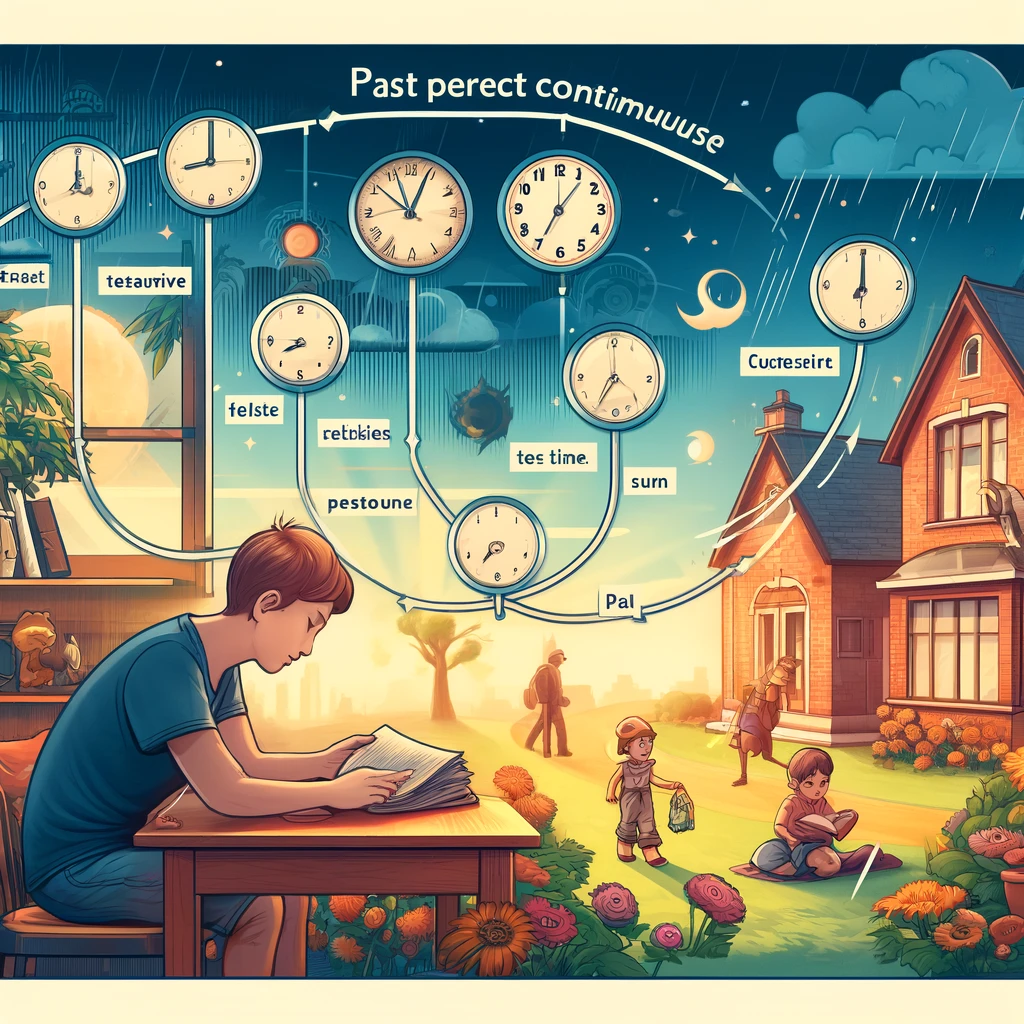
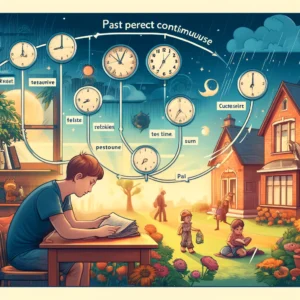
    The Past Perfect Continuous Tense, also known as the past perfect progressive, is used to describe an action that started in the past and continued up to another point in the past. It emphasizes the duration or continuity of an action that was happening before a specific time or another action in the past.
    Uses

    1. To show the duration of an action up to a certain point in the past.

    Examples:

    • They had been waiting for two hours by the time the bus finally came. (This sentence highlights the ongoing action of waiting that lasted for two hours until the bus arrived.)
    • She had been studying for three hours when her friends arrived. (The action of studying continued for three hours up to the point when her friends arrived.)
    • He had been working at the company for ten years before he decided to resign. (This indicates that the action of working at the company lasted for ten years until he made the decision to resign.)

    2. To describe an action that was in progress before another action occurred.

    Examples:

    • He had been working on the project before he fell ill. (This indicates that the work was ongoing and then interrupted by his illness.)
    • They had been planning the event for weeks before it was cancelled. (The planning was an ongoing process that was halted by the cancellation of the event.)
    • She had been cleaning the house when the guests arrived early. (The cleaning was an ongoing action that was interrupted by the early arrival of the guests.)

    3. To set the scene for another past event.

    Examples:

    • The children had been playing outside when it started to rain. (The ongoing action of playing outside sets the context for the sudden event of the rain starting.)
    • He had been reading a book when the phone rang. (The reading was an ongoing activity that was interrupted by the phone ringing.)
    • They had been discussing their plans when the news broke. (The ongoing discussion sets the scene for the interruption caused by breaking news.)

    Pattern

    The following are the grammatical pattern of the Past Perfect Continuous Tense:

    Affirmative: Subject + had + been + present participle (verb+ing)

    • She had been reading.
    • They had been talking.

    Negative: Subject + had + not + been + present participle (verb+ing)

    • She had not (hadn’t) been reading.
    • They had not (hadn’t) been talking.

    Interrogative: Had + subject + been + present participle (verb+ing)

    • Had she been reading?
    • Had they been talking?

    Time Signals

    Common time signals used with the Past Perfect Continuous Tense include:

    • For
    • Since
    • Before
    • By the time
    • Until
    • When

    Common Mistakes and How to Avoid Them

    1. Confusing with the Past Continuous Tense

    Mistake: “She was reading for two hours.” Correction: “She had been reading for two hours.” Tip: Remember, the Past Continuous is used for an action happening at a specific moment in the past, while the Past Perfect Continuous emphasizes the duration of an action up to a point in the past.

    2. Using the wrong auxiliary verb

    Mistake: “They was been playing.” Correction: “They had been playing.” Tip: Always use “had” as the auxiliary verb in the Past Perfect Continuous Tense, regardless of the subject.

    3. Omitting “been”

    Mistake: “He had studying all night.” Correction: “He had been studying all night.” Tip: The word “been” is essential in forming the Past Perfect Continuous Tense.

    Conclusion

    The Past Perfect Continuous Tense is a useful tense for expressing actions that were ongoing up until a specific point in the past. By understanding its definition, uses, pattern, and common time signals, learners can effectively incorporate this tense into their writing and speaking. Avoiding common mistakes will further enhance your proficiency in using the Past Perfect Continuous Tense.

    Quiz

    Test your understanding of the Past Perfect  Continuous Tense with this 10-question multiple-choice quiz. Choose the correct answer for each question.

    1. They ____ for an hour before the train arrived.

    2. She ____ the piano for years before she gave her first concert.

    3. By the time we got home, it ____ snowing for hours.

    4. He ____ to lose weight before his wedding.

    5. The students ____ for the exam until late at night.

    6. They ____ for hours before the manager finally arrived.

    7. I ____ to get tickets for the concert for weeks before they sold out.

    8. We ____ about the trip when he called.

    9. She ____ all afternoon before she took a break.

    10. They ____ for a new house before they found this one.

  • Mastering the Simple Future Tense: Rules, Examples, and Practice Questions

    Mastering the Simple Future Tense: Rules, Examples, and Practice Questions

    Definition

    The Simple Future Tense is a verb tense used to describe actions that will happen at a later time. It is a crucial part of English grammar that helps convey plans, promises, predictions, and spontaneous decisions. The Simple Future Tense is used to express actions or events that will occur in the future. It is formed by using the auxiliary verb “will” followed by the base form of the main verb.

    Uses

    1. Predictions: The Simple Future Tense is often used to make predictions about the future.

    Examples:

    • It will rain tomorrow. (This sentence predicts the weather for the next day.)
    • The stock market will recover by the end of the year. (This sentence predicts the performance of the stock market.)
    • She will become a successful doctor. (This sentence predicts someone’s future career success.)
    1. Spontaneous Decisions: It is used when deciding to do something at the moment of speaking.

    Examples:

    • I will help you with your homework. (The speaker offers help spontaneously.)
    • I will get the door. (The speaker decides to open the door at that moment.)
    • I will buy some snacks. (The speaker decides to purchase snacks immediately.)
    1. Promises or Offers: This tense is commonly used to make promises or offers.

    Examples:

    • I will call you later. (The speaker is making a promise to call in the future.)
    • We will send you the documents tomorrow. (The speaker promises to send documents.)
    • I will take care of your plants while you’re away. (The speaker offers to take care of the plants.)

    Pattern

    The structure of the Simple Future Tense is straightforward. It follows the pattern:

    • Affirmative: Subject + will + base form of the verb.
      • Example: “She will travel to Paris.”
    • Negative: Subject + will not (won’t) + base form of the verb.
      • Example: “They will not (won’t) attend the meeting.”
    • Interrogative: Will + subject + base form of the verb?
      • Example: “Will you join us for dinner?”

    Time Signals

    To indicate that an action will occur in the future, certain time signals are often used:

    • Tomorrow
    • Next week/month/year
    • In a few days
    • Soon
    • Later

    Common Mistakes and How to Avoid Them

    1. Using “will” with another future form:
      • Incorrect: “I will going to the store.”
      • Correct: “I will go to the store.”
      • Tip: Remember that “will” should be followed by the base form of the verb.
    2. Confusion between “will” and “going to”:
      • Incorrect: “I will going to study tonight.”
      • Correct: “I am going to study tonight.”
      • Tip: Use “will” for spontaneous decisions and “going to” for planned actions.
    3. Neglecting subject-verb agreement:
      • Incorrect: “She will goes to school.”
      • Correct: “She will go to school.”
      • Tip: Ensure that the verb following “will” is always in its base form, regardless of the subject.

    Conclusion

    The Simple Future Tense is essential for discussing future events, predictions, spontaneous decisions, and promises. By understanding its uses, patterns, and common mistakes, learners can effectively communicate about the future in English. Remember to use appropriate time signals and ensure proper verb forms to avoid common errors.

    Quiz

    Test your understanding of the Simple Future Tense with this 10-question multiple-choice quiz. Choose the correct answer for each question.

    1. Which sentence is in the Simple Future Tense?

    2. Choose the correct form of the verb: "They ____ (visit) the museum tomorrow."

    3. Which time signal is commonly used with the Simple Future Tense?

    4. Identify the incorrect sentence:

    5. Fill in the blank: "I ____ (not / attend) the meeting."

    6. Which of the following sentences is a prediction?

    7. Form the question: "____ (you / finish) your homework?"

    8. Identify the promise in the following sentences:

    9. Correct the mistake: "He will plays football."

    10. Choose the correct sentence: