Tag: English Tenses

  • Mastering The Future Perfect Continuous Tense: Rules, Examples, and Practice Questions

    Mastering The Future Perfect Continuous Tense: Rules, Examples, and Practice Questions

    The Future Perfect Continuous Tense

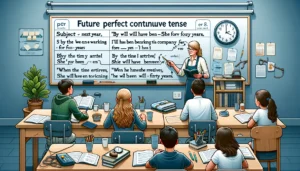
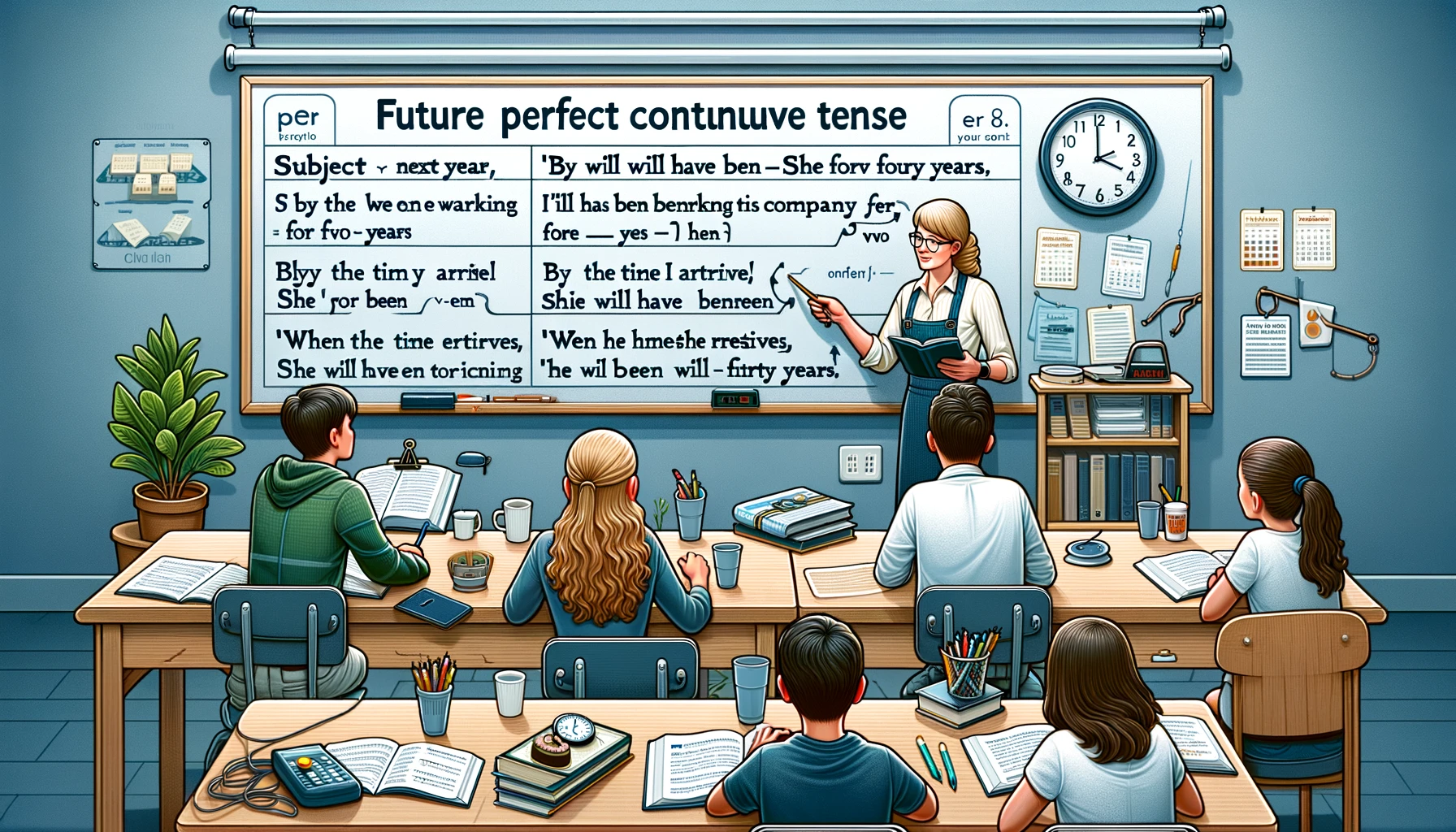
    The Future Perfect Continuous Tense is an advanced aspect of English grammar that combines elements of the future, perfect, and continuous tenses. It is used to describe actions that will have been ongoing for a period of time up to a specific point in the future.
    Definition

    The Future Perfect Continuous Tense describes actions that will continue up until a specific future moment. This tense emphasizes the duration of an activity that will be ongoing and completed at a certain future time.

    Uses

    The Future Perfect Continuous Tense is used in various contexts, including:

    1. Describing the Duration of an Action Up to a Future Point

    This tense highlights how long an action will have been happening by a specific future time.

    Examples:

    • By next year, I will have been working at this company for five years. (The action of working will have continued for five years by next year.)
    • By the time you arrive, she will have been cooking for two hours. (The action of cooking will have been ongoing for two hours by the time you arrive.)
    • When he retires, he will have been teaching for thirty years. (The action of teaching will have lasted for thirty years by the time he retires.)
    1. Expressing Planned Future Actions with Emphasis on Duration

    This tense is used to describe planned activities that focus on the duration up to a future point.

    Examples:

    • By December, they will have been traveling for six months. (The action of traveling will have been ongoing for six months by December.)
    • At the end of this course, you will have been learning English for a year. (The learning process will have continued for a year by the end of the course.)
    • By tomorrow evening, we will have been driving for ten hours. (The action of driving will have been in progress for ten hours by tomorrow evening.)
    1. Predicting Ongoing Actions Up to a Future Point

    It can be used to predict the duration of ongoing actions up to a specific time in the future.

    Examples:

    • When you see me next, I will have been studying for my exams. (The speaker predicts that the action of studying will have been ongoing.)
    • By the time he finishes, he will have been writing the report for a week. (The action of writing the report will have been in progress for a week.)
    • At the end of the day, she will have been waiting for four hours. (The action of waiting will have continued for four hours by the end of the day.)

    Pattern

    The grammatical pattern of the Future Perfect Continuous Tense involves the following structure:

    Subject + will have been + present participle (verb+ing)

    For example:

    • Affirmative: “I will have been studying for three hours.”
    • Negative: “She will not have been working here for long.”
    • Interrogative: “Will they have been traveling for a year?”

    Time Signals

    Common time signals used with the Future Perfect Continuous Tense include:

    • By [future time]
    • By the time
    • For [duration]
    • When

    Common Mistakes and How to Avoid Them

    Learners often make mistakes with the Future Perfect Continuous Tense. Here are some common errors and tips to avoid them:

    1. Incorrect Verb Form
      • Mistake: “I will have be studying.”
      • Correction: Use “been” correctly: “I will have been studying.”
      • Tip: Remember to use “been” after “will have” and before the present participle.
    2. Misplacing Time Signals
      • Mistake: “I will have been for two hours studying.”
      • Correction: Correctly place the time signal: “I will have been studying for two hours.”
      • Tip: Place time signals after the present participle for clarity.
    3. Confusing with Other Future Tenses
      • Mistake: “I will be studying for two hours.”
      • Correction: Use the correct tense for duration: “I will have been studying for two hours.”
      • Tip: Ensure the tense matches the emphasis on the duration up to a future point.

    Conclusion

    The Future Perfect Continuous Tense is a valuable tool for describing actions that will have been ongoing up to a specific point in the future. By understanding its structure, uses, and common time signals, learners can effectively communicate the duration of future activities. Avoiding common mistakes ensures clarity and precision in usage.

    Quiz

    Test your understanding of the Future Perfect Continuous Tense with this 10-question multiple-choice quiz. Choose the correct answer for each question.

    1. Which sentence correctly uses the Future Perfect Continuous Tense?

    2. Identify the correct use of Future Perfect Continuous Tense for a planned event:

    3. Which of these is not a time signal for the Future Perfect Continuous Tense?

    4. By next summer, they __________ (live) in this city for ten years.

    5. Which sentence correctly predicts an ongoing action up to a future point?

    6. What is the correct form to express a future action’s duration?

    7. Choose the sentence with the correct time signal:

    8. By the time he retires, how long will he have been teaching?

    9. Which sentence correctly uses the Future Perfect Continuous Tense?

    10. Identify the error: "By next week, they will have been finish the project."

  • Mastering The Future Continuous Tense: Rules, Examples, and Practice Questions

    Mastering The Future Continuous Tense: Rules, Examples, and Practice Questions

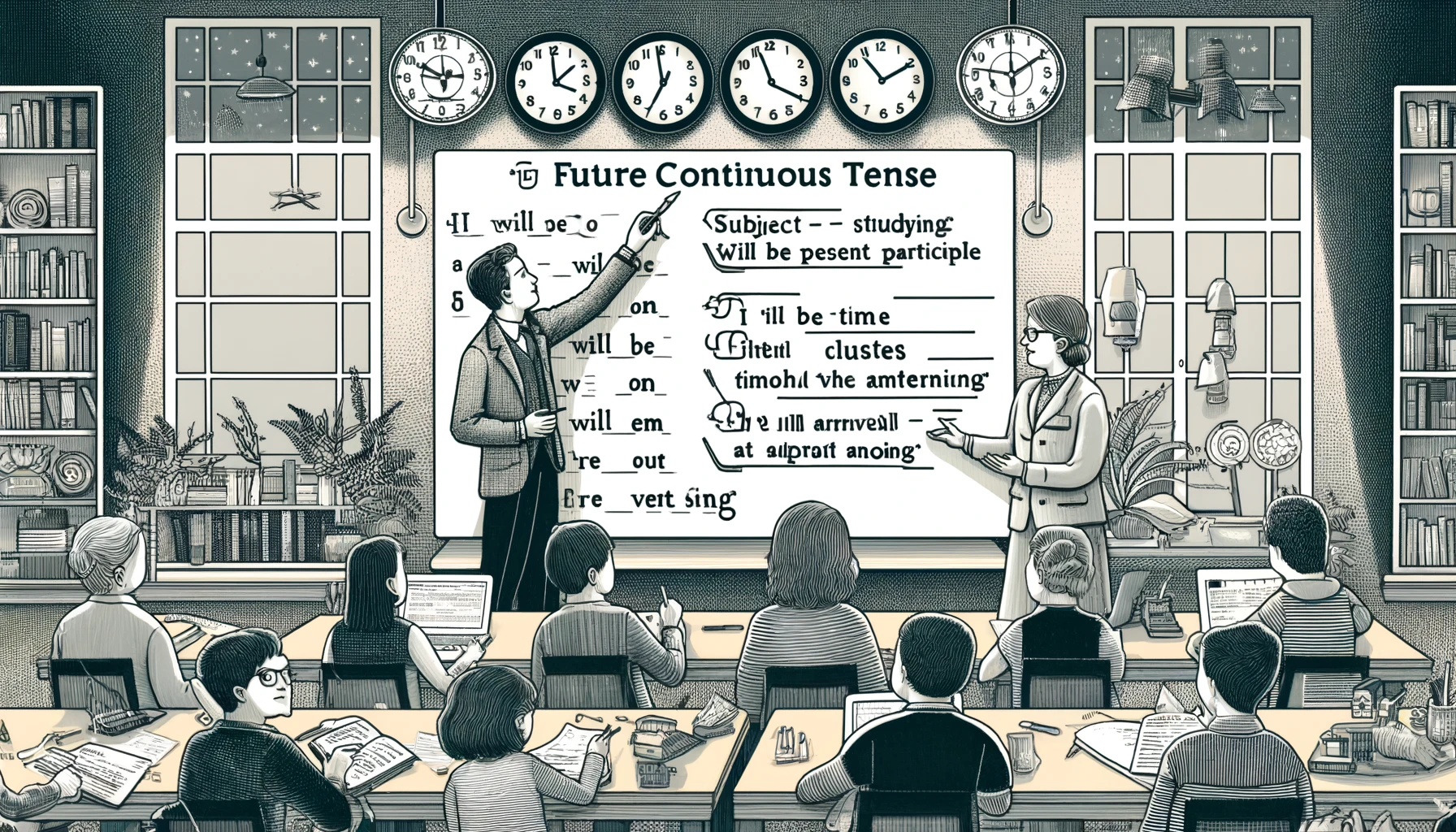
    The Future Continuous Tense

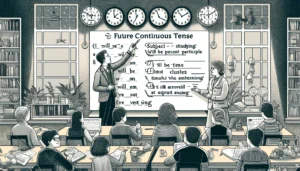
    The Future Continuous Tense is an essential aspect of English grammar that allows speakers to describe actions that will be ongoing at a specific point in the future. This tense is particularly useful for expressing future activities that are planned or expected to occur over a duration of time.

    Definition

    The Future Continuous Tense describes actions that will be happening at a particular moment in the future. It emphasizes the duration or continuity of an activity that will be in progress at a future time.

    Uses

    The Future Continuous Tense is used in various contexts, including:

    1. Actions in Progress at a Specific Future Time

     This tense indicates that an action will be ongoing at a particular future moment.

    Examples:

    • This time next week, I will be traveling to Japan. (The action of traveling will be happening at a specific future time.)
    • At 10 PM tonight, she will be working on her project. (The action of working will be happening at 10 PM.)
    • By tomorrow morning, they will be flying to New York. (The action of flying will be ongoing tomorrow morning.)
    1. Planned Future Activities

    It expresses activities that are already planned or arranged to happen in the future.

    Examples:

    • She will be meeting with the clients tomorrow afternoon. (The meeting is a scheduled activity that will take place in the future.)
    • We will be attending the conference next week. (Attending the conference is a planned activity for next week.)
    • He will be hosting a dinner party on Friday. (Hosting the dinner party is a pre-arranged event for Friday.)
    1. Predicting the Present

    Sometimes, it is used to speculate about what is currently happening, based on future knowledge.

    Examples:

    • They will be arriving at the airport right now. (Based on future plans, the speaker predicts the current activity.)
    • She will be having lunch at this moment. (The speaker assumes that she is currently having lunch based on her usual schedule.)
    • He will be studying for his exams now. (The speaker predicts that he is studying at the present moment, considering his upcoming exams.)

    Pattern

    The grammatical pattern of the Future Continuous Tense involves the following structure:

    Subject + will be + present participle (verb+ing)

    For example:

    • Affirmative: “I will be studying at 8 PM.”
    • Negative: “She will not be coming to the party.”
    • Interrogative: “Will they be joining us for dinner?”

    Time Signals

    Common time signals used with the Future Continuous Tense include:

    • At this time next week
    • Tomorrow at [specific time]
    • In the future
    • Next [day/week/month/year]

    Common Mistakes and How to Avoid Them

    Learners often make mistakes with the Future Continuous Tense. Here are some common errors and tips to avoid them:

    1. Incorrect Auxiliary Verb Usage
      • Mistake: “I am will be studying.”
      • Correction: Use “will be” correctly: “I will be studying.”
      • Tip: Remember that “will” is always followed by “be” and then the present participle.
    2. Misplacing Time Signals
      • Mistake: “I will be at this time next week studying.”
      • Correction: Correctly place the time signal: “At this time next week, I will be studying.”
      • Tip: Place time signals at the beginning or end of the sentence for clarity.
    3. Forgetting the Present Participle Form
      • Mistake: “She will be to cook dinner.”
      • Correction: Use the present participle form: “She will be cooking dinner.”
      • Tip: Always use the -ing form of the verb after “will be.”

    Conclusion

    The Future Continuous Tense is a versatile and useful tense for describing actions that will be ongoing at a specific future time, planned future activities, and speculating about the present based on future knowledge. By understanding its structure, uses, and common time signals, learners can effectively use this tense to communicate their future plans and predictions. Avoiding common mistakes ensures clarity and accuracy in usage.

    Test your understanding of the Future Continuous Tense with this 10-question multiple-choice quiz. Choose the correct answer for each question.

    1. Which sentence correctly uses the Future Continuous Tense?

    2. Choose the sentence with the correct time signal:

    3. Identify the correct use of Future Continuous Tense for a scheduled event:

    4. Choose the sentence that predicts a current action:

    5. Which of these is not a time signal for the Future Continuous Tense?

    6. Correct the mistake: "She will be sings in the choir."

    7. Which of the following sentences correctly uses the Future Continuous Tense to indicate an action in progress at a specific future time?

    8. How do you express a planned future activity using the Future Continuous Tense?

    9. Which sentence is predicting a current action based on future knowledge?

    10. Choose the sentence that correctly uses the Future Continuous Tense for a planned activity:

  • Teaching English Grammar in Senior High Schools Using the Mind Mapping Method

    Teaching English Grammar in Senior High Schools Using the Mind Mapping Method

    Introduction

    Teaching English grammar in senior high schools can be challenging for educators and students alike. Traditional methods of teaching grammar often involve rote memorization and repetitive exercises, which can be tedious and uninspiring. However, incorporating mind mapping into grammar instruction can transform the learning experience, making it more engaging and effective. This article explores the benefits of using mind mapping to teach English grammar and provides practical tips for educators.

    What is Mind Mapping?

    Mind mapping is a visual representation of information that organizes and structures concepts hierarchically. It begins with a central idea, with related subtopics branching out from it. This method, developed by Tony Buzan, leverages the brain’s natural way of processing information, making it easier for students to understand and retain complex concepts.

    Benefits of Mind Mapping in Grammar Instruction

    1. Enhanced Understanding: Mind maps help students visualize the relationships between different grammatical concepts, making it easier to grasp how they interconnect.
    2. Improved Memory Retention: The visual and hierarchical nature of mind maps aids in better memory retention. Students can recall information more effectively by associating it with visual cues.
    3. Increased Engagement: Creating mind maps is an interactive process that involves creativity and critical thinking, which can make learning grammar more enjoyable for students.
    4. Simplified Complex Information: Mind maps break down complex grammatical rules into smaller, manageable parts, making it easier for students to comprehend and apply them.

    How to Use Mind Mapping to Teach Grammar

    1. Identify the Central Concept: Begin by identifying the central concept you want to teach, such as “English Grammar.” Place this concept at the center of the mind map.
    1. Create Main Branches: Identify the main categories related to the central concept. For English grammar, these could include:
      • Tenses
      • Parts of Speech
      • Sentence Structure
      • Punctuation
      • Common Errors
    2. Add Sub-Branches: For each main category, add sub-branches that represent more detailed topics. For example, under “Tenses,” you could have:
      • Present Simple
      • Past Simple
      • Future Simple
      • Present Continuous
      • Past Continuous
      • Present Perfect
      • Past Perfect
    3. Include Examples and Rules: On each branch or sub-branch, include examples and grammatical rules. This helps students see the practical application of each concept.
    4. Use Colors and Images: To make the mind map more engaging, use different colors for each branch and include relevant images or icons. This visual appeal can help in better retention and understanding.

    Practical Tips for Educators

    1. Interactive Lessons: Encourage students to create their own mind maps during lessons. This interactive approach can help them internalize the concepts better.
    2. Group Activities: Organize group activities where students collaborate to create mind maps. This not only fosters teamwork but also allows students to learn from each other.
    3. Digital Tools: Utilize digital mind mapping tools like MindMeister, XMind, or Coggle. These tools offer various features that can enhance the learning experience.
    4. Regular Reviews: Incorporate mind maps into regular review sessions. Revisiting the maps can help reinforce the concepts and ensure long-term retention.
    5. Assessment: Use mind maps as a part of assessments. Ask students to create mind maps on specific grammar topics to demonstrate their understanding.

    Example: Teaching Tenses with Mind Mapping

    To illustrate how mind mapping can be used to teach tenses, let’s take “Tenses” as the central concept. Here’s how the mind map might look:

    Central Concept: Tenses

    • Present Tense
      • Present Simple: “She writes every day.”
      • Present Continuous: “She is writing right now.”
      • Present Perfect: “She has written three letters.”
      • Present Perfect Continuous: “She has been writing for an hour.”
    • Past Tense
      • Past Simple: “She wrote yesterday.”
      • Past Continuous: “She was writing when I called.”
      • Past Perfect: “She had written a letter before he arrived.”
      • Past Perfect Continuous: “She had been writing for two hours before he arrived.”
    • Future Tense
      • Future Simple: “She will write tomorrow.”
      • Future Continuous: “She will be writing when you arrive.”
      • Future Perfect: “She will have written the letter by noon.”
      • Future Perfect Continuous: “She will have been writing for two hours by the time you arrive.”

    Conclusion

    Using mind mapping to teach English grammar in senior high schools offers a dynamic and effective approach to learning. By visually organizing grammatical concepts, students can better understand, remember, and apply what they learn. Educators can make grammar lessons more engaging and interactive, ultimately leading to improved student outcomes.

    By breaking down tenses into their subcategories and providing examples, students can see the differences and similarities between them more clearly.

    Conclusion

  • Mastering the Present Perfect Tense: Rules, Examples, and Practice Questions

    Mastering the Present Perfect Tense: Rules, Examples, and Practice Questions

    Definition

    The Present Perfect Tense is used to describe actions that have occurred at an unspecified time before now. The exact time is not important. This tense is also used to describe actions that began in the past and continue to the present.

    Uses

    1. Actions That Occurred at an Unspecified Time in the Past
      The Present Perfect Tense is used to express actions that happened at some point in the past, but the exact time is not mentioned.
      Examples:
      -I have visited Paris. (The speaker has visited Paris at some time in the past, but the specific time is not mentioned.)
      -They have read the book. (The action of reading the book happened at some point in the past, without specifying when.)
      -She has gone to the store. (She went to the store at an unspecified time in the past.)
    2. Actions That Started in the Past and Continue to the Present
      This tense is used to describe actions that began in the past and are still happening now or have an effect on the present moment.
      Examples:
      -She has lived here for ten years. (She started living here ten years ago and still lives here.)
      -We have known each other since childhood. (The relationship began in childhood and continues to the present.)
      -He has worked at this company since 2015. (He started working at the company in 2015 and still works there.)
    3. Completed Actions with Relevance to the Present
      The Present Perfect Tense is also used to describe past actions that have a connection to the present moment.
      Examples:
      -He has finished his homework. (He completed his homework at some point in the past, and now the homework is done.)
      -I have cleaned the house. (The house was cleaned at some point in the past, and it is now clean.)
      -They have made dinner. (Dinner was prepared at some point in the past, and it is now ready to be eaten.)

    Pattern

    The grammatical pattern of the Present Perfect Tense is as follows:

    • Affirmative: Subject + has/have + past participle
      • Example: “She has eaten.”
    • Negative: Subject + has/have + not + past participle
      • Example: “They have not seen.”
    • Interrogative: Has/Have + subject + past participle?
      • Example: “Have you been?”

    Time Signals

    Common time signals used with the Present Perfect Tense include:

    • Ever
    • Never
    • Already
    • Yet
    • Just
    • Recently
    • So far
    • Until now
    • For
    • Since

    Common Mistakes and How to Avoid Them

    1. Using the Simple Past Instead of Present Perfect
      • Mistake: “I visited Paris last year.”
      • Correction: “I have visited Paris.”
      • Tip: Use the Present Perfect when the time is not specified or is not important.
    2. Forgetting to Use ‘Has’ or ‘Have’
      • Mistake: “She eaten her lunch.”
      • Correction: “She has eaten her lunch.”
      • Tip: Always include ‘has’ or ‘have’ before the past participle.
    3. Confusing ‘For’ and ‘Since’
      • Mistake: “I have lived here since ten years.”
      • Correction: “I have lived here for ten years.”
      • Tip: Use ‘for’ to indicate the duration of time and ‘since’ to indicate the starting point.

    Conclusion

    The Present Perfect Tense is a versatile and essential part of English grammar. It is used to describe actions without specifying the exact time, actions that continue to the present, and completed actions with relevance to now. Remember the pattern, time signals, and common mistakes to master the Present Perfect Tense.

    Quiz

    Test your understanding of the Present Perfect Tense with this 10-question multiple-choice quiz. Choose the correct answer for each question.

    1. Which sentence is in the Present Perfect Tense?

    2. Choose the correct form: "She ___ (to be) to the new restaurant."

    3. Which time signal is commonly used with the Present Perfect Tense?

    4. Fill in the blank: "They ___ (to finish) their project."

    5. Identify the error: "I has visited London."

    6. Which sentence is correct?

    7. Choose the correct form: "We ___ (to not see) that film."

    8. Which sentence uses ‘since’ correctly?

    9. Fill in the blank: "___ you ever ___ (to try) sushi?"

    10. Identify the error: "They has just arrived."

  • Mastering the Simple Present Tense: Rules, Examples, and Practice Questions

    Mastering the Simple Present Tense: Rules, Examples, and Practice Questions

    Understanding the Simple Present Tense

    The simple present tense is one of the most commonly used tenses in English. It describes habits, general truths, unchanging situations, emotions, and fixed arrangements. Understanding how to properly use the simple present tense is essential for mastering the English language.

    Uses of Simple Present Tense

    1. Habits and Routines
      Examples:
      -She drinks coffee every morning. (This sentence describes a habitual action that she performs regularly every morning.)
      -They play tennis every weekend. (This indicates a routine activity that happens every weekend.)
      -I read the newspaper daily. (This shows a regular habit of reading the newspaper each day.)
    2. General Truths and Facts
      Examples:
      -The sun rises in the east. (This is a general truth that does not change over time.)
      -Water boils at 100 degrees Celsius. (This is a scientific fact that remains constant.)
      -Cats meow. (This describes a general truth about the behavior of cats.)
    3. Unchanging Situations
      Examples:
      -He lives in New York. (This describes a situation that is not expected to change.)
      -She works at a bank. (This indicates a stable employment situation.)
      -The store opens at 9 AM. (This describes a fixed opening time that does not change.)

    Structure of Simple Present Tense

    The simple present tense is formed using the base form of the verb for most subjects (I, you, we, they). For the third person singular (he, she, it), an ‘s’ or ‘es’ is added to the base form of the verb.

    • Affirmative Sentences:
      • I/You/We/They play football.
      • He/She/It plays football.
    • Negative Sentences:
      • I/You/We/They do not (don’t) play football.
      • He/She/It does not (doesn’t) play football.
    • Interrogative Sentences:
      • Do I/you/we/they play football?
      • Does he/she/it play football?

    Spelling Rules for Adding ‘s’ or ‘es’

    1. For most verbs, simply add ‘s’:
      • run → runs
      • eat → eats
    2. For verbs ending in ‘s’, ‘ss’, ‘sh’, ‘ch’, ‘x’, or ‘z’, add ‘es’:
      • kiss → kisses
      • wash → washes
    3. For verbs ending in a consonant + ‘y’, change ‘y’ to ‘i’ and add ‘es’:
      • try → tries
      • study → studies
    4. For verbs ending in a vowel + ‘y’, simply add ‘s’:
      • play → plays
      • enjoy → enjoys

    Common Mistakes and How to Avoid Them

    1. Forgetting to add ‘s’ or ‘es’ in the third person singular:
      • Incorrect: He go to school.
      • Correct: He goes to school.
    2. Using the base form instead of ‘does’ for questions in third person singular:
      • Incorrect: Does she likes apples?
      • Correct: Does she like apples?
    3. Neglecting the auxiliary ‘do/does’ in negative sentences:
      • Incorrect: She not like coffee.
      • Correct: She does not like coffee.

    Quiz

    Test your understanding of the Simple Present Tense with this 10-question multiple-choice quiz. Choose the correct answer for each question.

    1. She _____ every morning.

    2. The sun _____ in the west.

    3. They usually _____ to the gym on Fridays.

    4. He _____ to New York every summer.

    5. _____ she like chocolate?

    6. Water _____ at 100 degrees Celsius.

    7. We don’t _____ to the park on Sundays.

    8. The dog always _____ loudly at night.

    9. She _____ her homework every day.

    10. My brother _____ football very well.