Tag: Grammar Mistakes

  • The Difference Between Simple Past Tense and Present Perfect Tense

    The Difference Between Simple Past Tense and Present Perfect Tense

    Question: What is the Difference Between  Simple Past Tense and Present Perfect Tense?

    Answer:

    Introduction

    English grammar can sometimes be confusing, especially when it comes to understanding the differences between various tenses. Among the most commonly misunderstood tenses are the Simple Past Tense and the Present Perfect Tense. This article aims to clarify the distinctions between these two tenses, providing clear definitions, examples, and illustrations to help learners grasp their proper usage.

    Definition of  Simple Past Tense

    The Simple Past Tense is used to describe actions that were completed at a specific time in the past. It is often accompanied by time expressions like yesterday, last week, in 2010, etc.

    Examples:

    • She visited Paris last summer.
    • They watched a movie yesterday.
    • He finished his homework two hours ago.

    Definition of Present Perfect Tense

    The Present Perfect Tense is used to describe actions that occurred at an unspecified time in the past and are relevant to the present. This tense often uses time expressions like ever, never, already, yet, just, and since/for.

    Examples:

    • She has visited Paris several times.
    • They have watched that movie already.
    • He has finished his homework.

    Key Differences Between Simple Past Tense and Present Perfect Tense

    1. Time Specificity:
      • Simple Past Tense: Refers to actions completed at a specific time in the past.
        • Example: She visited Paris last summer.
      • Present Perfect Tense: Refers to actions that happened at an unspecified time and have relevance to the present.
        • Example: She has visited Paris several times.
    2. Usage of Time Expressions:
      • Simple Past Tense: Uses definite time expressions (yesterday, last week, in 2010).
        • Example: They watched a movie yesterday.
      • Present Perfect Tense: Uses indefinite time expressions (ever, never, already, yet).
        • Example: They have watched that movie already.
    3. Focus on Experience vs. Completed Action:
      • Simple Past Tense: Focuses on the completion of the action.
        • Example: He finished his homework two hours ago.
      • Present Perfect Tense: Focuses on the experience or the result of the action.
        • Example: He has finished his homework.

    Common Mistakes and How to Avoid Them

    1. Mixing Up Time Expressions:
      • Mistake: I have visited Paris last summer.
      • Correction: I visited Paris last summer.
    2. Using Present Perfect Tense with Specific Times:
      • Mistake: He has finished his homework two hours ago.
      • Correction: He finished his homework two hours ago.
    3. Ignoring the Relevance to the Present:
      • Mistake: They watched that movie already.
      • Correction: They have watched that movie already.

    Conclusion

    Understanding the difference between the Simple Past Tense and the Present Perfect Tense is crucial for mastering English grammar. Remember, the Simple Past Tense is used for actions completed at a specific time in the past, while the Present Perfect Tense is used for actions that have relevance to the present without specifying the exact time. Practice using these tenses correctly to improve your fluency and accuracy in English.

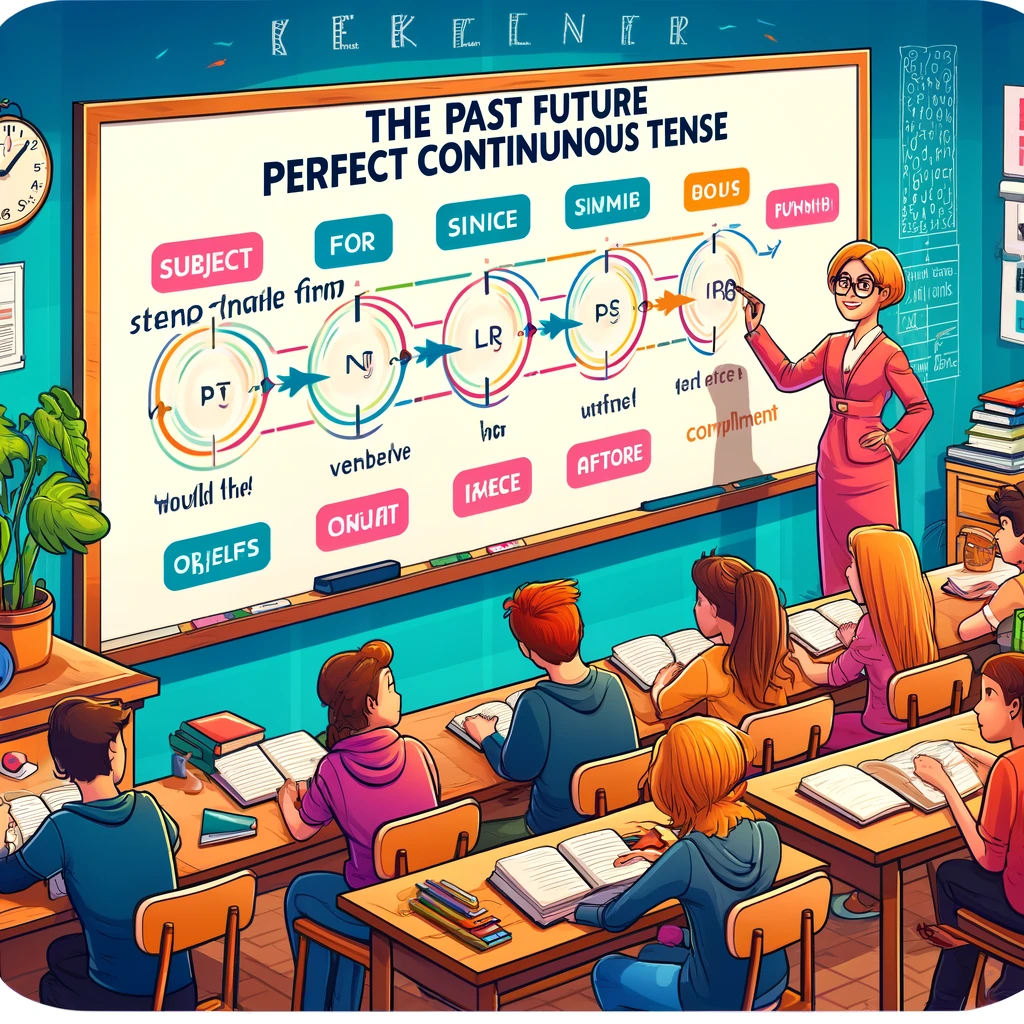
  • Mastering The Past Future Perfect Continuous Tense: Rules, Examples, and Practice Questions

    Mastering The Past Future Perfect Continuous Tense: Rules, Examples, and Practice Questions

    Mastering The Past Future Perfect Continuous Tense: Rules, Examples, and Practice Questions

    Definition: The Past Future Perfect Continuous Tense is used to describe actions that would have been ongoing for a certain period of time in the past, as viewed from another point in the past. It is often used to show the duration of an action up to a specific moment in the past.

    Uses:

    1. Hypothetical Situations in the Past

    This tense is used to talk about hypothetical or imagined actions that would have been happening over time in the past.

    Examples:

    • She would have been studying for five hours by the time her friends arrived. (This sentence indicates a continuous action that was supposed to happen over a certain period in the past.)
      • By the end of the year, he would have been working at the company for a decade. (Imagines a long-term action in the past that did not happen.)
      • They would have been traveling for six months by now if they hadn’t cancelled their trip. (Describes a hypothetical ongoing action that didn’t take place.)
    1. Conditional Statements

    It is also used in conditional sentences to indicate a continuous action that would have been occurring under certain conditions.

    Examples:

    • If it had not rained, we would have been playing soccer for hours. (This shows an ongoing action that did not happen because of a past condition.)
      • Had she attended the meeting, she would have been presenting her project. (An ongoing action that would have happened under a different condition.)
      • If they had saved more money, they would have been living in their new house by now. (A continuous action that would have occurred if a condition had been met.)
    1. Reported Speech

    When reporting what someone said in the past about an ongoing action that would have continued up to a later point in the past.

    Examples:

    • He said that by next month, they would have been living here for a year. (This reports what someone said about a future continuous action from their past viewpoint.)
      • She mentioned that by the time the project was completed, they would have been working on it for over a year. (Reported speech indicating a future continuous action from a past perspective.)
      • They told us that by the end of the semester, the students would have been studying the topic for several months. (Reporting a statement about a future continuous action from the past.)

    Pattern:

    The grammatical pattern for the Past Future Perfect Continuous Tense includes different forms: affirmative, negative, and interrogative.

    1. Affirmative Form:
      • Formula: Subject + would have been + verb (base form) + ing + object/complement
      • Example: “She would have been working on the project for hours.”
    2. Negative Form:
      • Formula: Subject + would not have been + verb (base form) + ing + object/complement
      • Example: “She would not have been working on the project for hours.”
    3. Interrogative Form:
      • Formula: Would + subject + have been + verb (base form) + ing + object/complement?
      • Example: “Would she have been working on the project for hours?”

    Time Signals:

    Common time signals used with the Past Future Perfect Continuous Tense include:

    • For
    • Since
    • By the time
    • Before
    • After

    Common Mistakes and How to Avoid Them:

    1. Using the Wrong Auxiliary Verb:
      • Mistake: “She will have been studying for hours by then.”
      • Correction: “She would have been studying for hours by then.”
      • Tip: Remember that the Past Future Perfect Continuous Tense uses “would have been,” not “will have been.”
    2. Incorrect Verb Form:
      • Mistake: “They would have been work for hours.”
      • Correction: “They would have been working for hours.”
      • Tip: Always use the base form of the verb + “ing.”
    3. Confusing with Other Tenses:
      • Mistake: “She would have studied for hours.”
      • Correction: “She would have been studying for hours.”
      • Tip: Ensure the action is continuous and ongoing, which requires the continuous form (verb + ing).

    Conclusion: The Past Future Perfect Continuous Tense is a useful structure for discussing hypothetical, conditional, and reported actions that would have been ongoing over time in the past. By understanding its uses, pattern, and common mistakes, learners can effectively incorporate this tense into their writing and speaking.

    Quiz:

    Test your understanding of The Past Future Perfect Continuous with this 10-question multiple-choice quiz. Choose the correct answer for each question.

    1. Analyze the use of the Past Future Perfect Continuous Tense in the following sentence and choose the correct explanation: "If he had taken the job offer, he would have been managing the new project by now."

    2. Compare the Past Future Perfect Continuous Tense with the Past Perfect Continuous Tense and choose the correct example for each:

    3. Evaluate the following sentence for correct tense usage and choose the correct justification: "She said that by the time we arrived, they would have been preparing dinner for two hours."

    4. Choose the sentence that correctly uses the Past Future Perfect Continuous Tense in a short story context:

    5. Interpret the underlying implication of using the Past Future Perfect Continuous Tense in this sentence and choose the correct answer: "By the end of the day, they would have been negotiating for six hours without a break."

    6. Choose the dialogue that correctly uses the Past Future Perfect Continuous Tense to express a regret:

    7. Propose a scenario where the Past Future Perfect Continuous Tense would be the best choice to convey the intended meaning and choose the correct sentence:

    8. He thought that by the time they returned, they _______ (to explore) the city for days.

    9. If I had known, I _______ (to travel) with you all week.

    10. If she had joined us, she _______ (to work) with us for months.

  • Mastering The Past Future Continuous Tense: Rules, Examples, and Practice Questions

    Mastering The Past Future Continuous Tense: Rules, Examples, and Practice Questions

    Mastering The Past Future Continuous Tense: Rules, Examples, and Practice Questions

    Definition

    The Past Future Continuous Tense is used to express an action that would be happening at a certain point in the future, from the perspective of a past time. It indicates that an action was expected to be in progress at a specific time in the future.

    Uses

    1.   Predicting Actions

    The Past Future Continuous Tense is often used to predict actions that would be happening at a future time from a past perspective.

    Examples:

    • I knew she would be studying at 10 PM. (This sentence means that at some point in the past, it was predicted or expected that she would be studying at 10 PM.)
    • He thought they would be traveling to New York by this time next week. (This indicates that from a past viewpoint, it was expected they would be in the process of traveling to New York.)
    • She expected the children would be playing in the garden. (This suggests that from her past perspective, it was predicted that the children would be playing in the garden.)

    2.   Indicating Planned Actions

    This tense can also indicate planned actions or events that were supposed to occur in the future from a past viewpoint.

    Examples:

    • He said they would be meeting the clients at 3 PM. (This implies that there was a plan to meet the clients at 3 PM, seen from a past point in time.)
    • She mentioned that she would be attending the conference the next day. (This indicates that from a past perspective, attending the conference was a planned future action.)
    • They told us they would be launching the product next month. (This means that the product launch was planned to occur next month, viewed from a past point in time.)

    3.   Describing Interrupted Actions

    It can describe an action that would be in progress in the future but gets interrupted.

    Examples:

    • They hoped we would be playing when they arrived. (This suggests that the playing would be interrupted by their arrival.)
    • She thought he would be cooking dinner when she got home. (This implies that the action of cooking dinner would be in progress but interrupted by her arrival.)
    • He imagined they would be discussing the project when he joined the meeting. (This means the discussion would be ongoing but interrupted by his joining the meeting.)

    Pattern

    The grammatical patterns for the Past Future Continuous Tense are:

    Positive Form

    Pattern: Subject + would be + verb-ing

    Example:

    • I would be working at that time.

    Negative Form

    Pattern: Subject + would not be + verb-ing

    Example:

    • I would not be working at that time.

    Interrogative Form

    Pattern: Would + subject + be + verb-ing?

    Example:

    • Would I be working at that time?

    Time Signals

    Common time signals used with the Past Future Continuous Tense include:

    • At that time
    • At this time tomorrow
    • By then
    • In the future from now
    • When he/she/they arrived

    Common Mistakes and How to Avoid Them

    Mistake 1: Misplacing “would”

    • Incorrect: “I would working be at that time.”
    • Correct: “I would be working at that time.”

    Tip: Always place “would” before “be.”

    Mistake 2: Forgetting the “ing” form

    • Incorrect: “She would be travel to New York.”
    • Correct: “She would be traveling to New York.”

    Tip: Use the “-ing” form of the verb after “be.”

    Mistake 3: Confusing Past Future Continuous with Past Continuous

    • Incorrect: “He was be working when they called.”
    • Correct: “He would be working when they called.”

    Tip: Remember that Past Continuous uses “was/were” while Past Future Continuous uses “would be.”

    Conclusion

    The Past Future Continuous Tense is essential for discussing actions that were expected to be in progress at a future time from a past viewpoint. By understanding its uses, patterns, and common mistakes, learners can effectively use this tense to enhance their English communication skills.

    Quiz

    Test your understanding of The Past Future Perfect Continuous with this 10-question multiple-choice quiz. Choose the correct answer for each question.

    1. Analyze the use of the Past Future Perfect Continuous Tense in the following sentence and choose the correct explanation: "If he had taken the job offer, he would have been managing the new project by now."

    2. Compare the Past Future Perfect Continuous Tense with the Past Perfect Continuous Tense and choose the correct example for each:

    3. Evaluate the following sentence for correct tense usage and choose the correct justification: "She said that by the time we arrived, they would have been preparing dinner for two hours."

    4. Choose the sentence that correctly uses the Past Future Perfect Continuous Tense in a short story context:

    5. Interpret the underlying implication of using the Past Future Perfect Continuous Tense in this sentence and choose the correct answer: "By the end of the day, they would have been negotiating for six hours without a break."

    6. Choose the dialogue that correctly uses the Past Future Perfect Continuous Tense to express a regret:

    7. Propose a scenario where the Past Future Perfect Continuous Tense would be the best choice to convey the intended meaning and choose the correct sentence:

    8. He thought that by the time they returned, they _______ (to explore) the city for days.

    9. If I had known, I _______ (to travel) with you all week.

    10. If she had joined us, she _______ (to work) with us for months.

  • Mastering the Present Perfect Tense: Rules, Examples, and Practice Questions

    Mastering the Present Perfect Tense: Rules, Examples, and Practice Questions

    Definition

    The Present Perfect Tense is used to describe actions that have occurred at an unspecified time before now. The exact time is not important. This tense is also used to describe actions that began in the past and continue to the present.

    Uses

    1. Actions That Occurred at an Unspecified Time in the Past
      The Present Perfect Tense is used to express actions that happened at some point in the past, but the exact time is not mentioned.
      Examples:
      -I have visited Paris. (The speaker has visited Paris at some time in the past, but the specific time is not mentioned.)
      -They have read the book. (The action of reading the book happened at some point in the past, without specifying when.)
      -She has gone to the store. (She went to the store at an unspecified time in the past.)
    2. Actions That Started in the Past and Continue to the Present
      This tense is used to describe actions that began in the past and are still happening now or have an effect on the present moment.
      Examples:
      -She has lived here for ten years. (She started living here ten years ago and still lives here.)
      -We have known each other since childhood. (The relationship began in childhood and continues to the present.)
      -He has worked at this company since 2015. (He started working at the company in 2015 and still works there.)
    3. Completed Actions with Relevance to the Present
      The Present Perfect Tense is also used to describe past actions that have a connection to the present moment.
      Examples:
      -He has finished his homework. (He completed his homework at some point in the past, and now the homework is done.)
      -I have cleaned the house. (The house was cleaned at some point in the past, and it is now clean.)
      -They have made dinner. (Dinner was prepared at some point in the past, and it is now ready to be eaten.)

    Pattern

    The grammatical pattern of the Present Perfect Tense is as follows:

    • Affirmative: Subject + has/have + past participle
      • Example: “She has eaten.”
    • Negative: Subject + has/have + not + past participle
      • Example: “They have not seen.”
    • Interrogative: Has/Have + subject + past participle?
      • Example: “Have you been?”

    Time Signals

    Common time signals used with the Present Perfect Tense include:

    • Ever
    • Never
    • Already
    • Yet
    • Just
    • Recently
    • So far
    • Until now
    • For
    • Since

    Common Mistakes and How to Avoid Them

    1. Using the Simple Past Instead of Present Perfect
      • Mistake: “I visited Paris last year.”
      • Correction: “I have visited Paris.”
      • Tip: Use the Present Perfect when the time is not specified or is not important.
    2. Forgetting to Use ‘Has’ or ‘Have’
      • Mistake: “She eaten her lunch.”
      • Correction: “She has eaten her lunch.”
      • Tip: Always include ‘has’ or ‘have’ before the past participle.
    3. Confusing ‘For’ and ‘Since’
      • Mistake: “I have lived here since ten years.”
      • Correction: “I have lived here for ten years.”
      • Tip: Use ‘for’ to indicate the duration of time and ‘since’ to indicate the starting point.

    Conclusion

    The Present Perfect Tense is a versatile and essential part of English grammar. It is used to describe actions without specifying the exact time, actions that continue to the present, and completed actions with relevance to now. Remember the pattern, time signals, and common mistakes to master the Present Perfect Tense.

    Quiz

    Test your understanding of the Present Perfect Tense with this 10-question multiple-choice quiz. Choose the correct answer for each question.

    1. Which sentence is in the Present Perfect Tense?

    2. Choose the correct form: "She ___ (to be) to the new restaurant."

    3. Which time signal is commonly used with the Present Perfect Tense?

    4. Fill in the blank: "They ___ (to finish) their project."

    5. Identify the error: "I has visited London."

    6. Which sentence is correct?

    7. Choose the correct form: "We ___ (to not see) that film."

    8. Which sentence uses ‘since’ correctly?

    9. Fill in the blank: "___ you ever ___ (to try) sushi?"

    10. Identify the error: "They has just arrived."