Tag: Grammar quiz

  • Mastering The Future Perfect Tense: Rules, Examples, and Practice Questions

    Mastering The Future Perfect Tense: Rules, Examples, and Practice Questions

    Mastering The Future Perfect Tense: Rules, Examples, and Practice Questions

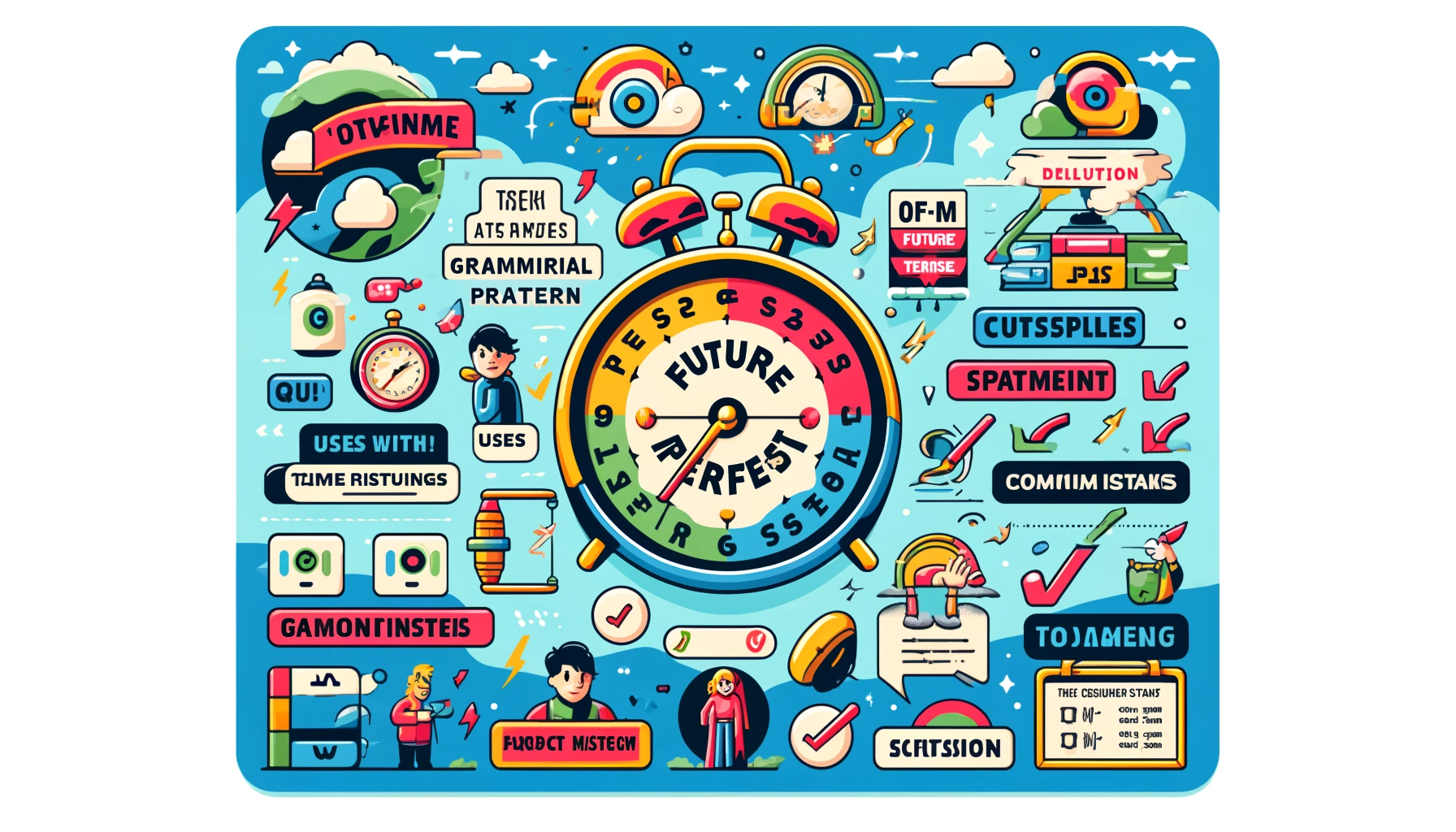
    The Future Perfect Tense is a grammatical tense used to describe actions that will be completed at a specific point in the future. Understanding this tense can enhance your ability to communicate future events with clarity and precision.

    Definition

    The Future Perfect Tense is used to express actions that will be finished before a certain time or event in the future. It emphasizes the completion of an activity rather than its duration or occurrence.

    Uses

    1. Indicating Completion Before a Future Time

    Examples:

    • By next year, she will have completed her degree. (This sentence indicates that her degree will be finished before next year.)
    • By 10 PM, I will have finished my homework. (This indicates that homework will be done before 10 PM.)
    • By the time you arrive, we will have eaten dinner. (This shows that dinner will be eaten before your arrival.)
    1. Predicting Results of Future Actions

    Examples:

    • He will have saved enough money to buy a car by the end of the month. (This predicts that his savings will be sufficient for a car purchase by month’s end.)
    • They will have learned all the necessary skills by the time they graduate. (This predicts that all necessary skills will be acquired before graduation.)
    • The project will have reached completion before the deadline. (This predicts that the project will be completed before the deadline.)
    1. Expressing Expectations

    Examples:

    • They will have arrived home before the storm hits. (This sentence expresses the expectation that they will be home before the storm.)
    • By tomorrow morning, she will have slept for eight hours. (This expects that she will complete eight hours of sleep by tomorrow morning.)
    • We will have finished the preparations by the time the guests arrive. (This expects that all preparations will be done before the guests’ arrival.)

    Pattern

    The grammatical pattern of the Future Perfect Tense is: Subject + will have + past participle

    Examples:

    • I will have finished the project.
    • They will have gone to bed.

    Time Signals

    Common time signals used with the Future Perfect Tense include:

    • By tomorrow
    • By next week/month/year
    • Before
    • By the time
    • In [time period] (e.g., in two hours)

    Common Mistakes and How to Avoid Them

    1. Using the Wrong Auxiliary Verb
      • Mistake: She will has completed the task.
      • Correction: She will have completed the task.
      • Tip: Always use “will have” followed by the past participle.
    2. Confusing with Future Simple Tense
      • Mistake: By 5 PM, he will finish his work.
      • Correction: By 5 PM, he will have finished his work.
      • Tip: Remember that the Future Perfect Tense emphasizes the completion of an action by a certain future time.
    3. Forgetting the Past Participle Form
      • Mistake: They will have go to the party.
      • Correction: They will have gone to the party.
      • Tip: Use the past participle form of the verb, not the base or present form.

    Conclusion

    The Future Perfect Tense is a useful tool for indicating that an action will be completed before a certain time in the future. By mastering its use, you can describe future events more precisely and avoid common grammatical errors.

    Test your understanding of the Future Perfect Tense with this 10-question multiple-choice quiz. Choose the correct answer for each question.

    1. By this time next year, I ___ my book.

    2. She ___ the report before the meeting starts.

    3. They ___ the construction by next month.

    4. By 8 PM, he ___ dinner.

    5. You ___ all the chapters by the time of the exam.

    6. The team ___ the project before the deadline.

    7. By the time he arrives, we ___.

    8. She ___ her homework before her friends arrive.

    9. By the end of the year, we ___ 100 products.

    10. He ___ the test by 3 PM.

  • Mastering the Past Continuous Tense: Rules, Examples, and Practice Questions

    Mastering the Past Continuous Tense: Rules, Examples, and Practice Questions

    Definition

    The Past Continuous Tense describes actions or events that were ongoing at a particular moment in the past. It emphasizes the duration of the action, indicating that it was happening at a specific point in time or during a specific period in the past.

    Uses

    1. Describing actions in progress at a specific moment in the past:

    Examples:

    • At 8 PM last night, I was reading a book. (This sentence indicates that the action of reading was happening at 8 PM last night.)
    • She was cooking dinner when the phone rang. (This sentence shows that the action of cooking dinner was in progress when another action (the phone ringing) occurred.
    • They were watching a movie at 10 AM yesterday. (This sentence highlights that the action of watching a movie was ongoing at a specific time in the past (10 AM yesterday).
    1. Setting the scene in a story:

    Examples:

    • The sun was setting, and the birds were singing. (This sentence uses the Past Continuous Tense to describe the background actions that were happening simultaneously in the past.)
      • It was raining, and people were hurrying to find shelter. (This sentence sets the scene by describing the ongoing actions during the rain.)
      • The children were playing in the park while their parents were chatting on the benches. (This sentence provides a vivid picture of the ongoing activities in the park.)
    1. Indicating interrupted actions:

    Examples:

    • I was sleeping when the alarm went off. (This sentence shows that the action of sleeping was interrupted by the alarm going off.)
    • He was writing an email when the computer crashed. (This sentence highlights that the action of writing an email was interrupted by the computer crashing.)
    • They were walking to the store when it started to rain. (This sentence indicates that the action of walking to the store was interrupted by the rain starting.)

    Pattern

    The grammatical pattern of the Past Continuous Tense is as follows:

    Subject + was/were + present participle (verb+ing)

    Positive Form

    Pattern: Subject + was/were + present participle (verb+ing)

    • Example: “She was reading a book.”
    • Explanation: The sentence indicates that the action of reading was ongoing in the past.

    Negative Form

    Pattern: Subject + was/were + not + present participle (verb+ing)

    • Example: “She was not reading a book.”
    • Explanation: The sentence indicates that the action of reading was not happening in the past.

    Interrogative Form

    Pattern: Was/Were + subject + present participle (verb+ing)?

    • Example: “Was she reading a book?”
    • Explanation: The sentence is a question asking if the action of reading was happening in the past.

    Time Signals

    Common time signals used with the Past Continuous Tense include:

    • While
    • When
    • At that moment
    • At (specific time)
    • During

    Common Mistakes and How to Avoid Them

    1. Using the wrong auxiliary verb:
      • Mistake: She were working.
      • Correction: She was working.
      • Tip: Remember to use “was” for singular subjects (he, she, it) and “were” for plural subjects (I, you, we, they).
    2. Mixing Past Continuous with Simple Past:
      • Mistake: I was worked all night.
      • Correction: I was working all night.
      • Tip: Use the present participle form of the verb (verb+ing) with the Past Continuous Tense.
    3. Confusing time signals:
      • Mistake: He was sleeping at that time.
      • Correction: He was sleeping when the bell rang.
      • Tip: Use appropriate time signals to indicate the specific time or period during which the action was happening.

    Conclusion

    The Past Continuous Tense is crucial for describing ongoing actions in the past, setting scenes in stories, and indicating interrupted actions. Understanding its uses, pattern, and common mistakes helps learners use this tense effectively. By mastering the Past Continuous Tense, learners can effectively describe ongoing actions in the past, set vivid scenes in stories, and indicate actions that were interrupted. This knowledge leads to more fluent and accurate communication in English.

    Quiz

    Test your understanding of the Past Continuous Tense with this 10-question multiple-choice quiz. Choose the correct answer for each question.

    1. Which sentence is in the Past Continuous Tense?

    2. Identify the correct use of the Past Continuous Tense:

    3. Choose the correct sentence:

    4. What is the correct form of the verb in this sentence? "She ___ (work) here last night."

    5. Which time signal is commonly used with the Past Continuous Tense?

    6. Choose the correct form: "We ___ (study) at 8 PM yesterday."

    7. Which sentence correctly uses the Past Continuous Tense to describe an interrupted action?

    8. Which sentence emphasizes the duration of the activity?

    9. Select the correct option: "I ___ (live) in this city last year."

    10. Which of the following sentences sets the scene for a story using the Past Continuous Tense?