
Tag: Learn English

  • Greetings in English: A Comprehensive Guide

    Greetings in English: A Comprehensive Guide

    Greetings in English: A Comprehensive Guide

    Greetings are an essential part of any language, and English is no exception. They serve as the first point of contact in conversations and can set the tone for interactions. In this article, we will explore the various types of greetings in English, provide examples, and demonstrate how to use them in daily conversations through dialogues.
    Types of Greetings in English

    1. Formal Greetings
    2. Informal Greetings
    3. Time-Specific Greetings
    4. Seasonal and Holiday Greetings
    Formal Greetings

    Formal greetings are used in professional settings or when addressing someone with respect. They are typically used with people you do not know well, such as colleagues, business partners, or elders.

    • Good morning: Used from sunrise until noon.
    • Good afternoon: Used from noon until around 6 PM.
    • Good evening: Used after 6 PM until bedtime.
    • Hello: A neutral, formal greeting suitable for any time of day.
    • How do you do?: A very formal greeting used when meeting someone for the first time.

    Example:

    • “How do you do, Mr. Smith?”
    Informal Greetings

    Informal greetings are used among friends, family, or peers. They are more relaxed and casual.

    • Hi
    • Hey
    • What’s up?
    • How’s it going?
    • How are you?

    Example:

    • “Hey, Sarah! What’s up?”
    Time-Specific Greetings

    These greetings are used at specific times of the day.

    • Good night: Used when parting ways at night or going to bed.
    • Good day: A formal way to greet someone during the daytime, not commonly used in modern English but still understood.

    Example:

    • “Good night, everyone. See you tomorrow.”
    Seasonal and Holiday Greetings

    These greetings are used during specific seasons or holidays to spread cheer and good wishes.

    • Merry Christmas
    • Happy New Year
    • Happy Holidays
    • Happy Easter

    Example:

    • “Happy Holidays, everyone!”

    Using Greetings in Daily Life

    To understand how these greetings are used in daily conversations, let’s look at some dialogues.

    Dialogue 1: Formal Setting

    John: How do you do, Dr. Adams?

    Dr. Adams: How do you do, John?

    John: Pleased to meet you.

    Dialogue 2: Informal Setting

    Anna: Hey, Tom! How’s it going?

    Tom: Hi, Anna! It’s going well, thanks. How about you?

    Anna: I’m good, just busy with work.

    Dialogue 3: Time-Specific Greeting

    Emily: Good night, everyone. See you tomorrow!

    Group: Good night, Emily!

    Dialogue 4: Seasonal Greeting

    Mike: Happy Holidays, Emma!

    Emma: Happy Holidays, Mike! Hope you have a great holiday.

    By understanding and practicing these greetings, you can improve your English communication skills and make a positive impression in various social and professional settings.

  • The Difference Between Simple Past Tense and Present Perfect Tense

    The Difference Between Simple Past Tense and Present Perfect Tense

    Question: What is the Difference Between  Simple Past Tense and Present Perfect Tense?

    Answer:

    Introduction

    English grammar can sometimes be confusing, especially when it comes to understanding the differences between various tenses. Among the most commonly misunderstood tenses are the Simple Past Tense and the Present Perfect Tense. This article aims to clarify the distinctions between these two tenses, providing clear definitions, examples, and illustrations to help learners grasp their proper usage.

    Definition of  Simple Past Tense

    The Simple Past Tense is used to describe actions that were completed at a specific time in the past. It is often accompanied by time expressions like yesterday, last week, in 2010, etc.

    Examples:

    • She visited Paris last summer.
    • They watched a movie yesterday.
    • He finished his homework two hours ago.

    Definition of Present Perfect Tense

    The Present Perfect Tense is used to describe actions that occurred at an unspecified time in the past and are relevant to the present. This tense often uses time expressions like ever, never, already, yet, just, and since/for.

    Examples:

    • She has visited Paris several times.
    • They have watched that movie already.
    • He has finished his homework.

    Key Differences Between Simple Past Tense and Present Perfect Tense

    1. Time Specificity:
      • Simple Past Tense: Refers to actions completed at a specific time in the past.
        • Example: She visited Paris last summer.
      • Present Perfect Tense: Refers to actions that happened at an unspecified time and have relevance to the present.
        • Example: She has visited Paris several times.
    2. Usage of Time Expressions:
      • Simple Past Tense: Uses definite time expressions (yesterday, last week, in 2010).
        • Example: They watched a movie yesterday.
      • Present Perfect Tense: Uses indefinite time expressions (ever, never, already, yet).
        • Example: They have watched that movie already.
    3. Focus on Experience vs. Completed Action:
      • Simple Past Tense: Focuses on the completion of the action.
        • Example: He finished his homework two hours ago.
      • Present Perfect Tense: Focuses on the experience or the result of the action.
        • Example: He has finished his homework.

    Common Mistakes and How to Avoid Them

    1. Mixing Up Time Expressions:
      • Mistake: I have visited Paris last summer.
      • Correction: I visited Paris last summer.
    2. Using Present Perfect Tense with Specific Times:
      • Mistake: He has finished his homework two hours ago.
      • Correction: He finished his homework two hours ago.
    3. Ignoring the Relevance to the Present:
      • Mistake: They watched that movie already.
      • Correction: They have watched that movie already.

    Conclusion

    Understanding the difference between the Simple Past Tense and the Present Perfect Tense is crucial for mastering English grammar. Remember, the Simple Past Tense is used for actions completed at a specific time in the past, while the Present Perfect Tense is used for actions that have relevance to the present without specifying the exact time. Practice using these tenses correctly to improve your fluency and accuracy in English.

  • Study At vs. Study In: Understanding the Difference

    Study At vs. Study In: Understanding the Difference

    Question: What is the Difference Between Study At and Study In?

    Answer:

    When learning English, prepositions can be tricky, especially when it comes to phrases like “study at” and “study in.” Both phrases are used frequently, but they have different meanings and contexts. Let’s break down the differences between “study at” and “study in” to help you use them correctly.

    1. Study At

    Usage:

    • “Study at” is typically used to refer to the specific institution where someone is studying.
    • It emphasizes the place of study rather than the broader location.

    Examples:

    • “She studies at Harvard University.”
    • “I am studying at a local community college.”
    • “He studied at Oxford for his undergraduate degree.”

    In these sentences, the focus is on the particular school or university where the studying is taking place.

    2. Study In

    Usage:

    • “Study in” is used to talk about the country, city, or region where the studying is happening.
    • It emphasizes the geographical location rather than the specific institution.

    Examples:

    • “She studies in the United States.”
    • “I am studying in London.”
    • “He studied in Germany for a semester.”

    Here, the emphasis is on the broader area where the study is taking place, rather than on a specific school or university.

    Key Points to Remember

    • Use “study at” when referring to a specific institution (e.g., school, college, university).
    • Use “study in” when referring to a geographical location (e.g., country, city, region).

    Examples for Clarity

    1. Study At:
      • Correct: “She wants to study at MIT.”
      • Incorrect: “She wants to study in MIT.”
    2. Study In:
      • Correct: “He is studying in France.”
      • Incorrect: “He is studying at France.”

    Understanding the difference between “study at” and “study in” will help you use these phrases more accurately and effectively in your writing and speaking.

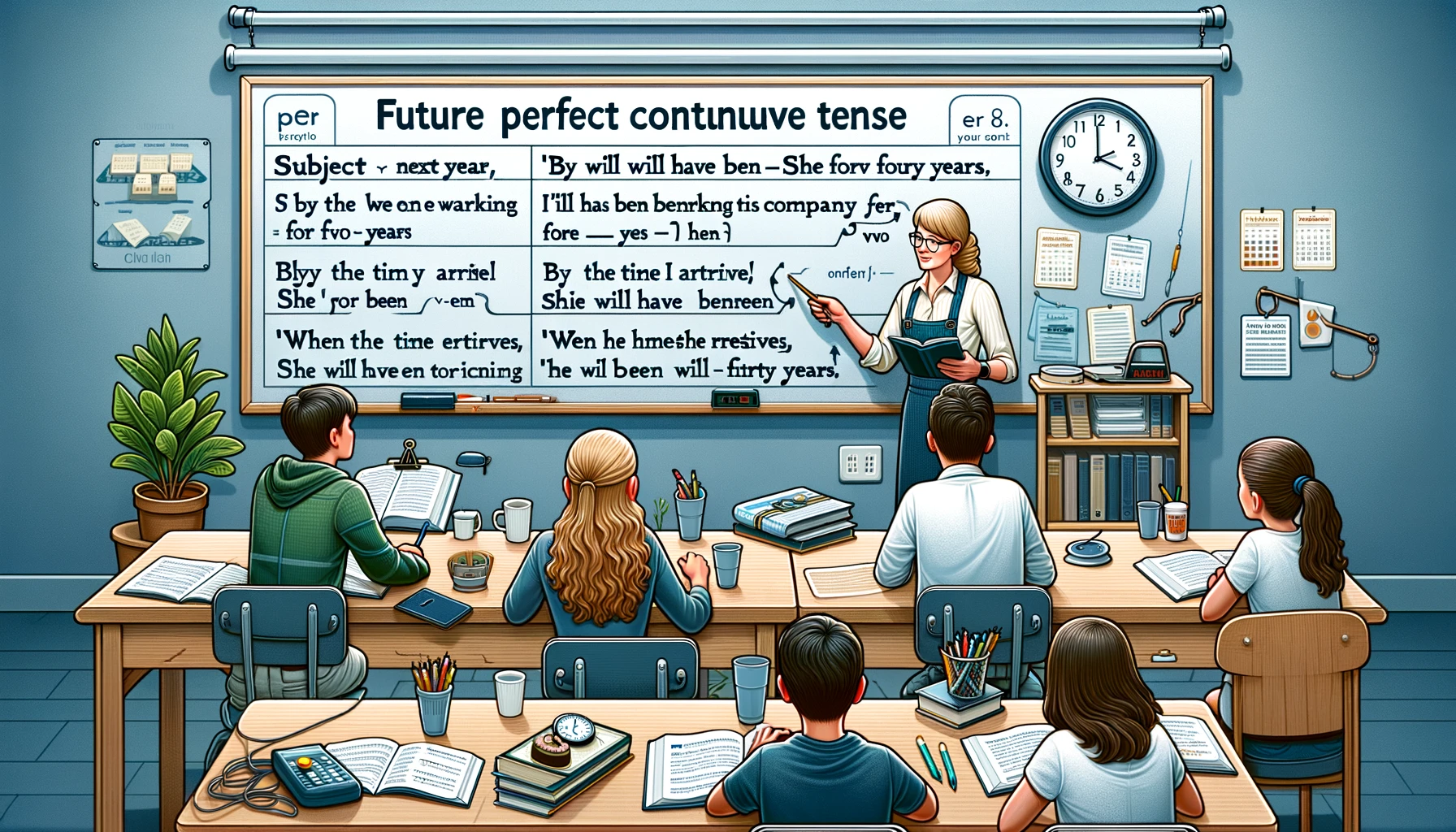
  • Mastering The Future Perfect Continuous Tense: Rules, Examples, and Practice Questions

    Mastering The Future Perfect Continuous Tense: Rules, Examples, and Practice Questions

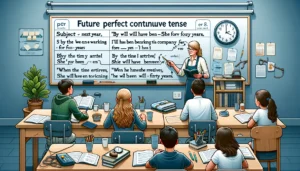
    The Future Perfect Continuous Tense

    The Future Perfect Continuous Tense is an advanced aspect of English grammar that combines elements of the future, perfect, and continuous tenses. It is used to describe actions that will have been ongoing for a period of time up to a specific point in the future.

    Definition

    The Future Perfect Continuous Tense describes actions that will continue up until a specific future moment. This tense emphasizes the duration of an activity that will be ongoing and completed at a certain future time.

    Uses

    The Future Perfect Continuous Tense is used in various contexts, including:

    1. Describing the Duration of an Action Up to a Future Point

    This tense highlights how long an action will have been happening by a specific future time.

    Examples:

    • By next year, I will have been working at this company for five years. (The action of working will have continued for five years by next year.)
    • By the time you arrive, she will have been cooking for two hours. (The action of cooking will have been ongoing for two hours by the time you arrive.)
    • When he retires, he will have been teaching for thirty years. (The action of teaching will have lasted for thirty years by the time he retires.)
    1. Expressing Planned Future Actions with Emphasis on Duration

    This tense is used to describe planned activities that focus on the duration up to a future point.

    Examples:

    • By December, they will have been traveling for six months. (The action of traveling will have been ongoing for six months by December.)
    • At the end of this course, you will have been learning English for a year. (The learning process will have continued for a year by the end of the course.)
    • By tomorrow evening, we will have been driving for ten hours. (The action of driving will have been in progress for ten hours by tomorrow evening.)
    1. Predicting Ongoing Actions Up to a Future Point

    It can be used to predict the duration of ongoing actions up to a specific time in the future.

    Examples:

    • When you see me next, I will have been studying for my exams. (The speaker predicts that the action of studying will have been ongoing.)
    • By the time he finishes, he will have been writing the report for a week. (The action of writing the report will have been in progress for a week.)
    • At the end of the day, she will have been waiting for four hours. (The action of waiting will have continued for four hours by the end of the day.)

    Pattern

    The grammatical pattern of the Future Perfect Continuous Tense involves the following structure:

    Subject + will have been + present participle (verb+ing)

    For example:

    • Affirmative: “I will have been studying for three hours.”
    • Negative: “She will not have been working here for long.”
    • Interrogative: “Will they have been traveling for a year?”

    Time Signals

    Common time signals used with the Future Perfect Continuous Tense include:

    • By [future time]
    • By the time
    • For [duration]
    • When

    Common Mistakes and How to Avoid Them

    Learners often make mistakes with the Future Perfect Continuous Tense. Here are some common errors and tips to avoid them:

    1. Incorrect Verb Form
      • Mistake: “I will have be studying.”
      • Correction: Use “been” correctly: “I will have been studying.”
      • Tip: Remember to use “been” after “will have” and before the present participle.
    2. Misplacing Time Signals
      • Mistake: “I will have been for two hours studying.”
      • Correction: Correctly place the time signal: “I will have been studying for two hours.”
      • Tip: Place time signals after the present participle for clarity.
    3. Confusing with Other Future Tenses
      • Mistake: “I will be studying for two hours.”
      • Correction: Use the correct tense for duration: “I will have been studying for two hours.”
      • Tip: Ensure the tense matches the emphasis on the duration up to a future point.

    Conclusion

    The Future Perfect Continuous Tense is a valuable tool for describing actions that will have been ongoing up to a specific point in the future. By understanding its structure, uses, and common time signals, learners can effectively communicate the duration of future activities. Avoiding common mistakes ensures clarity and precision in usage.

    Quiz

    Test your understanding of the Future Perfect Continuous Tense with this 10-question multiple-choice quiz. Choose the correct answer for each question.

    1. Which sentence correctly uses the Future Perfect Continuous Tense?

    2. Identify the correct use of Future Perfect Continuous Tense for a planned event:

    3. Which of these is not a time signal for the Future Perfect Continuous Tense?

    4. By next summer, they __________ (live) in this city for ten years.

    5. Which sentence correctly predicts an ongoing action up to a future point?

    6. What is the correct form to express a future action’s duration?

    7. Choose the sentence with the correct time signal:

    8. By the time he retires, how long will he have been teaching?

    9. Which sentence correctly uses the Future Perfect Continuous Tense?

    10. Identify the error: "By next week, they will have been finish the project."

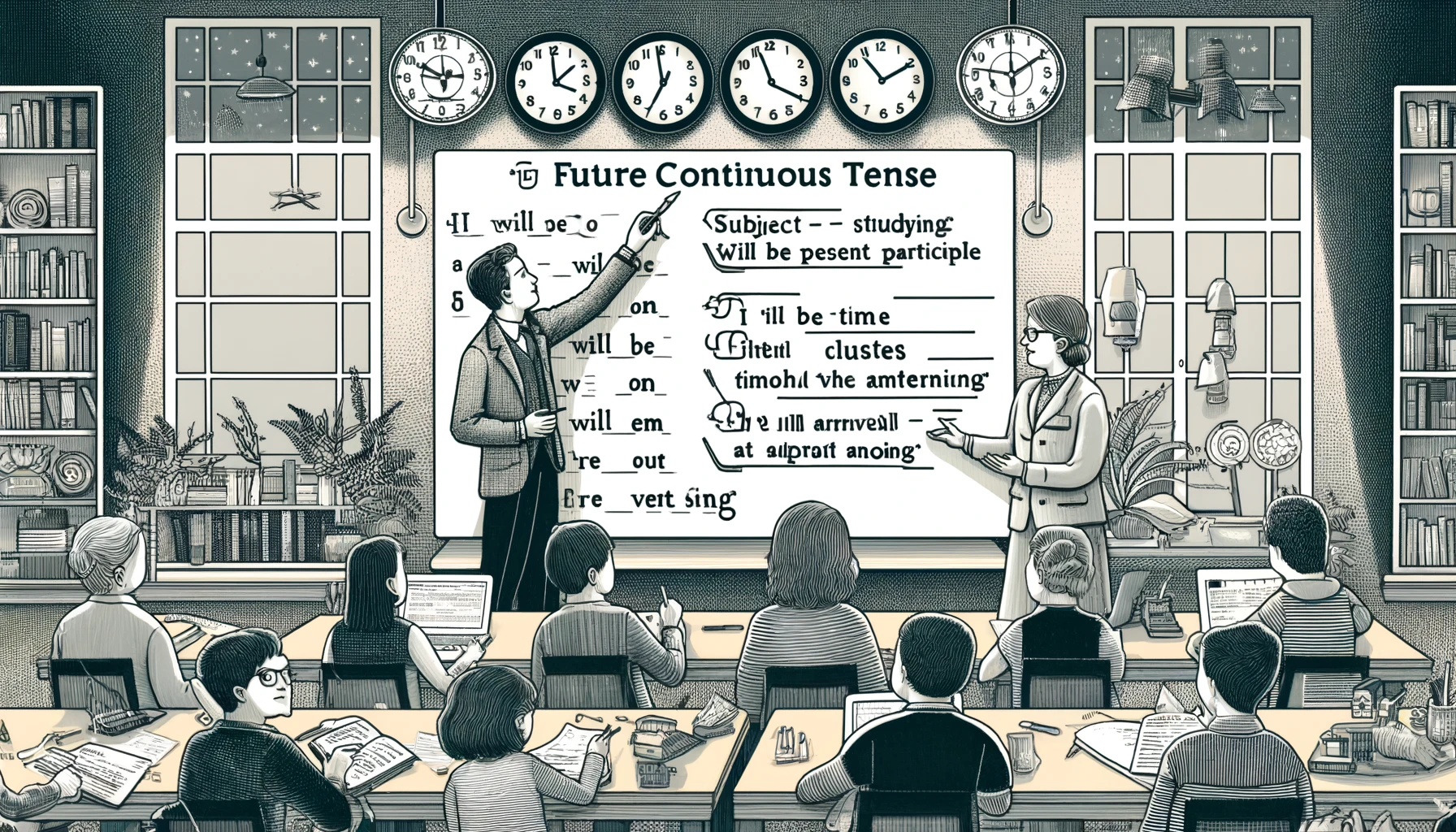
  • Mastering The Future Continuous Tense: Rules, Examples, and Practice Questions

    Mastering The Future Continuous Tense: Rules, Examples, and Practice Questions

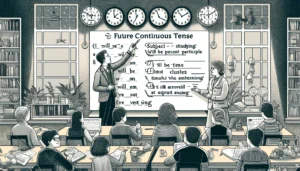
    The Future Continuous Tense

    The Future Continuous Tense is an essential aspect of English grammar that allows speakers to describe actions that will be ongoing at a specific point in the future. This tense is particularly useful for expressing future activities that are planned or expected to occur over a duration of time.

    Definition

    The Future Continuous Tense describes actions that will be happening at a particular moment in the future. It emphasizes the duration or continuity of an activity that will be in progress at a future time.

    Uses

    The Future Continuous Tense is used in various contexts, including:

    1. Actions in Progress at a Specific Future Time

     This tense indicates that an action will be ongoing at a particular future moment.

    Examples:

    • This time next week, I will be traveling to Japan. (The action of traveling will be happening at a specific future time.)
    • At 10 PM tonight, she will be working on her project. (The action of working will be happening at 10 PM.)
    • By tomorrow morning, they will be flying to New York. (The action of flying will be ongoing tomorrow morning.)
    1. Planned Future Activities

    It expresses activities that are already planned or arranged to happen in the future.

    Examples:

    • She will be meeting with the clients tomorrow afternoon. (The meeting is a scheduled activity that will take place in the future.)
    • We will be attending the conference next week. (Attending the conference is a planned activity for next week.)
    • He will be hosting a dinner party on Friday. (Hosting the dinner party is a pre-arranged event for Friday.)
    1. Predicting the Present

    Sometimes, it is used to speculate about what is currently happening, based on future knowledge.

    Examples:

    • They will be arriving at the airport right now. (Based on future plans, the speaker predicts the current activity.)
    • She will be having lunch at this moment. (The speaker assumes that she is currently having lunch based on her usual schedule.)
    • He will be studying for his exams now. (The speaker predicts that he is studying at the present moment, considering his upcoming exams.)

    Pattern

    The grammatical pattern of the Future Continuous Tense involves the following structure:

    Subject + will be + present participle (verb+ing)

    For example:

    • Affirmative: “I will be studying at 8 PM.”
    • Negative: “She will not be coming to the party.”
    • Interrogative: “Will they be joining us for dinner?”

    Time Signals

    Common time signals used with the Future Continuous Tense include:

    • At this time next week
    • Tomorrow at [specific time]
    • In the future
    • Next [day/week/month/year]

    Common Mistakes and How to Avoid Them

    Learners often make mistakes with the Future Continuous Tense. Here are some common errors and tips to avoid them:

    1. Incorrect Auxiliary Verb Usage
      • Mistake: “I am will be studying.”
      • Correction: Use “will be” correctly: “I will be studying.”
      • Tip: Remember that “will” is always followed by “be” and then the present participle.
    2. Misplacing Time Signals
      • Mistake: “I will be at this time next week studying.”
      • Correction: Correctly place the time signal: “At this time next week, I will be studying.”
      • Tip: Place time signals at the beginning or end of the sentence for clarity.
    3. Forgetting the Present Participle Form
      • Mistake: “She will be to cook dinner.”
      • Correction: Use the present participle form: “She will be cooking dinner.”
      • Tip: Always use the -ing form of the verb after “will be.”

    Conclusion

    The Future Continuous Tense is a versatile and useful tense for describing actions that will be ongoing at a specific future time, planned future activities, and speculating about the present based on future knowledge. By understanding its structure, uses, and common time signals, learners can effectively use this tense to communicate their future plans and predictions. Avoiding common mistakes ensures clarity and accuracy in usage.

    Test your understanding of the Future Continuous Tense with this 10-question multiple-choice quiz. Choose the correct answer for each question.

    1. Which sentence correctly uses the Future Continuous Tense?

    2. Choose the sentence with the correct time signal:

    3. Identify the correct use of Future Continuous Tense for a scheduled event:

    4. Choose the sentence that predicts a current action:

    5. Which of these is not a time signal for the Future Continuous Tense?

    6. Correct the mistake: "She will be sings in the choir."

    7. Which of the following sentences correctly uses the Future Continuous Tense to indicate an action in progress at a specific future time?

    8. How do you express a planned future activity using the Future Continuous Tense?

    9. Which sentence is predicting a current action based on future knowledge?

    10. Choose the sentence that correctly uses the Future Continuous Tense for a planned activity:

  • Mastering the Past Continuous Tense: Rules, Examples, and Practice Questions

    Mastering the Past Continuous Tense: Rules, Examples, and Practice Questions

    Definition

    The Past Continuous Tense describes actions or events that were ongoing at a particular moment in the past. It emphasizes the duration of the action, indicating that it was happening at a specific point in time or during a specific period in the past.

    Uses

    1. Describing actions in progress at a specific moment in the past:

    Examples:

    • At 8 PM last night, I was reading a book. (This sentence indicates that the action of reading was happening at 8 PM last night.)
    • She was cooking dinner when the phone rang. (This sentence shows that the action of cooking dinner was in progress when another action (the phone ringing) occurred.
    • They were watching a movie at 10 AM yesterday. (This sentence highlights that the action of watching a movie was ongoing at a specific time in the past (10 AM yesterday).
    1. Setting the scene in a story:

    Examples:

    • The sun was setting, and the birds were singing. (This sentence uses the Past Continuous Tense to describe the background actions that were happening simultaneously in the past.)
      • It was raining, and people were hurrying to find shelter. (This sentence sets the scene by describing the ongoing actions during the rain.)
      • The children were playing in the park while their parents were chatting on the benches. (This sentence provides a vivid picture of the ongoing activities in the park.)
    1. Indicating interrupted actions:

    Examples:

    • I was sleeping when the alarm went off. (This sentence shows that the action of sleeping was interrupted by the alarm going off.)
    • He was writing an email when the computer crashed. (This sentence highlights that the action of writing an email was interrupted by the computer crashing.)
    • They were walking to the store when it started to rain. (This sentence indicates that the action of walking to the store was interrupted by the rain starting.)

    Pattern

    The grammatical pattern of the Past Continuous Tense is as follows:

    Subject + was/were + present participle (verb+ing)

    Positive Form

    Pattern: Subject + was/were + present participle (verb+ing)

    • Example: “She was reading a book.”
    • Explanation: The sentence indicates that the action of reading was ongoing in the past.

    Negative Form

    Pattern: Subject + was/were + not + present participle (verb+ing)

    • Example: “She was not reading a book.”
    • Explanation: The sentence indicates that the action of reading was not happening in the past.

    Interrogative Form

    Pattern: Was/Were + subject + present participle (verb+ing)?

    • Example: “Was she reading a book?”
    • Explanation: The sentence is a question asking if the action of reading was happening in the past.

    Time Signals

    Common time signals used with the Past Continuous Tense include:

    • While
    • When
    • At that moment
    • At (specific time)
    • During

    Common Mistakes and How to Avoid Them

    1. Using the wrong auxiliary verb:
      • Mistake: She were working.
      • Correction: She was working.
      • Tip: Remember to use “was” for singular subjects (he, she, it) and “were” for plural subjects (I, you, we, they).
    2. Mixing Past Continuous with Simple Past:
      • Mistake: I was worked all night.
      • Correction: I was working all night.
      • Tip: Use the present participle form of the verb (verb+ing) with the Past Continuous Tense.
    3. Confusing time signals:
      • Mistake: He was sleeping at that time.
      • Correction: He was sleeping when the bell rang.
      • Tip: Use appropriate time signals to indicate the specific time or period during which the action was happening.

    Conclusion

    The Past Continuous Tense is crucial for describing ongoing actions in the past, setting scenes in stories, and indicating interrupted actions. Understanding its uses, pattern, and common mistakes helps learners use this tense effectively. By mastering the Past Continuous Tense, learners can effectively describe ongoing actions in the past, set vivid scenes in stories, and indicate actions that were interrupted. This knowledge leads to more fluent and accurate communication in English.

    Quiz

    Test your understanding of the Past Continuous Tense with this 10-question multiple-choice quiz. Choose the correct answer for each question.

    1. Which sentence is in the Past Continuous Tense?

    2. Identify the correct use of the Past Continuous Tense:

    3. Choose the correct sentence:

    4. What is the correct form of the verb in this sentence? "She ___ (work) here last night."

    5. Which time signal is commonly used with the Past Continuous Tense?

    6. Choose the correct form: "We ___ (study) at 8 PM yesterday."

    7. Which sentence correctly uses the Past Continuous Tense to describe an interrupted action?

    8. Which sentence emphasizes the duration of the activity?

    9. Select the correct option: "I ___ (live) in this city last year."

    10. Which of the following sentences sets the scene for a story using the Past Continuous Tense?

  • Mastering the Present Perfect Continuous Tense: Rules, Examples, and Practice Questions

    Mastering the Present Perfect Continuous Tense: Rules, Examples, and Practice Questions

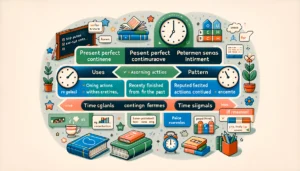
    Definition

    The Present Perfect Continuous Tense, also known as the Present Perfect Progressive Tense, is used to describe actions that started in the past and are still continuing or have recently stopped but have a connection to the present. This tense emphasizes the duration of an action or the continuity of an activity over a period of time.

    Uses

    1. To express an action that started in the past and is still continuing:

    Examples:

    • She has been studying for three hours. (This sentence indicates that the studying began three hours ago and is still happening at the moment of speaking.)
    • We have been living in this city since 2010. (This shows that the action of living in the city started in 2010 and continues up to the present.)
    • He has been working at the same company for five years. (This implies that he started working at the company five years ago and is still employed there.)
    1. To indicate a recently finished action that has a result in the present:

    Examples:

    • They have been working on the project, and now it’s nearly complete. (The action of working on the project has recently finished, and the result is that the project is almost done.)
    • I have been cooking all afternoon, and the meal is finally ready. (The cooking just finished, and the result is that the meal is now ready to be eaten.)
    • She has been cleaning the house, so it looks spotless now. (The action of cleaning was recently completed, resulting in a spotless house.)
    1. To show repeated actions that started in the past and are still continuing:

    Examples:

    • He has been visiting his grandmother every weekend. (This sentence tells us that the visits started in the past and are still happening regularly.)
    • They have been meeting for coffee every morning for years. (This indicates that the action of meeting for coffee started years ago and continues to this day.)
    • She has been attending yoga classes every week since January. (This shows that the action of attending yoga classes began in January and continues regularly.)

    By understanding these uses and examples, learners can effectively apply the Present Perfect Continuous Tense to express ongoing actions, recently completed actions with present relevance, and repeated actions continuing from the past.

    Pattern

    The grammatical pattern of the Present Perfect Continuous Tense is: Subject + has/have + been + verb (present participle)

    Positive Form

    • Pattern: Subject + has/have + been + verb (present participle)
    • Example: “I have been studying Mandarin Chinese for three hours.”

    Negative Form

    • Pattern: Subject + has/have + not + been + verb (present participle)
    • Example: “I have not been studying English for three hours.”

    Interrogative Form

    • Pattern: Has/Have + subject + been + verb (present participle)?
    • Example: “Have you been studying Japanese for three hours?”

    Time Signals

    Common time signals used with the Present Perfect Continuous Tense include:

    • For (a period of time): for two hours, for a month
    • Since (a point in time): since Monday, since 2010
    • Lately, Recently

    Common Mistakes and How to Avoid Them

    1. Using the wrong auxiliary verb:
      • Mistake: “She have been reading.”
      • Correction: “She has been reading.”
      • Tip: Remember to use “has” with third-person singular subjects (he, she, it) and “have” with all other subjects (I, you, we, they).
    2. Omitting ‘been’:
      • Mistake: “They have working all day.”
      • Correction: “They have been working all day.”
      • Tip: Always include “been” after “has/have” in this tense.
    3. Confusing Present Perfect with Present Perfect Continuous:
      • Mistake: “I have read for three hours.”
      • Correction: “I have been reading for three hours.”
      • Tip: Use the Present Perfect Continuous to emphasize the duration or continuity of the action.

    Conclusion

    The Present Perfect Continuous Tense is a versatile tense used to describe actions that started in the past and are still ongoing or have recently stopped with present relevance. By understanding its uses, patterns, and common mistakes, learners can effectively communicate actions with a sense of duration and continuity.

    Quiz

    Test your understanding of the Present Perfect Continuous Tense with this 10-question multiple-choice quiz. Choose the correct answer for each question.

    1. How long ____ you been studying English?

    2. She ____ been living in New York since 2015.

    3. They ____ been working on this project for months.

    4. I ____ been feeling well lately.

    5. He ____ been playing the guitar since he was a child.

    6. We ____ been watching this show for hours.

    7. She ____ been going to the gym regularly.

    8. You ____ been working hard recently.

    9. It ____ been raining all day.

    10. I ____ been trying to reach you.

  • Mastering the Present Perfect Tense: Rules, Examples, and Practice Questions

    Mastering the Present Perfect Tense: Rules, Examples, and Practice Questions

    Definition

    The Present Perfect Tense is used to describe actions that have occurred at an unspecified time before now. The exact time is not important. This tense is also used to describe actions that began in the past and continue to the present.

    Uses

    1. Actions That Occurred at an Unspecified Time in the Past
      The Present Perfect Tense is used to express actions that happened at some point in the past, but the exact time is not mentioned.
      Examples:
      -I have visited Paris. (The speaker has visited Paris at some time in the past, but the specific time is not mentioned.)
      -They have read the book. (The action of reading the book happened at some point in the past, without specifying when.)
      -She has gone to the store. (She went to the store at an unspecified time in the past.)
    2. Actions That Started in the Past and Continue to the Present
      This tense is used to describe actions that began in the past and are still happening now or have an effect on the present moment.
      Examples:
      -She has lived here for ten years. (She started living here ten years ago and still lives here.)
      -We have known each other since childhood. (The relationship began in childhood and continues to the present.)
      -He has worked at this company since 2015. (He started working at the company in 2015 and still works there.)
    3. Completed Actions with Relevance to the Present
      The Present Perfect Tense is also used to describe past actions that have a connection to the present moment.
      Examples:
      -He has finished his homework. (He completed his homework at some point in the past, and now the homework is done.)
      -I have cleaned the house. (The house was cleaned at some point in the past, and it is now clean.)
      -They have made dinner. (Dinner was prepared at some point in the past, and it is now ready to be eaten.)

    Pattern

    The grammatical pattern of the Present Perfect Tense is as follows:

    • Affirmative: Subject + has/have + past participle
      • Example: “She has eaten.”
    • Negative: Subject + has/have + not + past participle
      • Example: “They have not seen.”
    • Interrogative: Has/Have + subject + past participle?
      • Example: “Have you been?”

    Time Signals

    Common time signals used with the Present Perfect Tense include:

    • Ever
    • Never
    • Already
    • Yet
    • Just
    • Recently
    • So far
    • Until now
    • For
    • Since

    Common Mistakes and How to Avoid Them

    1. Using the Simple Past Instead of Present Perfect
      • Mistake: “I visited Paris last year.”
      • Correction: “I have visited Paris.”
      • Tip: Use the Present Perfect when the time is not specified or is not important.
    2. Forgetting to Use ‘Has’ or ‘Have’
      • Mistake: “She eaten her lunch.”
      • Correction: “She has eaten her lunch.”
      • Tip: Always include ‘has’ or ‘have’ before the past participle.
    3. Confusing ‘For’ and ‘Since’
      • Mistake: “I have lived here since ten years.”
      • Correction: “I have lived here for ten years.”
      • Tip: Use ‘for’ to indicate the duration of time and ‘since’ to indicate the starting point.

    Conclusion

    The Present Perfect Tense is a versatile and essential part of English grammar. It is used to describe actions without specifying the exact time, actions that continue to the present, and completed actions with relevance to now. Remember the pattern, time signals, and common mistakes to master the Present Perfect Tense.

    Quiz

    Test your understanding of the Present Perfect Tense with this 10-question multiple-choice quiz. Choose the correct answer for each question.

    1. Which sentence is in the Present Perfect Tense?

    2. Choose the correct form: "She ___ (to be) to the new restaurant."

    3. Which time signal is commonly used with the Present Perfect Tense?

    4. Fill in the blank: "They ___ (to finish) their project."

    5. Identify the error: "I has visited London."

    6. Which sentence is correct?

    7. Choose the correct form: "We ___ (to not see) that film."

    8. Which sentence uses ‘since’ correctly?

    9. Fill in the blank: "___ you ever ___ (to try) sushi?"

    10. Identify the error: "They has just arrived."

  • Mastering the Simple Present Tense: Rules, Examples, and Practice Questions

    Mastering the Simple Present Tense: Rules, Examples, and Practice Questions

    Understanding the Simple Present Tense

    The simple present tense is one of the most commonly used tenses in English. It describes habits, general truths, unchanging situations, emotions, and fixed arrangements. Understanding how to properly use the simple present tense is essential for mastering the English language.

    Uses of Simple Present Tense

    1. Habits and Routines
      Examples:
      -She drinks coffee every morning. (This sentence describes a habitual action that she performs regularly every morning.)
      -They play tennis every weekend. (This indicates a routine activity that happens every weekend.)
      -I read the newspaper daily. (This shows a regular habit of reading the newspaper each day.)
    2. General Truths and Facts
      Examples:
      -The sun rises in the east. (This is a general truth that does not change over time.)
      -Water boils at 100 degrees Celsius. (This is a scientific fact that remains constant.)
      -Cats meow. (This describes a general truth about the behavior of cats.)
    3. Unchanging Situations
      Examples:
      -He lives in New York. (This describes a situation that is not expected to change.)
      -She works at a bank. (This indicates a stable employment situation.)
      -The store opens at 9 AM. (This describes a fixed opening time that does not change.)

    Structure of Simple Present Tense

    The simple present tense is formed using the base form of the verb for most subjects (I, you, we, they). For the third person singular (he, she, it), an ‘s’ or ‘es’ is added to the base form of the verb.

    • Affirmative Sentences:
      • I/You/We/They play football.
      • He/She/It plays football.
    • Negative Sentences:
      • I/You/We/They do not (don’t) play football.
      • He/She/It does not (doesn’t) play football.
    • Interrogative Sentences:
      • Do I/you/we/they play football?
      • Does he/she/it play football?

    Spelling Rules for Adding ‘s’ or ‘es’

    1. For most verbs, simply add ‘s’:
      • run → runs
      • eat → eats
    2. For verbs ending in ‘s’, ‘ss’, ‘sh’, ‘ch’, ‘x’, or ‘z’, add ‘es’:
      • kiss → kisses
      • wash → washes
    3. For verbs ending in a consonant + ‘y’, change ‘y’ to ‘i’ and add ‘es’:
      • try → tries
      • study → studies
    4. For verbs ending in a vowel + ‘y’, simply add ‘s’:
      • play → plays
      • enjoy → enjoys

    Common Mistakes and How to Avoid Them

    1. Forgetting to add ‘s’ or ‘es’ in the third person singular:
      • Incorrect: He go to school.
      • Correct: He goes to school.
    2. Using the base form instead of ‘does’ for questions in third person singular:
      • Incorrect: Does she likes apples?
      • Correct: Does she like apples?
    3. Neglecting the auxiliary ‘do/does’ in negative sentences:
      • Incorrect: She not like coffee.
      • Correct: She does not like coffee.

    Quiz

    Test your understanding of the Simple Present Tense with this 10-question multiple-choice quiz. Choose the correct answer for each question.

    1. She _____ every morning.

    2. The sun _____ in the west.

    3. They usually _____ to the gym on Fridays.

    4. He _____ to New York every summer.

    5. _____ she like chocolate?

    6. Water _____ at 100 degrees Celsius.

    7. We don’t _____ to the park on Sundays.

    8. The dog always _____ loudly at night.

    9. She _____ her homework every day.

    10. My brother _____ football very well.