Tag: learning English

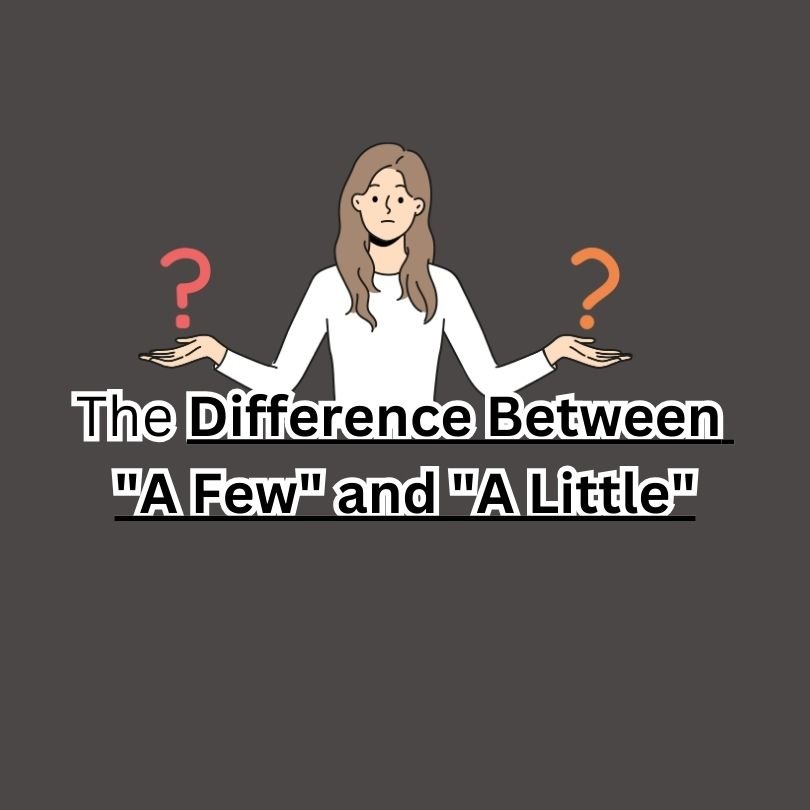
  • What is the Difference Between “A Few” and “A Little”?

    What is the Difference Between “A Few” and “A Little”?

    Question: What is the Difference Between “A Few” and “A Little”?

    Answer:

    Understanding the difference between “a few” and “a little” is essential for mastering English grammar. Both phrases are used to indicate a small quantity, but they are applied differently based on whether the noun they describe is countable or uncountable. In this article, we will explain the usage of “a few” and “a little” in a simple and detailed manner, provide examples, and demonstrate their use in daily conversations through dialogues.

    What Are Countable and Uncountable Nouns?

    Before diving into the difference between “a few” and “a little,” it’s important to understand the concepts of countable and uncountable nouns.

    • Countable nouns are items that can be counted individually. They have both singular and plural forms (e.g., “apple” and “apples”).
    • Uncountable nouns are items that cannot be counted individually. They do not have a plural form (e.g., “water,” “sand”).

    A Few

    “A few” is used with countable nouns to indicate a small number of items.

    Examples:

    • I have a few friends in New York.
    • She bought a few apples at the market.
    • We need a few chairs for the event.

    In these sentences, “a few” refers to a small number of individual items that can be counted.

    A Little

    “A little” is used with uncountable nouns to indicate a small amount of something.

    Examples:

    • There is a little milk left in the fridge.
    • He needs a little water to drink.
    • She added a little sugar to her coffee.

    In these sentences, “a little” refers to a small quantity of something that cannot be counted individually.

    Using “A Few” and “A Little” in Daily Life

    To better understand how “a few” and “a little” are used in daily conversations, let’s look at some dialogues.

    Dialogue 1: Using “A Few”

    Emily: Do you have any plans for the weekend?

    John: Yes, I have a few things to do. I need to buy a few groceries and meet a few friends.

    Emily: Sounds like a busy weekend!

    Dialogue 2: Using “A Little”

    Sarah: Can I have some water, please?

    Tom: Sure, there’s a little water left in the bottle. Help yourself.

    Sarah: Thank you!

    Key Points to Remember

    • Use “a few” with countable nouns (e.g., “a few books,” “a few cars”).
    • Use “a little” with uncountable nouns (e.g., “a little time,” “a little rice”).

    By remembering these simple rules, you can use “a few” and “a little” correctly in your conversations and writing.

    Meta Description

    Learn the difference between “a few” and “a little” with easy-to-understand explanations, examples, and dialogues. Master the use of countable and uncountable nouns in English grammar. Enhance your English skills with practical tips and phrases.

    By understanding and practicing the use of “a few” and “a little,” you can improve your English communication skills and make your speech and writing more accurate and effective.

  • Will vs. Going to: Understanding Future Intentions and Plans

    Will vs. Going to: Understanding Future Intentions and Plans

    Question: What is the difference between Will and Going to?

    Answer:

    Introduction

    When learning English, one of the common areas of confusion is knowing when to use “will” and “going to” for expressing future intentions and plans. While both are used to talk about the future, they are used in different contexts and have distinct meanings. This article will help you understand the differences between “will” and “going to” and provide practical examples to use them correctly.

    Understanding “Will”

    “Will” is a modal verb that is used to express:

    1. Spontaneous Decisions: Decisions made at the moment of speaking.
      • Example: “I’m thirsty. I think I will get a glass of water.”
    2. Predictions: Predictions about the future that are based on opinions or experiences.
      • Example: “I think it will rain tomorrow.”
    3. Promises: Making promises or offers.
      • Example: “I will help you with your homework.”
    4. Offers: Offering help or services.
      • Example: “I will carry your bag for you.”

    Understanding “Going to”

    “Going to” is used to express:

    1. Plans or Intentions: Plans that were decided before the moment of speaking.
      • Example: “I am going to visit my grandparents next weekend.”
    2. Predictions with Evidence: Predictions about the future that are based on current evidence.
      • Example: “Look at those dark clouds. It is going to rain.”

    Key Differences

    1. Decision Time: “Will” is used for decisions made at the moment of speaking, while “going to” is used for decisions made before the moment of speaking.
      • Example:
        • Will: “I will call him now.”
        • Going to: “I am going to call him after dinner.”
    2. Predictions: “Will” is often used for general predictions, while “going to” is used for predictions based on evidence.
      • Example:
        • Will: “You will get better soon.”
        • Going to: “You are going to get better. The doctor said so.”
    3. Plans and Intentions: “Going to” is used for plans or intentions.
      • Example: “She is going to start a new job next month.”

    Practical Exercises

    1. Fill-in-the-Blanks
      • I ____ (will/going to) travel to Japan next summer. (Answer: am going to)
      • It looks like it ____ (will/going to) snow soon. (Answer: is going to)
      • I think they ____ (will/going to) win the match. (Answer: will)
      • She ____ (will/going to) call you when she arrives. (Answer: will)
    2. Correct the Sentences
      • I think I’m going to get a taxi. (Correct: I think I will get a taxi.)
      • Look at the sky. It will rain. (Correct: Look at the sky. It is going to rain.)
    3. Role-Play Activity
      • Pair up with a partner and create dialogues using “will” and “going to” appropriately. Discuss future plans, make spontaneous decisions, and predict the future.

    Conclusion

    Understanding the differences between “will” and “going to” is essential for expressing future plans and intentions correctly in English. Remember, “will” is used for spontaneous decisions, general predictions, promises, and offers, while “going to” is used for pre-decided plans and predictions with evidence. Practice using these forms in different contexts to become more comfortable and confident in your English communication.