Tag: Tense usage

  • Mastering The Past Future Perfect Tense: Rules, Examples, and Practice Questions

    Mastering The Past Future Perfect Tense: Rules, Examples, and Practice Questions

    Mastering The Past Future Perfect Tense: Rules, Examples, and Practice Questions

    The Past Future Perfect Tense: A Comprehensive Guide

    Definition

    The Past Future Perfect Tense is a verb form used to describe an action that would have been completed before a certain point in the past. It is used to indicate that an action was expected or intended to happen, but it was also anticipated to be completed before another action in the past.

    Uses

    1. To Express Actions That Would Have Been Completed in the Past

    This tense is used to talk about actions that were supposed to be finished before another past action or time.

    Examples:

    • By the time we arrived, they would have finished dinner. (The sentence means that at the time we arrived, the action of finishing dinner was expected to be already completed.)
    • She would have left by the time you got there. (This means she was expected to leave before you arrived.)
    • They would have completed the project by yesterday if they had started on time. (The project was expected to be finished by yesterday if they had started as planned.)
    1. To Describe Past Expectations

    It can be used to express an expectation or a prediction about what would have happened by a certain time in the past.

    Examples:

    • She would have graduated by last year if she hadn’t taken a gap year. (This indicates that graduation was expected to happen by last year if not for the gap year.)
    • They would have been here by now if they had caught the earlier train. (They were expected to be here by now, assuming they caught the earlier train.)
    • He would have finished his homework by now if he hadn’t gone out. (The homework was expected to be done by now if he hadn’t gone out.)
    1. To Indicate Regret or Assumptions About the Past

    This tense helps to express assumptions or regrets about actions that were expected to be completed in the past.

    Examples:

    • I thought you would have called me by now. (This implies that the speaker expected a call by now, suggesting an assumption or regret about the action not happening.)
    • We assumed they would have arrived by 8 PM. (The expectation was that they would have arrived by 8 PM, indicating an assumption about their arrival time.)
    • She would have apologized by now if she realized her mistake. (There is a regret or assumption that an apology would have happened if she recognized her error.)

    Pattern

    The grammatical pattern for the Past Future Perfect Tense is:

    1. Positive Form
      • Pattern: Subject + would have + past participle
      • Example: They would have completed the task by now.
    2. Negative Form
      • Pattern: Subject + would not have + past participle
      • Example: She would not have missed the bus if she had left earlier.
    3. Interrogative Form
      • Pattern: Would + subject + have + past participle?
      • Example: Would you have finished the report if you had more time?

    Time Signals

    Common time signals used with the Past Future Perfect Tense include:

    • By the time
    • Before
    • By then
    • By (a specific time)
    • Already

    Common Mistakes and How to Avoid Them

    1. Confusing with Other Tenses
      • Mistake: Using the Past Future Perfect Tense interchangeably with the Future Perfect or Past Perfect tenses.
      • Tip: Remember that the Past Future Perfect Tense specifically deals with actions that were expected to be completed before another action in the past, while the Future Perfect is about actions expected to be completed before a future point, and the Past Perfect deals with actions completed before another past action.
    2. Incorrect Use of “Would Have”
      • Mistake: Using “would have” in clauses where it is not needed.
      • Tip: Ensure that “would have” is only used in the main clause of the sentence when referring to an expected or intended action in the past.
    3. Omitting the Past Participle
      • Mistake: Forgetting to use the past participle form of the verb.
      • Tip: Always use the past participle (e.g., finished, called, seen) after “would have.”

    Conclusion

    The Past Future Perfect Tense is a valuable tool for discussing actions that were expected to be completed before a certain time in the past. Understanding its uses, pattern, and common mistakes can help you use it accurately in your writing and speech.

    Quiz

    Test your understanding of the Past Future Perfect with this 10-question multiple-choice quiz. Choose the correct answer for each question.

    1. By the time the guests arrived, we _______ (decorate) the entire hall.

    2. If he had known about the meeting, he _______ (prepare) a presentation by last week.

    3. She thought that by the end of the month, they _______ (complete) the construction.

    4. By the time you saw the movie, they _______ (release) the sequel.

    5. Had you asked for directions, we _______ (arrive) earlier.

    6. By last winter, the committee _______ (implement) the new policies.

    7. If they had followed the schedule, they _______ (launch) the product by now.

    8. He assumed that by the age of 30, he _______ (achieve) his career goals.

    9. By the time the train arrived, we _______ (wait) for over an hour.

    10. By the time the meeting started, I _______ (read) all the reports.

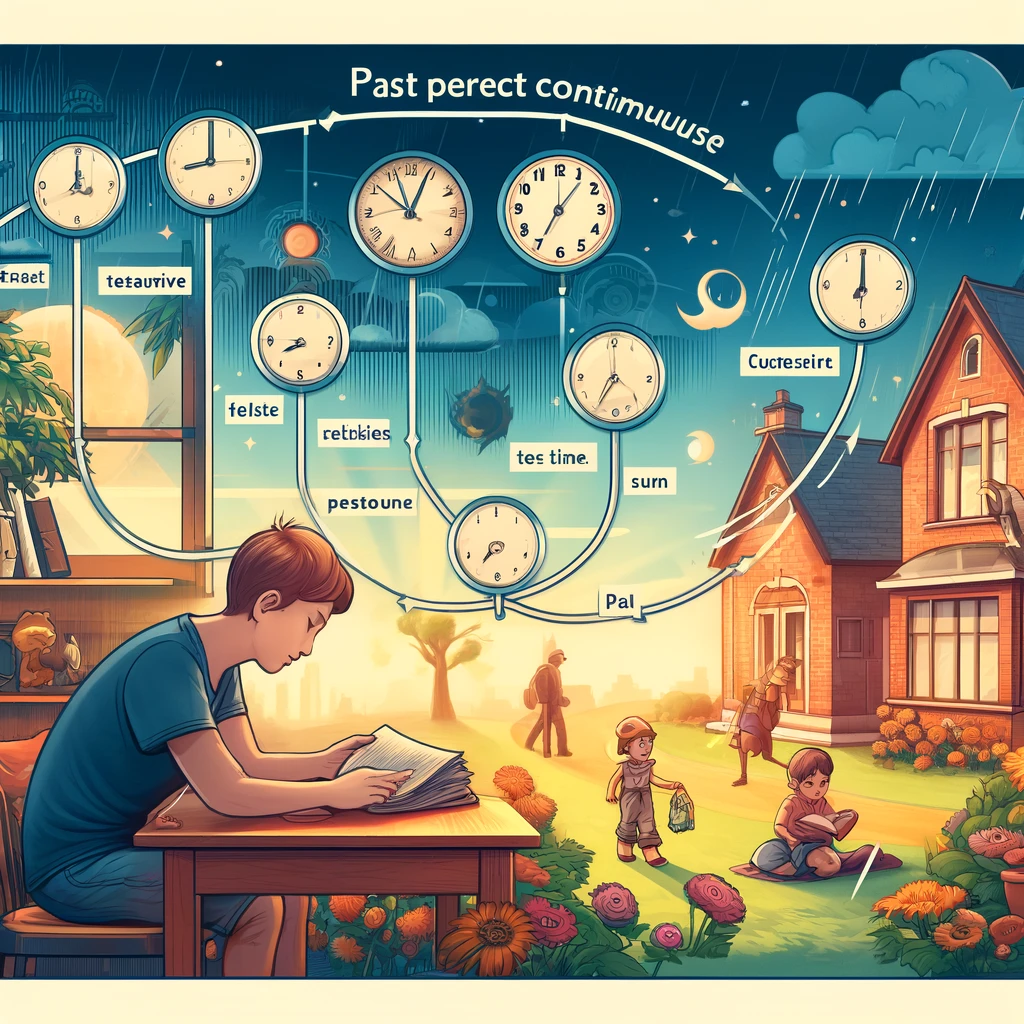
  • Mastering the Past Perfect Continuous Tense: Rules, Examples, and Practice Questions

    Mastering the Past Perfect Continuous Tense: Rules, Examples, and Practice Questions

    Definition

    The Past Perfect Continuous Tense, also known as the past perfect progressive, is used to describe an action that started in the past and continued up to another point in the past. It emphasizes the duration or continuity of an action that was happening before a specific time or another action in the past.

    Uses

    1. To show the duration of an action up to a certain point in the past.

    Examples:

    • They had been waiting for two hours by the time the bus finally came. (This sentence highlights the ongoing action of waiting that lasted for two hours until the bus arrived.)
    • She had been studying for three hours when her friends arrived. (The action of studying continued for three hours up to the point when her friends arrived.)
    • He had been working at the company for ten years before he decided to resign. (This indicates that the action of working at the company lasted for ten years until he made the decision to resign.)

    2. To describe an action that was in progress before another action occurred.

    Examples:

    • He had been working on the project before he fell ill. (This indicates that the work was ongoing and then interrupted by his illness.)
    • They had been planning the event for weeks before it was cancelled. (The planning was an ongoing process that was halted by the cancellation of the event.)
    • She had been cleaning the house when the guests arrived early. (The cleaning was an ongoing action that was interrupted by the early arrival of the guests.)

    3. To set the scene for another past event.

    Examples:

    • The children had been playing outside when it started to rain. (The ongoing action of playing outside sets the context for the sudden event of the rain starting.)
    • He had been reading a book when the phone rang. (The reading was an ongoing activity that was interrupted by the phone ringing.)
    • They had been discussing their plans when the news broke. (The ongoing discussion sets the scene for the interruption caused by breaking news.)

    Pattern

    The following are the grammatical pattern of the Past Perfect Continuous Tense:

    Affirmative: Subject + had + been + present participle (verb+ing)

    • She had been reading.
    • They had been talking.

    Negative: Subject + had + not + been + present participle (verb+ing)

    • She had not (hadn’t) been reading.
    • They had not (hadn’t) been talking.

    Interrogative: Had + subject + been + present participle (verb+ing)

    • Had she been reading?
    • Had they been talking?

    Time Signals

    Common time signals used with the Past Perfect Continuous Tense include:

    • For
    • Since
    • Before
    • By the time
    • Until
    • When

    Common Mistakes and How to Avoid Them

    1. Confusing with the Past Continuous Tense

    Mistake: “She was reading for two hours.” Correction: “She had been reading for two hours.” Tip: Remember, the Past Continuous is used for an action happening at a specific moment in the past, while the Past Perfect Continuous emphasizes the duration of an action up to a point in the past.

    2. Using the wrong auxiliary verb

    Mistake: “They was been playing.” Correction: “They had been playing.” Tip: Always use “had” as the auxiliary verb in the Past Perfect Continuous Tense, regardless of the subject.

    3. Omitting “been”

    Mistake: “He had studying all night.” Correction: “He had been studying all night.” Tip: The word “been” is essential in forming the Past Perfect Continuous Tense.

    Conclusion

    The Past Perfect Continuous Tense is a useful tense for expressing actions that were ongoing up until a specific point in the past. By understanding its definition, uses, pattern, and common time signals, learners can effectively incorporate this tense into their writing and speaking. Avoiding common mistakes will further enhance your proficiency in using the Past Perfect Continuous Tense.

    Quiz

    Test your understanding of the Past Perfect  Continuous Tense with this 10-question multiple-choice quiz. Choose the correct answer for each question.

    1. They ____ for an hour before the train arrived.

    2. She ____ the piano for years before she gave her first concert.

    3. By the time we got home, it ____ snowing for hours.

    4. He ____ to lose weight before his wedding.

    5. The students ____ for the exam until late at night.

    6. They ____ for hours before the manager finally arrived.

    7. I ____ to get tickets for the concert for weeks before they sold out.

    8. We ____ about the trip when he called.

    9. She ____ all afternoon before she took a break.

    10. They ____ for a new house before they found this one.

  • Mastering the Past Continuous Tense: Rules, Examples, and Practice Questions

    Mastering the Past Continuous Tense: Rules, Examples, and Practice Questions

    Definition

    The Past Continuous Tense describes actions or events that were ongoing at a particular moment in the past. It emphasizes the duration of the action, indicating that it was happening at a specific point in time or during a specific period in the past.

    Uses

    1. Describing actions in progress at a specific moment in the past:

    Examples:

    • At 8 PM last night, I was reading a book. (This sentence indicates that the action of reading was happening at 8 PM last night.)
    • She was cooking dinner when the phone rang. (This sentence shows that the action of cooking dinner was in progress when another action (the phone ringing) occurred.
    • They were watching a movie at 10 AM yesterday. (This sentence highlights that the action of watching a movie was ongoing at a specific time in the past (10 AM yesterday).
    1. Setting the scene in a story:

    Examples:

    • The sun was setting, and the birds were singing. (This sentence uses the Past Continuous Tense to describe the background actions that were happening simultaneously in the past.)
      • It was raining, and people were hurrying to find shelter. (This sentence sets the scene by describing the ongoing actions during the rain.)
      • The children were playing in the park while their parents were chatting on the benches. (This sentence provides a vivid picture of the ongoing activities in the park.)
    1. Indicating interrupted actions:

    Examples:

    • I was sleeping when the alarm went off. (This sentence shows that the action of sleeping was interrupted by the alarm going off.)
    • He was writing an email when the computer crashed. (This sentence highlights that the action of writing an email was interrupted by the computer crashing.)
    • They were walking to the store when it started to rain. (This sentence indicates that the action of walking to the store was interrupted by the rain starting.)

    Pattern

    The grammatical pattern of the Past Continuous Tense is as follows:

    Subject + was/were + present participle (verb+ing)

    Positive Form

    Pattern: Subject + was/were + present participle (verb+ing)

    • Example: “She was reading a book.”
    • Explanation: The sentence indicates that the action of reading was ongoing in the past.

    Negative Form

    Pattern: Subject + was/were + not + present participle (verb+ing)

    • Example: “She was not reading a book.”
    • Explanation: The sentence indicates that the action of reading was not happening in the past.

    Interrogative Form

    Pattern: Was/Were + subject + present participle (verb+ing)?

    • Example: “Was she reading a book?”
    • Explanation: The sentence is a question asking if the action of reading was happening in the past.

    Time Signals

    Common time signals used with the Past Continuous Tense include:

    • While
    • When
    • At that moment
    • At (specific time)
    • During

    Common Mistakes and How to Avoid Them

    1. Using the wrong auxiliary verb:
      • Mistake: She were working.
      • Correction: She was working.
      • Tip: Remember to use “was” for singular subjects (he, she, it) and “were” for plural subjects (I, you, we, they).
    2. Mixing Past Continuous with Simple Past:
      • Mistake: I was worked all night.
      • Correction: I was working all night.
      • Tip: Use the present participle form of the verb (verb+ing) with the Past Continuous Tense.
    3. Confusing time signals:
      • Mistake: He was sleeping at that time.
      • Correction: He was sleeping when the bell rang.
      • Tip: Use appropriate time signals to indicate the specific time or period during which the action was happening.

    Conclusion

    The Past Continuous Tense is crucial for describing ongoing actions in the past, setting scenes in stories, and indicating interrupted actions. Understanding its uses, pattern, and common mistakes helps learners use this tense effectively. By mastering the Past Continuous Tense, learners can effectively describe ongoing actions in the past, set vivid scenes in stories, and indicate actions that were interrupted. This knowledge leads to more fluent and accurate communication in English.

    Quiz

    Test your understanding of the Past Continuous Tense with this 10-question multiple-choice quiz. Choose the correct answer for each question.

    1. Which sentence is in the Past Continuous Tense?

    2. Identify the correct use of the Past Continuous Tense:

    3. Choose the correct sentence:

    4. What is the correct form of the verb in this sentence? "She ___ (work) here last night."

    5. Which time signal is commonly used with the Past Continuous Tense?

    6. Choose the correct form: "We ___ (study) at 8 PM yesterday."

    7. Which sentence correctly uses the Past Continuous Tense to describe an interrupted action?

    8. Which sentence emphasizes the duration of the activity?

    9. Select the correct option: "I ___ (live) in this city last year."

    10. Which of the following sentences sets the scene for a story using the Past Continuous Tense?