Tag: uncountable nouns

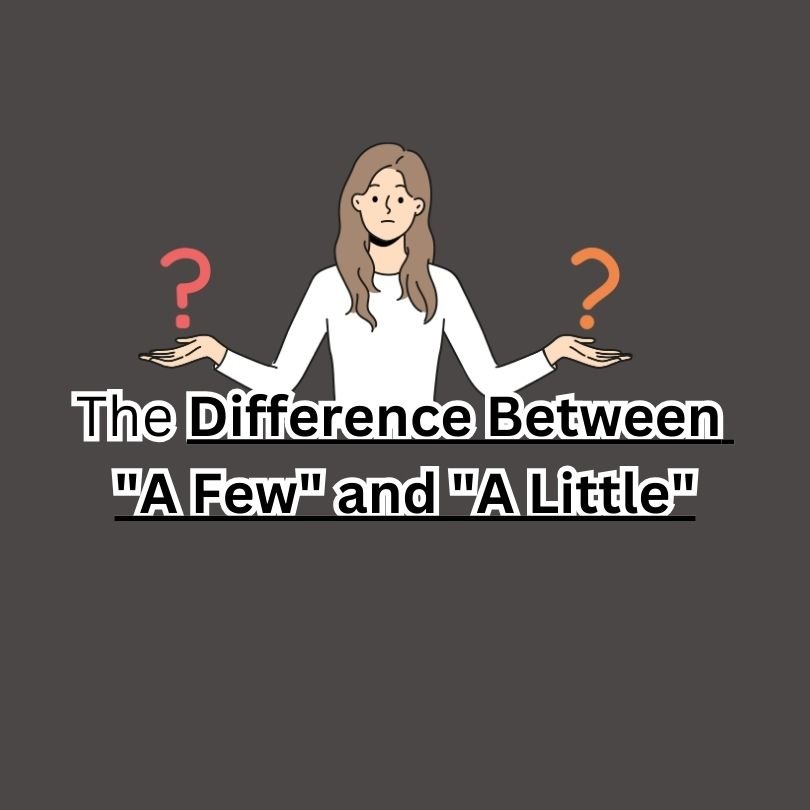
  • What is the Difference Between “A Few” and “A Little”?

    What is the Difference Between “A Few” and “A Little”?

    Question: What is the Difference Between “A Few” and “A Little”?

    Answer:

    Understanding the difference between “a few” and “a little” is essential for mastering English grammar. Both phrases are used to indicate a small quantity, but they are applied differently based on whether the noun they describe is countable or uncountable. In this article, we will explain the usage of “a few” and “a little” in a simple and detailed manner, provide examples, and demonstrate their use in daily conversations through dialogues.

    What Are Countable and Uncountable Nouns?

    Before diving into the difference between “a few” and “a little,” it’s important to understand the concepts of countable and uncountable nouns.

    • Countable nouns are items that can be counted individually. They have both singular and plural forms (e.g., “apple” and “apples”).
    • Uncountable nouns are items that cannot be counted individually. They do not have a plural form (e.g., “water,” “sand”).

    A Few

    “A few” is used with countable nouns to indicate a small number of items.

    Examples:

    • I have a few friends in New York.
    • She bought a few apples at the market.
    • We need a few chairs for the event.

    In these sentences, “a few” refers to a small number of individual items that can be counted.

    A Little

    “A little” is used with uncountable nouns to indicate a small amount of something.

    Examples:

    • There is a little milk left in the fridge.
    • He needs a little water to drink.
    • She added a little sugar to her coffee.

    In these sentences, “a little” refers to a small quantity of something that cannot be counted individually.

    Using “A Few” and “A Little” in Daily Life

    To better understand how “a few” and “a little” are used in daily conversations, let’s look at some dialogues.

    Dialogue 1: Using “A Few”

    Emily: Do you have any plans for the weekend?

    John: Yes, I have a few things to do. I need to buy a few groceries and meet a few friends.

    Emily: Sounds like a busy weekend!

    Dialogue 2: Using “A Little”

    Sarah: Can I have some water, please?

    Tom: Sure, there’s a little water left in the bottle. Help yourself.

    Sarah: Thank you!

    Key Points to Remember

    • Use “a few” with countable nouns (e.g., “a few books,” “a few cars”).
    • Use “a little” with uncountable nouns (e.g., “a little time,” “a little rice”).

    By remembering these simple rules, you can use “a few” and “a little” correctly in your conversations and writing.

    Meta Description

    Learn the difference between “a few” and “a little” with easy-to-understand explanations, examples, and dialogues. Master the use of countable and uncountable nouns in English grammar. Enhance your English skills with practical tips and phrases.

    By understanding and practicing the use of “a few” and “a little,” you can improve your English communication skills and make your speech and writing more accurate and effective.

  • Understanding the Difference Between “Fewer” and “Less”

    Understanding the Difference Between “Fewer” and “Less”

    Question: What is the Difference Between “Fewer” and “Less”?

    Answer:

    English grammar can often be confusing, especially when it comes to words that seem similar but are used in different contexts. Two such words are “fewer” and “less.” While both are used to indicate a smaller quantity of something, they are not interchangeable. Understanding the correct usage of “fewer” and “less” is essential for clear and precise communication. This article will explore the differences between these two words, provide examples, and offer tips on how to use them correctly.

    Fewer vs. Less: The Basic Rule

    The primary rule to remember is that “fewer” is used with countable nouns, and “less” is used with uncountable nouns.

    Countable Nouns

    Countable nouns are items that can be counted individually. They have both singular and plural forms. Examples include “apples,” “books,” “cars,” and “students.” When referring to a smaller quantity of countable nouns, use “fewer.”

    Examples:

    • She has fewer apples than he does.
    • There are fewer books on the shelf.
    • Fewer cars were sold this month compared to last month.
    • We need fewer students in each classroom to improve learning.

    Uncountable Nouns

    Uncountable nouns, also known as mass nouns, refer to substances or concepts that cannot be counted individually. They do not have a plural form. Examples include “water,” “money,” “time,” and “information.” When referring to a smaller quantity of uncountable nouns, use “less.”

    Examples:

    • She drinks less water than he does.
    • There is less money in my wallet.
    • We have less time to complete the project.
    • The new software requires less information to operate.

    Common Mistakes and How to Avoid Them

    Even native English speakers sometimes misuse “fewer” and “less.” Here are some common mistakes and tips to avoid them:

    Mistake 1: Using “Less” with Countable Nouns

    Incorrect: There are less people in the room. Correct: There are fewer people in the room.

    Tip: If you can count the items individually, use “fewer.”

    Mistake 2: Using “Fewer” with Uncountable Nouns

    Incorrect: I need fewer advice from you. Correct: I need less advice from you.

    Tip: If the noun cannot be counted individually, use “less.”

    Mistake 3: Using “Less” with Countable Time Periods

    Incorrect: He stayed for less than five days. Correct: He stayed for fewer than five days.

    Tip: When referring to countable time periods (days, hours, minutes), use “fewer.”

    Exceptions to the Rule

    While the fewer/less rule is generally reliable, there are a few exceptions, particularly in informal English and idiomatic expressions. For example:

    • “Less” is commonly used with distances, amounts of money, and periods of time, even though they are technically countable. Examples:
      • The store is less than five miles away.
      • I spent less than twenty dollars.
      • We have less than ten minutes left.

    Practice Makes Perfect

    To master the use of “fewer” and “less,” practice by creating sentences and checking if the noun is countable or uncountable. Here are a few exercises to get started:

    Exercise 1: Choose the Correct Word

    1. There are (fewer/less) chairs in the room now.
    2. She needs (fewer/less) sugar in her tea.
    3. We have (fewer/less) assignments this week.
    4. He spent (fewer/less) than fifty dollars.

    Answers:

    1. Fewer
    2. Less
    3. Fewer
    4. Less

    Exercise 2: Correct the Mistakes

    1. He has less friends now than before.
    2. The recipe requires fewer flour than we have.
    3. There are less cars in the parking lot today.
    4. She has fewer patience for nonsense.

    Corrected Sentences:

    1. He has fewer friends now than before.
    2. The recipe requires less flour than we have.
    3. There are fewer cars in the parking lot today.
    4. She has less patience for nonsense.

    Conclusion

    Understanding the difference between “fewer” and “less” is essential for accurate and effective communication. Remember that “fewer” is used with countable nouns, while “less” is used with uncountable nouns. By practicing and being mindful of these rules, you can avoid common mistakes and improve your grammar skills. Happy writing!