Tag: Grammar Tips

  • What is the Difference Between “A Few” and “A Little”?

    What is the Difference Between “A Few” and “A Little”?

    Question: What is the Difference Between “A Few” and “A Little”?

    Answer:

    Understanding the difference between “a few” and “a little” is essential for mastering English grammar. Both phrases are used to indicate a small quantity, but they are applied differently based on whether the noun they describe is countable or uncountable. In this article, we will explain the usage of “a few” and “a little” in a simple and detailed manner, provide examples, and demonstrate their use in daily conversations through dialogues.

    What Are Countable and Uncountable Nouns?

    Before diving into the difference between “a few” and “a little,” it’s important to understand the concepts of countable and uncountable nouns.

    • Countable nouns are items that can be counted individually. They have both singular and plural forms (e.g., “apple” and “apples”).
    • Uncountable nouns are items that cannot be counted individually. They do not have a plural form (e.g., “water,” “sand”).

    A Few

    “A few” is used with countable nouns to indicate a small number of items.

    Examples:

    • I have a few friends in New York.
    • She bought a few apples at the market.
    • We need a few chairs for the event.

    In these sentences, “a few” refers to a small number of individual items that can be counted.

    A Little

    “A little” is used with uncountable nouns to indicate a small amount of something.

    Examples:

    • There is a little milk left in the fridge.
    • He needs a little water to drink.
    • She added a little sugar to her coffee.

    In these sentences, “a little” refers to a small quantity of something that cannot be counted individually.

    Using “A Few” and “A Little” in Daily Life

    To better understand how “a few” and “a little” are used in daily conversations, let’s look at some dialogues.

    Dialogue 1: Using “A Few”

    Emily: Do you have any plans for the weekend?

    John: Yes, I have a few things to do. I need to buy a few groceries and meet a few friends.

    Emily: Sounds like a busy weekend!

    Dialogue 2: Using “A Little”

    Sarah: Can I have some water, please?

    Tom: Sure, there’s a little water left in the bottle. Help yourself.

    Sarah: Thank you!

    Key Points to Remember

    • Use “a few” with countable nouns (e.g., “a few books,” “a few cars”).
    • Use “a little” with uncountable nouns (e.g., “a little time,” “a little rice”).

    By remembering these simple rules, you can use “a few” and “a little” correctly in your conversations and writing.

    Meta Description

    Learn the difference between “a few” and “a little” with easy-to-understand explanations, examples, and dialogues. Master the use of countable and uncountable nouns in English grammar. Enhance your English skills with practical tips and phrases.

    By understanding and practicing the use of “a few” and “a little,” you can improve your English communication skills and make your speech and writing more accurate and effective.

  • Will vs. Going to: Understanding Future Intentions and Plans

    Will vs. Going to: Understanding Future Intentions and Plans

    Question: What is the difference between Will and Going to?

    Answer:

    Introduction

    When learning English, one of the common areas of confusion is knowing when to use “will” and “going to” for expressing future intentions and plans. While both are used to talk about the future, they are used in different contexts and have distinct meanings. This article will help you understand the differences between “will” and “going to” and provide practical examples to use them correctly.

    Understanding “Will”

    “Will” is a modal verb that is used to express:

    1. Spontaneous Decisions: Decisions made at the moment of speaking.
      • Example: “I’m thirsty. I think I will get a glass of water.”
    2. Predictions: Predictions about the future that are based on opinions or experiences.
      • Example: “I think it will rain tomorrow.”
    3. Promises: Making promises or offers.
      • Example: “I will help you with your homework.”
    4. Offers: Offering help or services.
      • Example: “I will carry your bag for you.”

    Understanding “Going to”

    “Going to” is used to express:

    1. Plans or Intentions: Plans that were decided before the moment of speaking.
      • Example: “I am going to visit my grandparents next weekend.”
    2. Predictions with Evidence: Predictions about the future that are based on current evidence.
      • Example: “Look at those dark clouds. It is going to rain.”

    Key Differences

    1. Decision Time: “Will” is used for decisions made at the moment of speaking, while “going to” is used for decisions made before the moment of speaking.
      • Example:
        • Will: “I will call him now.”
        • Going to: “I am going to call him after dinner.”
    2. Predictions: “Will” is often used for general predictions, while “going to” is used for predictions based on evidence.
      • Example:
        • Will: “You will get better soon.”
        • Going to: “You are going to get better. The doctor said so.”
    3. Plans and Intentions: “Going to” is used for plans or intentions.
      • Example: “She is going to start a new job next month.”

    Practical Exercises

    1. Fill-in-the-Blanks
      • I ____ (will/going to) travel to Japan next summer. (Answer: am going to)
      • It looks like it ____ (will/going to) snow soon. (Answer: is going to)
      • I think they ____ (will/going to) win the match. (Answer: will)
      • She ____ (will/going to) call you when she arrives. (Answer: will)
    2. Correct the Sentences
      • I think I’m going to get a taxi. (Correct: I think I will get a taxi.)
      • Look at the sky. It will rain. (Correct: Look at the sky. It is going to rain.)
    3. Role-Play Activity
      • Pair up with a partner and create dialogues using “will” and “going to” appropriately. Discuss future plans, make spontaneous decisions, and predict the future.

    Conclusion

    Understanding the differences between “will” and “going to” is essential for expressing future plans and intentions correctly in English. Remember, “will” is used for spontaneous decisions, general predictions, promises, and offers, while “going to” is used for pre-decided plans and predictions with evidence. Practice using these forms in different contexts to become more comfortable and confident in your English communication.

  • Understanding the Difference Between “Who” and “Whom”

    Understanding the Difference Between “Who” and “Whom”

    Question: What is the Difference Between “Who” and “Whom”?

    Answer:

    English grammar can often be challenging, and one common area of confusion is the correct usage of “who” and “whom.” Both words are pronouns, but they serve different functions in a sentence. Understanding when to use “who” and when to use “whom” is crucial for clear and grammatically correct writing. This article will explain the differences between “who” and “whom,” provide examples, and offer tips for proper usage.

    Who vs. Whom: The Basic Rule

    The basic rule is that “who” is used as the subject of a sentence or clause, while “whom” is used as the object of a verb or preposition.

    Subjective Case: Who

    “Who” is used as the subject of a verb. It performs the action in a sentence.

    Examples:

    • Who is coming to the party?
    • Do you know who made this cake?
    • Who is responsible for this project?

    In these examples, “who” is the subject performing the action.

    Objective Case: Whom

    “Whom” is used as the object of a verb or preposition. It receives the action in a sentence.

    Examples:

    • Whom did you invite to the party?
    • To whom should I address the letter?
    • Whom are you going to call?

    In these examples, “whom” is the object receiving the action.

    Tips for Correct Usage

    Determining when to use “who” or “whom” can sometimes be tricky. Here are some tips to help you decide:

    Tip 1: Answer the Question

    When in doubt, try answering the question posed by the sentence. If the answer is “he” or “she,” use “who.” If the answer is “him” or “her,” use “whom.”

    Examples:

    • Who/Whom is calling? (He is calling. → Who is calling?)
    • To who/whom did you give the book? (I gave the book to him. → To whom did you give the book?)

    Tip 2: Check the Function

    Identify whether the pronoun is acting as a subject or an object in the sentence. Remember, “who” is for subjects, and “whom” is for objects.

    Tip 3: Use Formality

    In formal writing and speech, using “whom” correctly can enhance clarity and precision. In casual conversation, people often use “who” even when “whom” is technically correct.

    Common Mistakes and How to Avoid Them

    Even seasoned writers sometimes misuse “who” and “whom.” Here are some common mistakes and how to avoid them:

    Mistake 1: Using “Who” as an Object

    Incorrect: Who did you see at the concert? Correct: Whom did you see at the concert?

    Mistake 2: Using “Whom” as a Subject

    Incorrect: Whom is calling me? Correct: Who is calling me?

    Mistake 3: Ignoring Prepositions

    Incorrect: Who did you give the book to? Correct: To whom did you give the book?

    Tip: Pay attention to the placement of prepositions, especially in formal writing.

    Practice Makes Perfect

    To master the use of “who” and “whom,” practice by creating sentences and checking if the pronoun is a subject or an object. Here are a few exercises to get started:

    Exercise 1: Choose the Correct Word

    1. (Who/Whom) is going to the meeting?
    2. I don’t know (who/whom) to ask for help.
    3. She is the person (who/whom) everyone admires.
    4. (Who/Whom) are they talking about?

    Answers:

    1. Who
    2. Whom
    3. Whom
    4. Whom

    Exercise 2: Correct the Mistakes

    1. Who did they choose as their leader?
    2. Whom is in charge of the project?
    3. Who should I send the email to?
    4. To who did you speak?

    Corrected Sentences:

    1. Whom did they choose as their leader?
    2. Who is in charge of the project?
    3. To whom should I send the email?
    4. To whom did you speak?

    Conclusion

    Understanding the difference between “who” and “whom” is essential for accurate and effective communication. Remember that “who” is used as the subject of a sentence, while “whom” is used as the object. By practicing and being mindful of these rules, you can avoid common mistakes and improve your grammar skills. Happy writing!

  • Understanding the Difference Between “Fewer” and “Less”

    Understanding the Difference Between “Fewer” and “Less”

    Question: What is the Difference Between “Fewer” and “Less”?

    Answer:

    English grammar can often be confusing, especially when it comes to words that seem similar but are used in different contexts. Two such words are “fewer” and “less.” While both are used to indicate a smaller quantity of something, they are not interchangeable. Understanding the correct usage of “fewer” and “less” is essential for clear and precise communication. This article will explore the differences between these two words, provide examples, and offer tips on how to use them correctly.

    Fewer vs. Less: The Basic Rule

    The primary rule to remember is that “fewer” is used with countable nouns, and “less” is used with uncountable nouns.

    Countable Nouns

    Countable nouns are items that can be counted individually. They have both singular and plural forms. Examples include “apples,” “books,” “cars,” and “students.” When referring to a smaller quantity of countable nouns, use “fewer.”

    Examples:

    • She has fewer apples than he does.
    • There are fewer books on the shelf.
    • Fewer cars were sold this month compared to last month.
    • We need fewer students in each classroom to improve learning.

    Uncountable Nouns

    Uncountable nouns, also known as mass nouns, refer to substances or concepts that cannot be counted individually. They do not have a plural form. Examples include “water,” “money,” “time,” and “information.” When referring to a smaller quantity of uncountable nouns, use “less.”

    Examples:

    • She drinks less water than he does.
    • There is less money in my wallet.
    • We have less time to complete the project.
    • The new software requires less information to operate.

    Common Mistakes and How to Avoid Them

    Even native English speakers sometimes misuse “fewer” and “less.” Here are some common mistakes and tips to avoid them:

    Mistake 1: Using “Less” with Countable Nouns

    Incorrect: There are less people in the room. Correct: There are fewer people in the room.

    Tip: If you can count the items individually, use “fewer.”

    Mistake 2: Using “Fewer” with Uncountable Nouns

    Incorrect: I need fewer advice from you. Correct: I need less advice from you.

    Tip: If the noun cannot be counted individually, use “less.”

    Mistake 3: Using “Less” with Countable Time Periods

    Incorrect: He stayed for less than five days. Correct: He stayed for fewer than five days.

    Tip: When referring to countable time periods (days, hours, minutes), use “fewer.”

    Exceptions to the Rule

    While the fewer/less rule is generally reliable, there are a few exceptions, particularly in informal English and idiomatic expressions. For example:

    • “Less” is commonly used with distances, amounts of money, and periods of time, even though they are technically countable. Examples:
      • The store is less than five miles away.
      • I spent less than twenty dollars.
      • We have less than ten minutes left.

    Practice Makes Perfect

    To master the use of “fewer” and “less,” practice by creating sentences and checking if the noun is countable or uncountable. Here are a few exercises to get started:

    Exercise 1: Choose the Correct Word

    1. There are (fewer/less) chairs in the room now.
    2. She needs (fewer/less) sugar in her tea.
    3. We have (fewer/less) assignments this week.
    4. He spent (fewer/less) than fifty dollars.

    Answers:

    1. Fewer
    2. Less
    3. Fewer
    4. Less

    Exercise 2: Correct the Mistakes

    1. He has less friends now than before.
    2. The recipe requires fewer flour than we have.
    3. There are less cars in the parking lot today.
    4. She has fewer patience for nonsense.

    Corrected Sentences:

    1. He has fewer friends now than before.
    2. The recipe requires less flour than we have.
    3. There are fewer cars in the parking lot today.
    4. She has less patience for nonsense.

    Conclusion

    Understanding the difference between “fewer” and “less” is essential for accurate and effective communication. Remember that “fewer” is used with countable nouns, while “less” is used with uncountable nouns. By practicing and being mindful of these rules, you can avoid common mistakes and improve your grammar skills. Happy writing!

  • The Difference Between Simple Past Tense and Present Perfect Tense

    The Difference Between Simple Past Tense and Present Perfect Tense

    Question: What is the Difference Between  Simple Past Tense and Present Perfect Tense?

    Answer:

    Introduction

    English grammar can sometimes be confusing, especially when it comes to understanding the differences between various tenses. Among the most commonly misunderstood tenses are the Simple Past Tense and the Present Perfect Tense. This article aims to clarify the distinctions between these two tenses, providing clear definitions, examples, and illustrations to help learners grasp their proper usage.

    Definition of  Simple Past Tense

    The Simple Past Tense is used to describe actions that were completed at a specific time in the past. It is often accompanied by time expressions like yesterday, last week, in 2010, etc.

    Examples:

    • She visited Paris last summer.
    • They watched a movie yesterday.
    • He finished his homework two hours ago.

    Definition of Present Perfect Tense

    The Present Perfect Tense is used to describe actions that occurred at an unspecified time in the past and are relevant to the present. This tense often uses time expressions like ever, never, already, yet, just, and since/for.

    Examples:

    • She has visited Paris several times.
    • They have watched that movie already.
    • He has finished his homework.

    Key Differences Between Simple Past Tense and Present Perfect Tense

    1. Time Specificity:
      • Simple Past Tense: Refers to actions completed at a specific time in the past.
        • Example: She visited Paris last summer.
      • Present Perfect Tense: Refers to actions that happened at an unspecified time and have relevance to the present.
        • Example: She has visited Paris several times.
    2. Usage of Time Expressions:
      • Simple Past Tense: Uses definite time expressions (yesterday, last week, in 2010).
        • Example: They watched a movie yesterday.
      • Present Perfect Tense: Uses indefinite time expressions (ever, never, already, yet).
        • Example: They have watched that movie already.
    3. Focus on Experience vs. Completed Action:
      • Simple Past Tense: Focuses on the completion of the action.
        • Example: He finished his homework two hours ago.
      • Present Perfect Tense: Focuses on the experience or the result of the action.
        • Example: He has finished his homework.

    Common Mistakes and How to Avoid Them

    1. Mixing Up Time Expressions:
      • Mistake: I have visited Paris last summer.
      • Correction: I visited Paris last summer.
    2. Using Present Perfect Tense with Specific Times:
      • Mistake: He has finished his homework two hours ago.
      • Correction: He finished his homework two hours ago.
    3. Ignoring the Relevance to the Present:
      • Mistake: They watched that movie already.
      • Correction: They have watched that movie already.

    Conclusion

    Understanding the difference between the Simple Past Tense and the Present Perfect Tense is crucial for mastering English grammar. Remember, the Simple Past Tense is used for actions completed at a specific time in the past, while the Present Perfect Tense is used for actions that have relevance to the present without specifying the exact time. Practice using these tenses correctly to improve your fluency and accuracy in English.

  • Study At vs. Study In: Understanding the Difference

    Study At vs. Study In: Understanding the Difference

    Question: What is the Difference Between Study At and Study In?

    Answer:

    When learning English, prepositions can be tricky, especially when it comes to phrases like “study at” and “study in.” Both phrases are used frequently, but they have different meanings and contexts. Let’s break down the differences between “study at” and “study in” to help you use them correctly.

    1. Study At

    Usage:

    • “Study at” is typically used to refer to the specific institution where someone is studying.
    • It emphasizes the place of study rather than the broader location.

    Examples:

    • “She studies at Harvard University.”
    • “I am studying at a local community college.”
    • “He studied at Oxford for his undergraduate degree.”

    In these sentences, the focus is on the particular school or university where the studying is taking place.

    2. Study In

    Usage:

    • “Study in” is used to talk about the country, city, or region where the studying is happening.
    • It emphasizes the geographical location rather than the specific institution.

    Examples:

    • “She studies in the United States.”
    • “I am studying in London.”
    • “He studied in Germany for a semester.”

    Here, the emphasis is on the broader area where the study is taking place, rather than on a specific school or university.

    Key Points to Remember

    • Use “study at” when referring to a specific institution (e.g., school, college, university).
    • Use “study in” when referring to a geographical location (e.g., country, city, region).

    Examples for Clarity

    1. Study At:
      • Correct: “She wants to study at MIT.”
      • Incorrect: “She wants to study in MIT.”
    2. Study In:
      • Correct: “He is studying in France.”
      • Incorrect: “He is studying at France.”

    Understanding the difference between “study at” and “study in” will help you use these phrases more accurately and effectively in your writing and speaking.

  • Mastering the Past Perfect Continuous Tense: Rules, Examples, and Practice Questions

    Mastering the Past Perfect Continuous Tense: Rules, Examples, and Practice Questions

    Definition

    The Past Perfect Continuous Tense, also known as the past perfect progressive, is used to describe an action that started in the past and continued up to another point in the past. It emphasizes the duration or continuity of an action that was happening before a specific time or another action in the past.

    Uses

    1. To show the duration of an action up to a certain point in the past.

    Examples:

    • They had been waiting for two hours by the time the bus finally came. (This sentence highlights the ongoing action of waiting that lasted for two hours until the bus arrived.)
    • She had been studying for three hours when her friends arrived. (The action of studying continued for three hours up to the point when her friends arrived.)
    • He had been working at the company for ten years before he decided to resign. (This indicates that the action of working at the company lasted for ten years until he made the decision to resign.)

    2. To describe an action that was in progress before another action occurred.

    Examples:

    • He had been working on the project before he fell ill. (This indicates that the work was ongoing and then interrupted by his illness.)
    • They had been planning the event for weeks before it was cancelled. (The planning was an ongoing process that was halted by the cancellation of the event.)
    • She had been cleaning the house when the guests arrived early. (The cleaning was an ongoing action that was interrupted by the early arrival of the guests.)

    3. To set the scene for another past event.

    Examples:

    • The children had been playing outside when it started to rain. (The ongoing action of playing outside sets the context for the sudden event of the rain starting.)
    • He had been reading a book when the phone rang. (The reading was an ongoing activity that was interrupted by the phone ringing.)
    • They had been discussing their plans when the news broke. (The ongoing discussion sets the scene for the interruption caused by breaking news.)

    Pattern

    The following are the grammatical pattern of the Past Perfect Continuous Tense:

    Affirmative: Subject + had + been + present participle (verb+ing)

    • She had been reading.
    • They had been talking.

    Negative: Subject + had + not + been + present participle (verb+ing)

    • She had not (hadn’t) been reading.
    • They had not (hadn’t) been talking.

    Interrogative: Had + subject + been + present participle (verb+ing)

    • Had she been reading?
    • Had they been talking?

    Time Signals

    Common time signals used with the Past Perfect Continuous Tense include:

    • For
    • Since
    • Before
    • By the time
    • Until
    • When

    Common Mistakes and How to Avoid Them

    1. Confusing with the Past Continuous Tense

    Mistake: “She was reading for two hours.” Correction: “She had been reading for two hours.” Tip: Remember, the Past Continuous is used for an action happening at a specific moment in the past, while the Past Perfect Continuous emphasizes the duration of an action up to a point in the past.

    2. Using the wrong auxiliary verb

    Mistake: “They was been playing.” Correction: “They had been playing.” Tip: Always use “had” as the auxiliary verb in the Past Perfect Continuous Tense, regardless of the subject.

    3. Omitting “been”

    Mistake: “He had studying all night.” Correction: “He had been studying all night.” Tip: The word “been” is essential in forming the Past Perfect Continuous Tense.

    Conclusion

    The Past Perfect Continuous Tense is a useful tense for expressing actions that were ongoing up until a specific point in the past. By understanding its definition, uses, pattern, and common time signals, learners can effectively incorporate this tense into their writing and speaking. Avoiding common mistakes will further enhance your proficiency in using the Past Perfect Continuous Tense.

    Quiz

    Test your understanding of the Past Perfect  Continuous Tense with this 10-question multiple-choice quiz. Choose the correct answer for each question.

    1. They ____ for an hour before the train arrived.

    2. She ____ the piano for years before she gave her first concert.

    3. By the time we got home, it ____ snowing for hours.

    4. He ____ to lose weight before his wedding.

    5. The students ____ for the exam until late at night.

    6. They ____ for hours before the manager finally arrived.

    7. I ____ to get tickets for the concert for weeks before they sold out.

    8. We ____ about the trip when he called.

    9. She ____ all afternoon before she took a break.

    10. They ____ for a new house before they found this one.

  • Mastering the Past Perfect Tense: Rules, Examples, and Practice Questions

    Mastering the Past Perfect Tense: Rules, Examples, and Practice Questions

    Definition

    The Past Perfect Tense is used to express an action that was completed before another action or event in the past. It highlights the sequence of events, showing which action happened first. The past perfect tense is formed by combining the auxiliary verb “had” with the past participle of the main verb.

    Uses

    1. Action Completed Before Another Past Action:

    Examples:

    • By the time she arrived at the party, John had already left. (John’s departure happened before her arrival at the party. The past perfect tense “had left” shows that his leaving occurred first.)
    • When I got home, I realized I had forgotten my keys. (Forgetting the keys happened before getting home. The past perfect tense “had forgotten” emphasizes the sequence.)
    • They had finished the meeting before the boss arrived. (The meeting was completed before the boss’s arrival. The past perfect tense “had finished” indicates the prior action.)
    1. Action Completed Before a Specific Time in the Past:

    Examples:

    • He had finished his homework before 8 PM. (This sentence indicates that the homework was completed prior to 8 PM. The past perfect tense “had finished” emphasizes the action was done by that specific time.)
    • By midnight, she had packed all her bags. (The packing was completed by midnight. The past perfect tense “had packed” shows the action’s completion before the specified time.)
    • The train had departed before we reached the station. (The departure of the train occurred before reaching the station. The past perfect tense “had departed” highlights the sequence of events.)
    1. Cause and Effect in the Past:

    Examples:

    • They were happy because they had won the match. (The reason for their happiness (winning the match) happened before they felt happy. The past perfect tense “had won” indicates the cause of their happiness.)
    • She was tired because she had worked all day. (Working all day caused her tiredness, which is highlighted by the past perfect tense “had worked.)
    • He felt relieved because he had completed his assignment. (Completing the assignment caused his relief. The past perfect tense “had completed” shows the reason for his feeling.)

    Pattern

    The grammatical pattern of the Past Perfect Tense is:

    • Affirmative: Subject + had + past participle (e.g., She had eaten.)
    • Negative: Subject + had + not + past participle (e.g., She had not eaten.)
    • Interrogative: Had + subject + past participle? (e.g., Had she eaten?)

    Time Signals

    Common time signals used with the Past Perfect Tense include:

    • Before
    • By the time
    • When
    • Already
    • Until
    • Never

    Common Mistakes and How to Avoid Them

    1. Using the Past Simple Instead of Past Perfect:
      • Mistake: She finished her work before he arrived.
      • Correction: She had finished her work before he arrived.
      • Tip: Remember to use “had” to show the action was completed before another past action.
    2. Forgetting the Auxiliary Verb “Had”:
      • Mistake: They eaten before they went out.
      • Correction: They had eaten before they went out.
      • Tip: Always use “had” with the past participle to form the past perfect tense.
    3. Confusing Past Perfect with Present Perfect:
      • Mistake: She has gone home before I called.
      • Correction: She had gone home before I called.
      • Tip: Use “had” for actions completed before another past event, not “has/have.”

    Conclusion

    The Past Perfect Tense is essential for describing actions that were completed before another event or time in the past. By understanding its definition, uses, pattern, and common time signals, learners can effectively use this tense to convey clear and accurate information about past events. Avoiding common mistakes and practicing regularly will help in mastering the past perfect tense.

    Quiz

    Test your understanding of the Past Perfect Tense with this 10-question multiple-choice quiz. Choose the correct answer for each question.

    1. By the time we _______ (arrive), the movie had already started.

    2. She had _______ (finish) her meal before the guests arrived.

    3. They _______ (not leave) the house until it had stopped raining.

    4. Had you _______ (read) the book before you watched the movie?

    5. We had _______ (know) each other for years before we got married.

    6. She _______ (never see) such a beautiful sunset before her trip to Hawaii.

    7. He realized he had _______ (forget) his keys when he reached the door.

    8. By the time I _______ (get) to the station, the train had left.

    9. Had they _______ (complete) the project before the deadline?

    10. She _______ (not hear) the news until she turned on the radio.

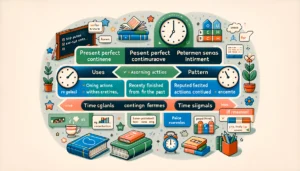
  • Mastering the Present Perfect Continuous Tense: Rules, Examples, and Practice Questions

    Mastering the Present Perfect Continuous Tense: Rules, Examples, and Practice Questions

    Definition

    The Present Perfect Continuous Tense, also known as the Present Perfect Progressive Tense, is used to describe actions that started in the past and are still continuing or have recently stopped but have a connection to the present. This tense emphasizes the duration of an action or the continuity of an activity over a period of time.
    Uses

    1. To express an action that started in the past and is still continuing:

    Examples:

    • She has been studying for three hours. (This sentence indicates that the studying began three hours ago and is still happening at the moment of speaking.)
    • We have been living in this city since 2010. (This shows that the action of living in the city started in 2010 and continues up to the present.)
    • He has been working at the same company for five years. (This implies that he started working at the company five years ago and is still employed there.)
    1. To indicate a recently finished action that has a result in the present:

    Examples:

    • They have been working on the project, and now it’s nearly complete. (The action of working on the project has recently finished, and the result is that the project is almost done.)
    • I have been cooking all afternoon, and the meal is finally ready. (The cooking just finished, and the result is that the meal is now ready to be eaten.)
    • She has been cleaning the house, so it looks spotless now. (The action of cleaning was recently completed, resulting in a spotless house.)
    1. To show repeated actions that started in the past and are still continuing:

    Examples:

    • He has been visiting his grandmother every weekend. (This sentence tells us that the visits started in the past and are still happening regularly.)
    • They have been meeting for coffee every morning for years. (This indicates that the action of meeting for coffee started years ago and continues to this day.)
    • She has been attending yoga classes every week since January. (This shows that the action of attending yoga classes began in January and continues regularly.)

    By understanding these uses and examples, learners can effectively apply the Present Perfect Continuous Tense to express ongoing actions, recently completed actions with present relevance, and repeated actions continuing from the past.
    Pattern

    The grammatical pattern of the Present Perfect Continuous Tense is: Subject + has/have + been + verb (present participle)
    Positive Form

    • Pattern: Subject + has/have + been + verb (present participle)
    • Example: “I have been studying Mandarin Chinese for three hours.”

    Negative Form

    • Pattern: Subject + has/have + not + been + verb (present participle)
    • Example: “I have not been studying English for three hours.”

    Interrogative Form

    • Pattern: Has/Have + subject + been + verb (present participle)?
    • Example: “Have you been studying Japanese for three hours?”

    Time Signals

    Common time signals used with the Present Perfect Continuous Tense include:
    • For (a period of time): for two hours, for a month
    • Since (a point in time): since Monday, since 2010
    • Lately, Recently

    Common Mistakes and How to Avoid Them

    1. Using the wrong auxiliary verb:
      • Mistake: “She have been reading.”
      • Correction: “She has been reading.”
      • Tip: Remember to use “has” with third-person singular subjects (he, she, it) and “have” with all other subjects (I, you, we, they).
    2. Omitting ‘been’:
      • Mistake: “They have working all day.”
      • Correction: “They have been working all day.”
      • Tip: Always include “been” after “has/have” in this tense.
    3. Confusing Present Perfect with Present Perfect Continuous:
      • Mistake: “I have read for three hours.”
      • Correction: “I have been reading for three hours.”
      • Tip: Use the Present Perfect Continuous to emphasize the duration or continuity of the action.
    Conclusion

    The Present Perfect Continuous Tense is a versatile tense used to describe actions that started in the past and are still ongoing or have recently stopped with present relevance. By understanding its uses, patterns, and common mistakes, learners can effectively communicate actions with a sense of duration and continuity.
    Quiz

    Test your understanding of the Present Perfect Continuous Tense with this 10-question multiple-choice quiz. Choose the correct answer for each question.
    1. How long ____ you been studying English?

    2. She ____ been living in New York since 2015.

    3. They ____ been working on this project for months.

    4. I ____ been feeling well lately.

    5. He ____ been playing the guitar since he was a child.

    6. We ____ been watching this show for hours.

    7. She ____ been going to the gym regularly.

    8. You ____ been working hard recently.

    9. It ____ been raining all day.

    10. I ____ been trying to reach you.

  • Mastering the Present Continuous Tense: Rules, Examples, and Practice Questions

    Mastering the Present Continuous Tense: Rules, Examples, and Practice Questions

    Definition

    The Present Continuous Tense, also known as the Present Progressive Tense, is used to describe actions that are currently happening at the moment of speaking or actions that are ongoing. This tense emphasizes the continuity and progression of an action.

    Uses

    The Present Continuous Tense is used in various contexts. Here are three primary uses along with multiple examples and explanations:

    1. Actions happening at the moment of speaking

    Examples:

    • She is reading a book right now. (This sentence indicates that the action of reading is occurring at this very moment.)
    • They are playing soccer in the park. (This sentence shows that the action of playing soccer is taking place as we speak.)
    • I am cooking dinner. (This sentence means that the action of cooking is happening right now.)
    1. Temporary actions or situations

    Examples:

    • They are staying at a hotel for the weekend. (This sentence implies that staying at the hotel is a temporary situation, limited to the weekend.)
    • He is working on a temporary project. (This sentence indicates that working on the project is a temporary situation.)
    • We are using my sister’s car while she is away. (This sentence shows that using the sister’s car is a temporary arrangement while she is away.)
    1. Planned future events

    Examples:

    • We are meeting them for dinner tomorrow. (This sentence indicates a future event that has already been arranged or planned.)
    • She is flying to New York next week. (This sentence shows a planned trip to New York in the future.)
    • They are starting a new course next month. (This sentence means that starting a new course is a planned future event.)

    Pattern

    The grammatical pattern of the Present Continuous Tense is straightforward:

    • Positive form: Subject + am/is/are + verb (base form) + -ing
      • Example: “I am working on my project.”
    • Negative form: Subject + am/is/are + not + verb (base form) + -ing
      • Example: “She is not watching TV.”
    • Question form: Am/Is/Are + subject + verb (base form) + -ing?
      • Example: “Are you coming to the party?”

    Time Signals

    Common time signals used with the Present Continuous Tense include:

    • Now
    • Right now
    • At the moment
    • Currently
    • Today
    • This week
    • Tonight

    Common Mistakes and How to Avoid Them

    Learners often make mistakes when using the Present Continuous Tense. Here are some common errors and tips to avoid them:

    1. Using the wrong auxiliary verb
      • Mistake: “He am playing soccer.”
      • Correction: “He is playing soccer.”
      • Tip: Ensure that the auxiliary verb (am, is, are) matches the subject.
    2. Forgetting the -ing ending
      • Mistake: “She is read a book.”
      • Correction: “She is reading a book.”
      • Tip: Always add the -ing ending to the main verb.
    3. Using the Present Continuous for non-continuous verbs
      • Mistake: “I am knowing the answer.”
      • Correction: “I know the answer.”
      • Tip: Some verbs (e.g., know, like, believe) are not typically used in the continuous form. Use the simple present tense for these verbs.

    Conclusion

    The Present Continuous Tense is essential for describing ongoing actions, temporary situations, and planned future events. By understanding its uses, grammatical pattern, time signals, and common mistakes, learners can use this tense effectively in their communication.

    Quiz

    Test your understanding of the Present Continuous Tense with this 10-question multiple-choice quiz. Choose the correct answer for each question.

    1. Which sentence is correct?

    2. What is the correct form of the verb in this sentence? "They ___ (play) soccer right now."

    3. Choose the correct sentence:

    4. Which sentence is in the Present Continuous Tense?

    5. Choose the correct form: "They ________ (play) soccer right now."

    6. Identify the time signal often used with the Present Continuous Tense:

    7. Which sentence indicates a temporary action?

    8. Fill in the blank: "I ________ (study) for my exams this week."

    9. Which form is correct for the Present Continuous Tense?

    10. Fill in the blank: "They ________ (not/watch) TV now."