


What is the Difference Between “Evening” and “Night”?
Many English learners feel confused about the words evening and night because both happen after the afternoon and before the next morning. In daily conversation, people sometimes use them casually, so they may sound similar. However, these two words actually describe different parts of the day and are used in different situations.
This article will explain the difference in a simple and easy-to-understand way for beginners.
Watch the video below to get better understanding about Difference Between “Evening” and “Night”!
A Simple Timeline
Think about the day like this:
Morning → Afternoon → Evening → Night → Morning
So, evening comes first, and night comes after evening.
You can think of evening as the “transition” time, while night is the fully dark and quieter part of the day.
What Is “Evening”?
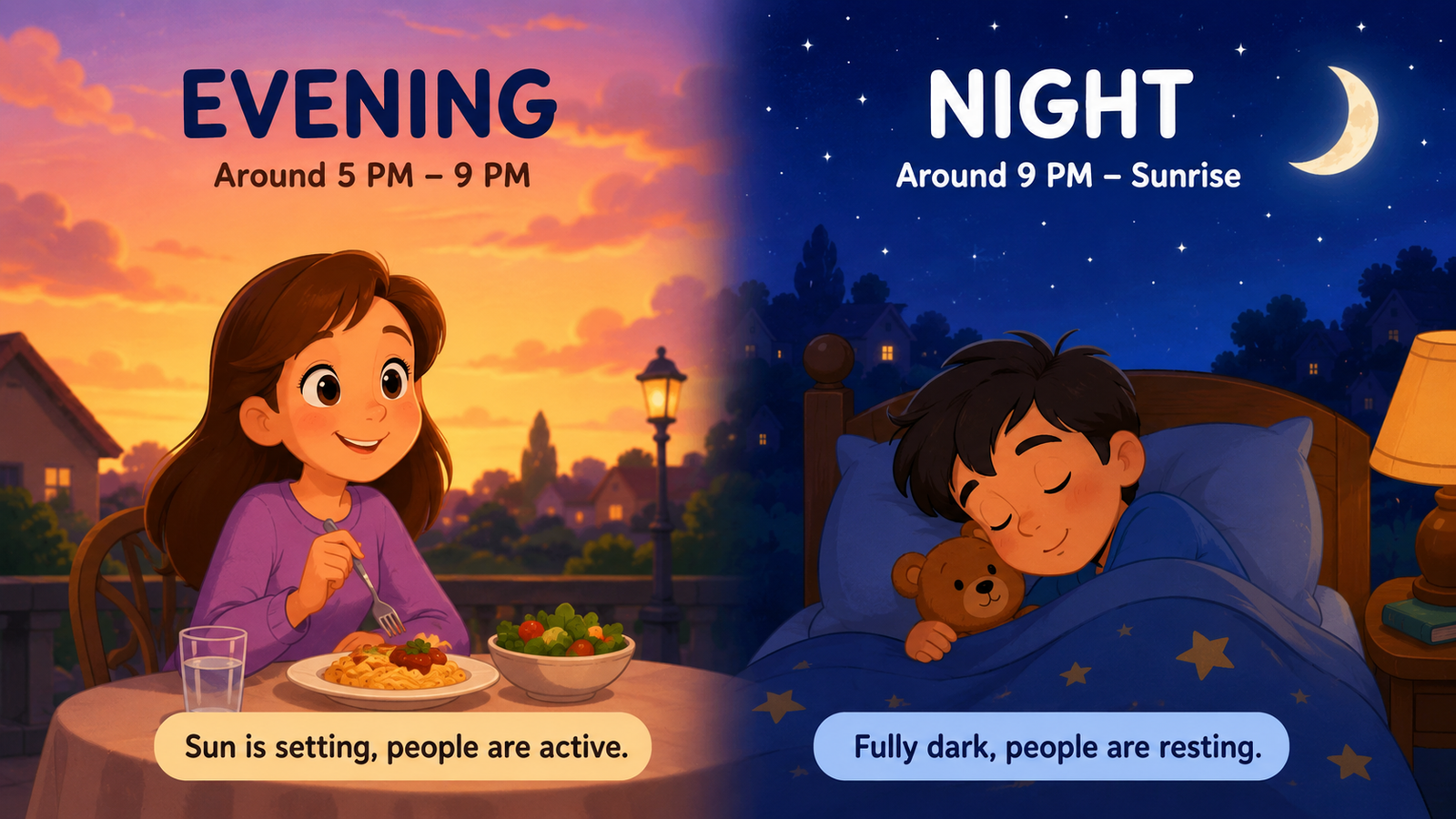
Evening is the transition period between afternoon and night. It starts when the afternoon ends (around 5 or 6 PM) and lasts until it gets fully dark—roughly until 8 or 9 PM, depending on the season and where you live.
During the evening:
- the sun is setting
- the sky may look orange, pink, or purple
- people are usually still active
- many people are finishing work or school
- families often eat dinner together
Evening is often seen as a relaxing and social time of day.
Common Evening Activities
People often:
- have dinner
- take a walk
- study
- watch TV
- meet friends
- spend time with family
Example Sentences with “Evening”
- I usually study English in the evening.
- We are meeting this evening at 7 PM.
- The evening sky looked beautiful today.
- My parents enjoy drinking tea in the evening.
- Good evening, everyone!
What Is “Night”?
Night is the dark part of the day when the sun is completely below the horizon. It starts after evening ends (around 8 or 9 PM) and lasts until sunrise the next morning.
Night is usually associated with:
- darkness
- quietness
- sleep
- rest
- stars and the moon
At night, most people stop working and prepare to sleep.
Common Night Activities
People often:
- sleep
- rest
- dream
- work night shifts
- watch the stars
- stay up late
Example Sentences with “Night”
- I sleep at 10 o’clock every night.
- The stars are very bright at night.
- She stayed up all night studying for her exam.
- It becomes very quiet at night.
- Good night, Mom.
Easy Comparison Table
| Feature | Evening | Night |
|---|---|---|
| Time | Around 5 PM – 9 PM | Around 9 PM – Sunrise |
| Sky | Sunset or getting dark | Completely dark |
| People | Usually active | Usually resting or sleeping |
| Activities | Dinner, hobbies, relaxing | Sleeping, resting |
| Greeting | “Good evening” | “Good night” (before sleep) |
The Difference Between “Good Evening” and “Good Night”
This is one of the most common mistakes for beginners.
“Good Evening”
We use good evening when we meet someone during the evening.
It is a greeting.
Examples
- Good evening, Sir.
- Good evening, everyone.
- Good evening, Anna. How are you?
“Good Night”
We usually use good night when:
- leaving someone late at night
- going to sleep
It is usually a goodbye expression, not a greeting.
Examples
- Good night, Dad.
- I’m going to bed. Good night!
- Good night. Sleep well.
A Common Beginner Mistake
Many learners say “Good night” when they arrive somewhere in the evening. This sounds unnatural in English.
Wrong
❌ “Good night, everyone!” (when arriving at a party)
Correct
✅ “Good evening, everyone!”
Later, when leaving the party, you can say:
✅ “Good night, everyone!”
A Simple Trick to Remember
Here is an easy way to remember the difference:
- Evening = people are still active.
- Night = people are preparing to sleep or already sleeping.
Another simple clue:
- If there is still some light in the sky, it is probably evening.
- If the sky is completely dark, it is night.
Real-Life Examples
Imagine you are making plans with a friend.
Example 1
“Let’s meet this evening at 6 PM.”
This means:
- you will meet before it becomes very late
- there may still be some daylight outside
Example 2
“I’ll call you tonight at 10 PM.”
This means:
- the call will happen late
- it will already be fully dark outside
Short Conversation Example
In the Evening
A: Good evening, Lisa!
B: Good evening, Tom! How was your day?
At Night
A: I’m tired. I’m going to sleep now.
B: Okay. Good night!
A: Good night!
Final Summary
Although evening and night both happen after the afternoon, they are not the same.
- Evening is the early part after afternoon when people are still active and the sky is becoming dark.
- Night is the later part when it is completely dark and most people are resting or sleeping.
Remember:
- Say “Good evening” when greeting someone.
- Say “Good night” when leaving or going to bed.
With practice, using these two words correctly will become easy and natural.